
How to Check Whether a Used Car's Kilometres Are Genuine: 7 Checks Before You Buy
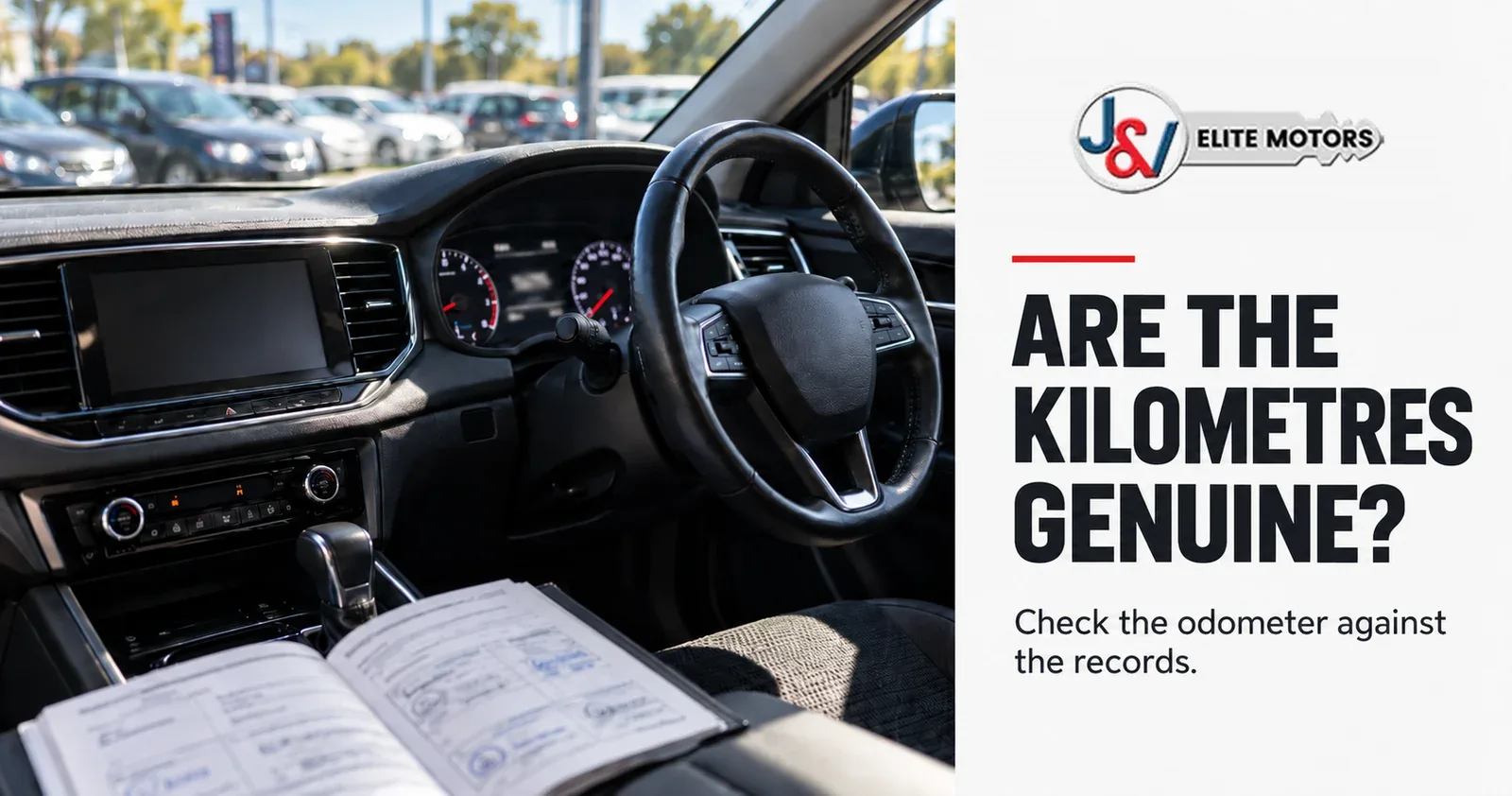
Genuine kilometres means a car's odometer shows the true total distance it has travelled. To check whether a used car's kilometres are genuine, compare the dash reading with independent records: logbook stamps that the servicing workshops confirm, and a VicRoads Vehicle Report. Then make sure the interior wear matches the reading and get an independent inspection. If the records and the odometer don't line up, don't buy until the gap is explained in writing.
Quick Answer: How to check a used car's kilometres Photograph the odometer and save the online listing. Check that every logbook stamp shows a rising reading below today's figure. Ask the servicing workshops to confirm those readings. Order a VicRoads Vehicle Report ($29.95) for recorded odometer readings. Compare kilometres with age and interior wear, then get an independent inspection. |
|---|
Key takeaways
Bottom line: No single document proves the kilometres. Genuine readings agree across several independent records.
Best evidence: Logbook readings confirmed by the workshops, plus a VicRoads Vehicle Report.
Not enough on its own: A PPSR search, a roadworthy certificate or a neat logbook.
Real risk: In a 2025 CAV sample of 50 cars relisted online by suspected unlicensed traders, 28% were advertised more than 25,000 km below their auction reading.
Lower risk: Licensed motor car traders give you protections a private sale does not.
How do you check if a used car's kilometres are genuine?
Run all seven checks before you pay a deposit. Each gives separate evidence, and genuine kilometres agree across all of them.
Check | What it confirms | Cost |
|---|---|---|
1. Record the reading and listing | What the seller claimed | Free |
2. Logbook readings | Readings rise over time | Free |
3. Workshop confirmation | Logbook entries are real | Free (phone calls) |
4. VicRoads Vehicle Report | Recorded readings and history | $29.95 |
5. Kilometres vs age | Whether usage looks plausible | Free |
6. Interior wear | Wear matches the reading | Free |
7. Independent inspection | Signs of tampering and faults | Varies by inspector |
1. Record the odometer reading and the listing
Do: Photograph the odometer with the ignition on and screenshot the online ad.
Why: Listings can be edited or removed, and you need both if the figures later disagree.
2. Check the logbook readings rise in order
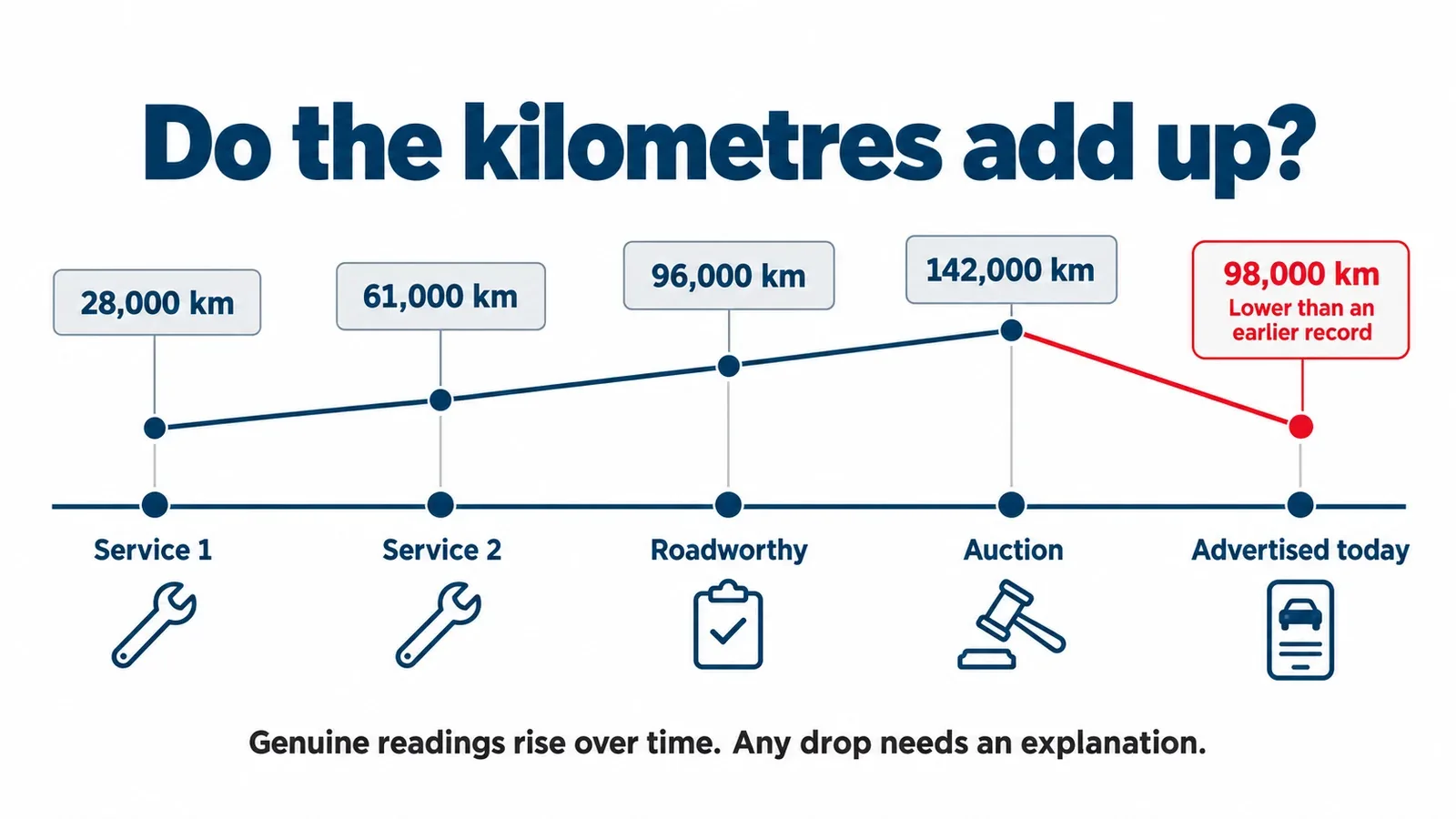
Do: Read every service stamp in date order. Each should show a higher reading than the last, at sensible intervals, and the latest must be below today's reading.
Source: CAV advises checking the logbook for odometer readings across the car's history.
Red flag: A service entry above today's reading, with no documented instrument cluster replacement to explain it.
3. Confirm the stamps with the workshops
Do: Call the workshops named in the logbook and ask them to confirm the date and reading. For dealer servicing, ask a franchised dealer for that brand whether it can check its records against the vehicle identification number (VIN).
Why: A logbook can be faked or have pages missing.
More: See how to check a used car's service history.
⚠ Common Mistake Trusting a neat logbook on its own. A reading only counts as evidence once the workshop that recorded it confirms it. |
|---|
4. Order a VicRoads Vehicle Report
Do: Order a VicRoads Vehicle Report ($29.95) online.
What it shows: Recorded odometer readings where available, Victorian registration and transfer history, electronic roadworthy history, written off and stolen records, and finance owing.
Also run: A $2 Personal Property Securities Register (PPSR) search for security interests, but it does not include odometer readings. Our PPSR check guide explains it.
5. Compare the kilometres with the car's age
Benchmark: About 11,100 km a year per passenger vehicle, from the ABS's final Survey of Motor Vehicle Use (year to June 2020, affected by COVID restrictions).
Do: Check the build date on the build plate, as CAV recommends, then compare kilometres per year with the table below.
Car age | Rough expected range | Worth asking about |
|---|---|---|
3 years | About 30,000 to 40,000 km | Under 15,000 km |
5 years | About 55,000 to 65,000 km | Under 25,000 km |
8 years | About 85,000 to 100,000 km | Under 40,000 km |
10 years | About 110,000 to 125,000 km | Under 50,000 km |
Illustrative ranges based on the ABS average of 11,100 km a year, not an official benchmark. Utes, vans and rideshare cars may travel much further.
Keep in mind: Low kilometres are not proof of tampering. A second car may genuinely travel very little, so ask the seller to explain the usage and show records.
6. Make sure the wear matches the reading
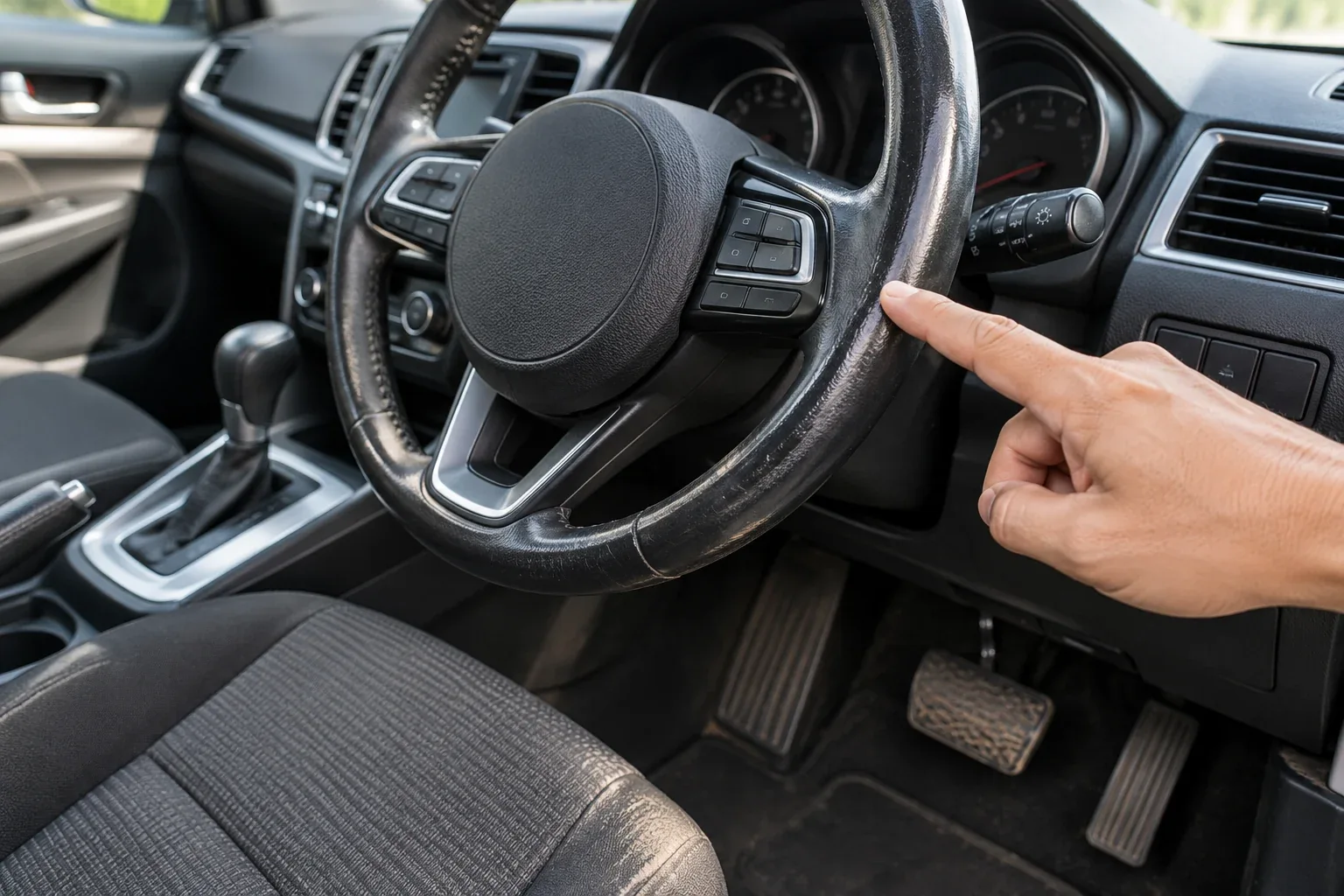
Source: CAV advises checking wear on carpets, seatbelts and the steering wheel, and being suspicious when a low-kilometre car shows heavy use.
Check these wear points:
Steering wheel and gear knob: shiny, smooth or cracked surfaces.
Pedal rubbers: worn through, or suspiciously new on an older car.
Driver's seat: flattened or split side bolster.
Seatbelt and carpets: frayed belt edges, worn carpet under the driver's heel.
Keys and buttons: worn key fob buttons and faded switch markings.
For more checks on the same visit, see what to look for when test driving a used car.
7. Get an independent inspection
Who: CAV suggests the RACV's vehicle inspection service, a Victorian Automobile Chamber of Commerce (VACC) member, or an independent qualified mechanic.
Ask for: Signs of odometer tampering as well as mechanical faults. Ask whether a scan of the car's electronics can show a mismatch in recorded distance; this works on some vehicles, not all.
If refused: CAV suggests you consider not buying. Otherwise, make the contract conditional on your satisfaction with an independent inspection report.
💡 Practical Tip Screenshot the listing, photograph the odometer and logbook, and note the VIN before you leave. If the figures later disagree, this record is your evidence. |
|---|
Warning signs the kilometres may not be genuine
One warning sign means ask questions. Two or more mean walk away or get expert advice before you go further.
Warning sign | Why it matters | What to do |
|---|---|---|
Logbook reading higher than the odometer | Genuine readings only rise, unless a documented cluster replacement explains it | Don't buy until a workshop explains it in writing |
Missing logbook or pages removed | Removes the easiest record to compare | Ask for invoices and workshop contacts; order a VicRoads report |
Wear far heavier than the reading suggests | Interior wear tracks distance travelled | Have a mechanic inspect and price the car on its condition |
New pedal rubbers or wheel cover on an older car | Can hide wear | Ask when and why they were replaced |
Seller buys and sells many cars privately | CAV found winding back among cars relisted by suspected unlicensed traders | Check the seller's identity; consider a licensed trader |
How common is odometer tampering in Victoria?
It happens, but no figure shows how common it is across all used cars. The clearest evidence is a 2025 Consumer Affairs Victoria (CAV) study of cars bought at auction and relisted online.
Finding | Result |
|---|---|
Vehicles sampled | 50, drawn from about 34,900 auction sales records |
Advertised more than 25,000 km lower than at auction | 28% of the sample |
Where the resale ads appeared | 98% Facebook Marketplace, 2% Gumtree |
Example: 2014 Isuzu D-Max | 336,174 km at auction, advertised at 170,000 km six days later |
Example: 2017 Nissan X-Trail | 355,166 km at auction, advertised at 130,000 km two days later |
Source: Consumer Affairs Victoria, Unlicensed Motor Car Trading in Victoria report (research dated October 2025).
Limit: The sample was small and limited to suspected unlicensed sellers, so it is not a market-wide rate.
Takeaway: Take extra care buying privately online, especially from a seller who appears to buy and sell cars often.
ℹ Important to Know Under section 38 of the Motor Car Traders Act 1986, tampering with or replacing an odometer carries a maximum penalty of 240 penalty units, two years in jail, or both, for an individual. Falsely representing an odometer's accuracy when selling a car carries a maximum of 100 penalty units for an individual. See CAV's penalties page. |
|---|
What to do if the kilometres don't add up
Stop before you pay. Getting money back is much harder once it has changed hands, especially in a private sale.
Ask the seller to explain the gap and provide records that support the reading.
If you already bought from a licensed motor car trader, contact the trader first, ideally in writing.
If it isn't resolved, or you suspect tampering, contact Consumer Affairs Victoria on 1300 55 81 81 or through its website.
Keep your photos, the ad, the contract and notes of any conversations.
If you bought from a licensed trader, you may in some circumstances be able to claim up to $40,000 from the Motor Car Traders Guarantee Fund, as outlined in CAV's 2026 used car campaign. The fund does not cover private sales.
Licensed dealer or private sale: which is safer?
Buying from a licensed motor car trader lowers your risk. Consumer Affairs Victoria (CAV) advises that you have more protections than in a private sale.
Protection | Licensed motor car trader | Private sale |
|---|---|---|
Statutory warranty | Yes, on eligible cars under 10 years old and under 160,000 km | No |
Cooling off period | 3 days, unless you take the car straight away | No |
Motor Car Traders Guarantee Fund | Up to $40,000 in some circumstances | No |
Vehicle history guarantee | Yes | No |
Source: Consumer Affairs Victoria. Protections depend on the car.
See our guide to used car warranties in Victoria for which cars qualify.
Conclusion
Bottom line: genuine kilometres leave a consistent trail. Logbook readings rise and workshops confirm them, VicRoads records agree, and cabin wear matches the dash. If any part of that trail breaks, get answers in writing before you pay.
J & V Elite Motors is a family operated dealership that has traded from Hammond Road, Dandenong since 2003. It was founded by Zia Agahi, a former mechanic, and its website states that its stock is "pre-inspected by our licensed Vic Roads Auto Repair Shop". You can read more about the business, browse current used car stock, or contact the team to view a car, ask what service history is available and arrange a test drive.
Frequently Asked Questions
Can a digital odometer be wound back?
Yes. Digital odometers can be altered, so a modern display is not proof the reading is genuine. Compare it with confirmed service records and a VicRoads Vehicle Report.
Does a PPSR check show odometer readings?
No. A PPSR search does not include odometer readings. A VicRoads Vehicle Report includes recorded readings where available.
Is it illegal to wind back an odometer in Victoria?
Yes. It is an offence under section 38 of the Motor Car Traders Act 1986, with a maximum of 240 penalty units, two years in jail, or both, for an individual.
How many kilometres a year is normal in Australia?
About 11,100 km for a passenger vehicle, based on the ABS's final survey for the year to June 2020. Treat it as a rough guide only.
What should I do if the logbook is missing?
Ask for service invoices and workshop names, order a VicRoads Vehicle Report and arrange an independent inspection. Without records, price the car on its condition.
Does a roadworthy certificate confirm the kilometres?
No. A roadworthy certificate is a safety inspection, not an odometer check, although roadworthy records can help build the car's history.