
What to Look for When Test Driving a Used Car
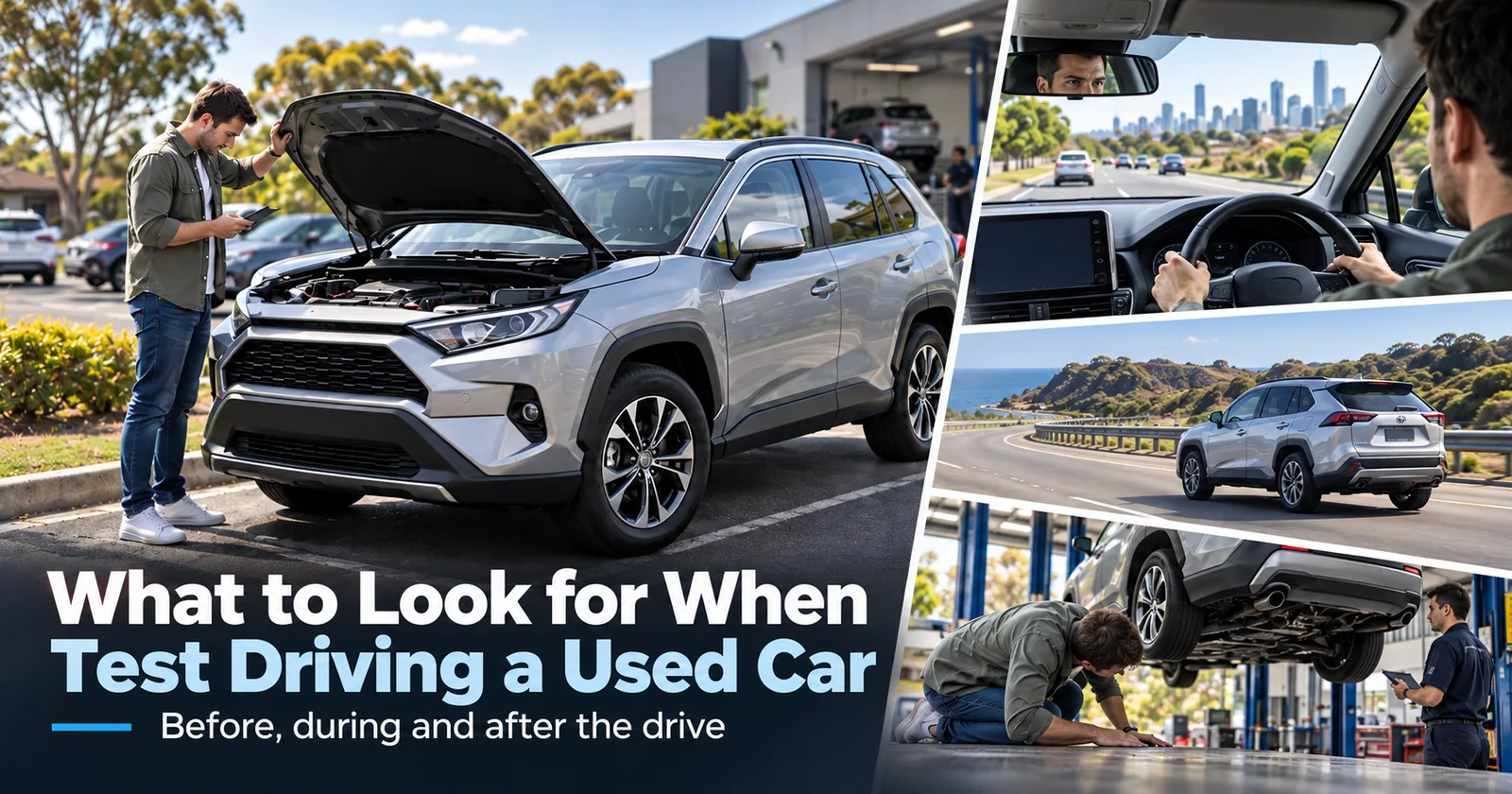
Look for five things on a test drive: how the engine starts from cold, how the brakes and steering behave under load, how the transmission shifts at low and highway speed, what the car does once it is hot, and whether it actually suits how you drive and what you carry. Drive for at least 20 minutes with the radio off, across car park, suburban, highway and rough road conditions. A test drive narrows the field. It does not replace a pre-purchase inspection.
Key takeaways
Insist on a cold start. A warmed-up engine hides faults that only appear on a cold start.
Drive for at least 20 minutes. Many faults appear only once the car reaches operating temperature.
Keep the radio off and a window down. You are listening as much as driving.
Cover four road types. Car park, suburban streets, highway and a rough road each reveal something different.
Watch the dashboard twice: on ignition and once running. A light that never illuminates is as suspicious as one that stays on.
Complete the after-stop checks while the engine is hot, when leaks and restart problems are most likely to show.
Judge fit as carefully as condition. A sound car that is uncomfortable or awkward to load is still the wrong car.
A test drive shortlists a car; it does not clear it. Book a pre-purchase inspection before you buy.
Terms used in this guide
Test driving involves mechanical terms that sellers use, and buyers often nod along to. The table below defines each one used in this guide.
Term | What it means |
|---|---|
Cold start | Starting an engine that has not run for several hours, usually overnight. |
Operating temperature | The normal running temperature an engine reaches after roughly 10 to 20 minutes of driving. |
Brake fade | A loss of braking performance as the brakes heat up during repeated use. |
Brake shudder | A pulsing felt through the pedal or steering wheel under braking, often from warped discs. |
Pulling | The car steering itself to one side when you briefly relax your grip on a straight, level road. |
Constant velocity joint | A driveline joint that allows the front wheels to steer and drive at once. Often shortened to CV joint. |
Bushes | Rubber or polyurethane mounts that locate suspension components and absorb vibration. |
Dual-clutch transmission | An automatic gearbox using two clutches. Known for hesitation at low speed when worn. |
Torque converter | The fluid coupling in a conventional automatic transmission. |
Blow-by | Combustion gases escaping past the piston rings, sometimes visible at the oil filler cap. |
Pre-purchase inspection | An independent mechanical inspection commissioned by the buyer before purchase. |
Roadworthy certificate | The Victorian inspection certificate required to transfer registration. It is not a condition report. |
What should you do before the test drive?
Arrange for the car to be cold when you arrive, confirm your licence and insurance position, and agree a route in advance. The preparation decides how much the drive is worth.
Why does a cold start matter so much?
A cold start exposes faults that disappear once an engine is warm. Timing chain rattle, worn starter motors, blue smoke from worn valve stem seals and rough idle from failing sensors are all most obvious in the first 30 seconds from cold.
Touch the bonnet when you arrive. If it is warm, the car has already been run. A seller may simply have moved it, but ask, and consider arranging to return when the engine is cold. A seller who refuses that request has told you something useful.
Are you insured to test drive a used car?
Ask before you drive, because the answer differs between a dealer and a private sale. Licensed dealers carry insurance covering their stock, but you should still ask what excess would apply to you in an incident. In a private sale, the owner’s policy may not cover a driver who is not listed, so ask the seller to confirm the position with their insurer before you take the wheel.
In Victoria, the TAC charge included in registration provides injury cover, but that is separate from cover for damage to the vehicle itself. Clarify the property damage position specifically rather than assuming registration covers everything.
This is general information rather than legal or insurance advice. Confirm the details with the seller and the relevant insurer.
What should you bring?
Bring your driver's licence, which any seller is entitled to see. Take a torch for looking underneath and into the engine bay, a phone for photographs of the logbook and anything you want to check later, and ideally a second person. Two sets of ears catch more than one.
Does the car actually suit you?
Judge fit as deliberately as you judge condition. A mechanically sound car you find uncomfortable, hard to park or awkward to load is still the wrong car. This is the half of a test drive most buyers skip, and it is the half they regret.
Bring what you actually carry
Take the child seat you own rather than assuming it fits, and fit it to the anchor points. Bring the pram, the golf clubs, the tools or the dog crate. Boot capacity in litres tells you volume, not shape, and a wheel arch in the wrong place defeats a figure that looks generous on paper.
Sit in the back seat yourself with the driver’s seat set where you would actually drive. Rear legroom quoted in a brochure assumes a driving position that may not be yours.
Check visibility properly
Reverse into a real parking space rather than relying on the camera. Look over your shoulder and check how much the rear pillars block. Adjust the mirrors and note any blind spots. A car with poor over-the-shoulder vision is something you live with every day.
Test the air conditioning and every accessory
Run the air conditioning on its coldest setting for several minutes and check it blows genuinely cold, not merely cool. Air conditioning repairs are a common and expensive used car cost, and a quick blast at the start of a drive will not reveal a system that fades.
Work through the rest deliberately: every window, central locking, the demister front and rear, headlights on both beams, indicators, wipers on every speed and the washers, the horn, the sunroof if fitted, and every seat adjustment including those you would not personally use.
Check for damp and smells
Press the carpets in all four footwells and in the boot under the spare wheel cover. Damp carpet or a musty smell can indicate a water leak or, at worst, flood damage. A strong air freshener in a used car is worth noticing, because it may be covering something.
What should you check during the test drive?
Check the brakes, steering, transmission and suspension deliberately rather than incidentally. Drive with the radio off and a window partly down, because much of what you are looking for is audible rather than visible.
How long should a test drive be?
Aim for at least 20 minutes. That is long enough for the engine and transmission to reach operating temperature, which is when a large share of faults appear. A five-minute drive around the block tests almost nothing beyond whether the car moves.
Ask for a longer drive if the car is expensive or the route has not covered highway speed. A reasonable seller will agree.
How should you test the brakes?
Brake progressively from moderate speed several times in a safe, clear stretch, then once firmly. The pedal should feel firm rather than spongy, the car should stop straight without steering to one side, and you should feel no pulsing through the pedal or wheel.
A pulsing sensation usually points to warped discs. A pedal that sinks slowly under steady pressure suggests a hydraulic problem. Both are reasons to stop and have the car inspected rather than continue negotiating.
How should you test the steering and suspension?
On a straight, level road with no traffic, briefly relax your grip and see whether the car tracks straight. Pulling to one side can be as simple as tyre pressures or as significant as alignment, worn components or past accident damage.
Turn full lock in both directions in a car park at low speed. Clicking usually indicates constant velocity joint wear on a front-wheel drive car. Over bumps, listen for knocking, which commonly points to worn bushes, links or shock absorbers. The body should settle after a bump rather than continue bouncing.
How should you test the transmission?
On an automatic, the car should pull away smoothly and change gears without shuddering, flaring or hesitating. Pay particular attention at low speed in traffic, where dual-clutch transmissions show wear first. On a manual, the clutch should engage smoothly partway through the pedal travel, and the gearbox should accept every gear including reverse without grinding.
Test the gearbox both cold and hot. Some transmission faults appear only at one temperature, which is another reason a short drive is inadequate.
What noises should you listen for?
Treat every entry above as a starting point for a mechanic rather than a diagnosis. What matters on the day is noticing the noise, noting when it occurs, and raising it before you commit.
What should the dashboard show?
Watch the instrument cluster twice. When the ignition is switched on, every warning light should illuminate as the car runs its self-test. Once the engine is running, they should all go out except the handbrake light until it is released.
A warning light bulb that has been removed is an old method of concealing a fault. If a light never appears during the ignition self-test, that is a reason to have the car scanned for stored fault codes.

What should you check after the test drive?
Check for leaks, smells, smoke and a hot restart immediately after you stop. The engine is now at full operating temperature, which makes this the most productive few minutes of the whole visit.
What does exhaust smoke tell you?
A little white vapour on a cold morning is condensation and clears quickly. Persistent thick white smoke once the engine is warm can indicate coolant entering the combustion chamber. Blue smoke suggests oil being burnt. Black smoke points to an over-rich fuel mixture.
Ask someone to watch the exhaust while you start the car and again while you briefly raise the engine speed at idle.
Should you restart the car while it is hot?
Yes, and it is one of the most useful checks available. Some starting faults appear only when the engine is hot, including worn starter motors and certain fuel delivery problems. Switch off after the drive, wait a minute, and start it again.
What extra checks apply to different powertrains?
Each powertrain adds checks a general test drive misses. An electric vehicle needs a battery state of health report. A hybrid needs its service record checked for annual battery health checks. A diesel needs a careful cold start and a question about how it is driven. A manual needs a clutch slip test. The four sections below cover each in turn.
What should you check on a used electric vehicle?
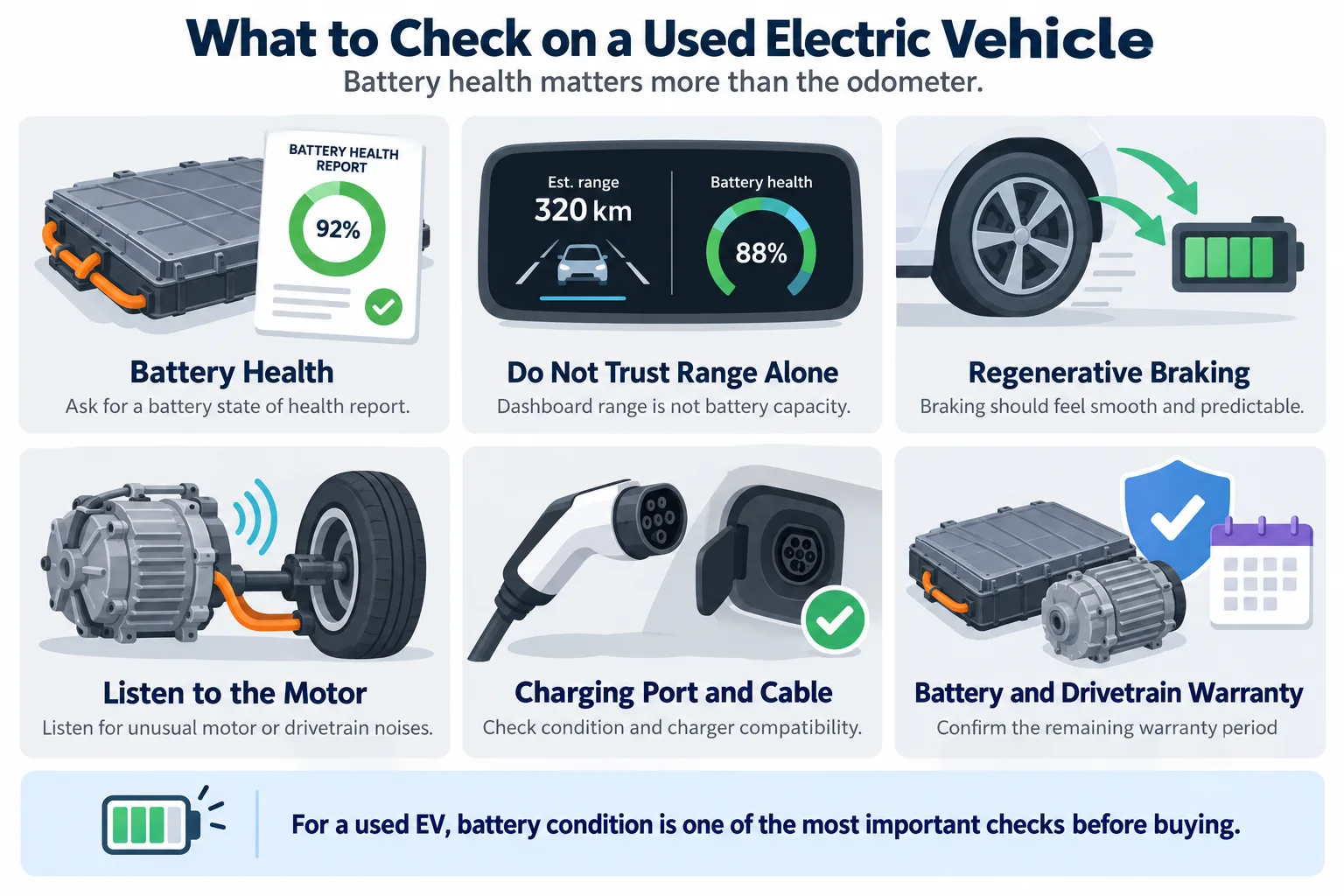
The battery is the most important component, and its state of health matters more than the odometer. Ask for a battery state of health report from the seller or a manufacturer dealership, or have a mobile inspector read it with an EV-capable scan tool. Do not rely on the range shown on the dashboard, which reflects recent driving rather than battery capacity.
The Australian picture is more reassuring than many buyers expect. Auction house Pickles tested more than 1,500 second-hand electric vehicles and found an average battery state of health of 96 per cent, with Australia’s moderate climate in most capital cities likely contributing to better than average battery condition.
On the drive, test the regenerative braking. Lifting off the accelerator should slow the car smoothly, and one-pedal driving where fitted should feel predictable. Regeneration is often reduced when the battery is cold or nearly full, so factor that in rather than assuming a fault. Listen for unusual noises from the motor, and check the charging port and cable for damage.
Two things to confirm before buying: that the charging port type suits the chargers you will actually use, and the remaining battery and drivetrain warranty. Manufacturer warranties in Australia generally transfer to the next owner, so ask for the start date and the remaining term.
What should you check on a used hybrid?
A conventional hybrid is not an electric vehicle, and most EV battery testing services do not cover them. For a hybrid, the service record does more work than any scan.
Some manufacturers extend hybrid battery coverage only on condition of an annual health check at a franchised dealer. Toyota, for example, covers the hybrid battery for five years and then extends it twelve months at a time up to a maximum of ten years, but only where the vehicle is presented for an annual hybrid health check. Ask to see evidence that those checks were done, because a gap can end the extension.
On the drive, the transition between electric and petrol running should be smooth and largely unnoticeable. Check that the car moves off on electric power where it should, and that the petrol engine starts without roughness.
What should you check on a used diesel?
Cold starting matters more on a diesel. Glow plugs should allow the engine to start promptly without excessive cranking or a cloud of white smoke that lingers.
Diesels fitted with a particulate filter need regular longer drives at higher speed to clean themselves. Ask what the car is used for, and be cautious about a diesel used only for short suburban trips. On the drive, note any warning light relating to the filter, and check for turbo lag that feels excessive or is accompanied by a whistle or whine.
How do you test a manual clutch and gearbox?
Test the clutch for slip, which is the most useful manual-specific check. In a safe place, with the handbrake firmly applied, select a higher gear such as third or fourth and gently raise the clutch while applying light accelerator. The engine should stall promptly. If it keeps running and the revs rise, the clutch is slipping and will need replacement.
Beyond that, the clutch should engage smoothly and partway through the pedal travel rather than right at the top. A bite point very high in the travel commonly indicates wear. Select every gear, including reverse, listening for crunching, and check that the gear lever does not jump out of gear under load.
What should you ask the seller after driving?
Ask about anything you noticed, and ask the questions that the drive itself cannot answer.
What is that noise, and when did it start?
When was the last service, and what was done?
Is anything currently due or overdue?
Has the car had any accident repair?
Are there any warning lights that come and go?
Do you mind if I arrange a pre-purchase inspection?
The last question is the most revealing of the six. A seller with nothing to hide has no reason to object to an independent inspection.
How do you compare several cars in one day?
Write notes immediately after each drive, before you see the next car. Memory blurs quickly once you have driven three similar vehicles, and the detail you lose is usually the one that mattered.
Use the same route for every car where you can, take a photograph of the odometer and the dashboard, and note the specific things you would need to fix or accept. Two cars an hour apart start to merge by the end of an afternoon, and a written list is what stops you from talking yourself into the wrong one.
What are the warning signs to walk away from?
Walk away, or at minimum stop and get an inspection, if the seller will not allow a cold start, refuses an independent inspection, will not let you drive at highway speed, or has warmed the car up and cannot explain why.
Mechanical signals that warrant stopping include grinding brakes, a brake pedal that sinks under steady pressure, a temperature gauge climbing above normal, thick smoke from the exhaust once warm, or a transmission that will not select a gear.
None of these means the car is worthless. They mean the next conversation is with a mechanic, not with the seller about price.
Does a test drive replace a pre-purchase inspection?
No. A test drive tells you how a car behaves on the day, from the driver’s seat. A pre-purchase inspection tells you the condition of components you cannot see, with the car on a hoist and a scan tool connected.
The two are complementary. Use the test drive to shortlist and to generate the questions worth asking. Use the inspection to confirm before money changes hands. A pre-purchase inspection generally costs between $200 and $450 in Australia, which is small against the cost of one undiagnosed transmission or engine fault.
How is test driving from a dealer different?
A licensed motor car trader carries obligations a private seller does not, including Australian Consumer Law responsibilities and, on eligible vehicles, a statutory warranty. Consumer Affairs Victoria states that a licensed trader must provide a statutory warranty if the car is less than 10 years old and has travelled less than 160,000 kilometres, lasting three months or 5,000 kilometres.
Practical differences on the day include insurance covering the test drive, a permanent business address, and the ability to compare several vehicles in one visit. Apply the same checks either way. A dealership setting does not remove the need for a cold start, a proper route or an independent inspection.
Do not let a short, supervised loop substitute for a real drive. Ask for the route you want.
How J & V Elite Motors can help
J & V Elite Motors is a family-operated used car dealership in Dandenong, Victoria, holding motor car trader licence LMCT 9914. The business was established by Zia Agahi in 2003. Zia worked as a mechanic before starting the dealership, which shaped how the business approaches vehicle selection and customer questions.
Practical support available at the Dandenong dealership includes:
Browsing all current listings and used car brands online before visiting
Test drives and inspections at 21 to 23 Hammond Road, Dandenong
Vehicle finance enquiries, subject to application, eligibility, lender criteria and approval
Trade-in enquiries on your existing vehicle
Servicing through the dealership’s own service centre after purchase
The website states that stock is pre-inspected through a licensed VicRoads auto repair shop, and the business identifies itself as an approved Australian Warranty Network dealer. Arrange a test drive in advance if you would like the vehicle left cold for a proper cold start.
Buyers in Noble Park, Springvale, Keysborough and Mulgrave are a short drive from the dealership. You can read more about the dealership or contact the team to book a time.
Before you decide
Treat the test drive as the step that generates your questions rather than the step that answers them. Arrive early enough for a cold start, drive long enough and widely enough to reach operating temperature, listen more than you look, and do the after-drive checks while the engine is hot. Then walk away and write down what you found.
Browse the current used car listings at J & V Elite Motors, then contact the Dandenong team on (03) 9706 8999 to book a test drive.
Frequently Asked Questions
How long should a used car test drive be?
At least 20 minutes, covering car park manoeuvring, suburban streets, highway speed and a rough road. That is long enough for the engine and transmission to reach operating temperature, which is when many faults appear. A short loop around the block tests very little.
Can you test drive a car without buying it?
Yes. A test drive carries no obligation to buy, at a dealership or in a private sale. Decide away from the car rather than in the seller’s driveway, and never feel pressured to commit on the spot.
Do you need insurance to test drive a used car?
It depends on the seller. Dealers carry insurance covering their stock, though you should ask what excess would apply to you. In a private sale, the owner’s policy may not extend to an unlisted driver, so ask the seller to confirm with their insurer first. This is general information, not insurance advice.
What should you listen for on a test drive?
Drive with the radio off and a window partly down. Listen for brake squeal or grinding, clicking on full-lock turns, knocking over bumps, whining that rises with road speed, rattle on cold start, and any hesitation as the transmission engages.
Should the engine be cold when you arrive?
Yes. Ask the seller not to run the car before you arrive, and touch the bonnet to check. A cold start reveals timing chain rattle, starting problems, smoke and rough idle that a warm engine hides.
Can I take a used car to my own mechanic?
Usually yes, and you should ask. Most sellers will allow a pre-purchase inspection at a workshop of your choosing, or will let a mobile mechanic inspect the car where it is. A refusal is a significant warning sign.