
Used Car Warranty in Victoria: Statutory Warranty vs Extended Warranty

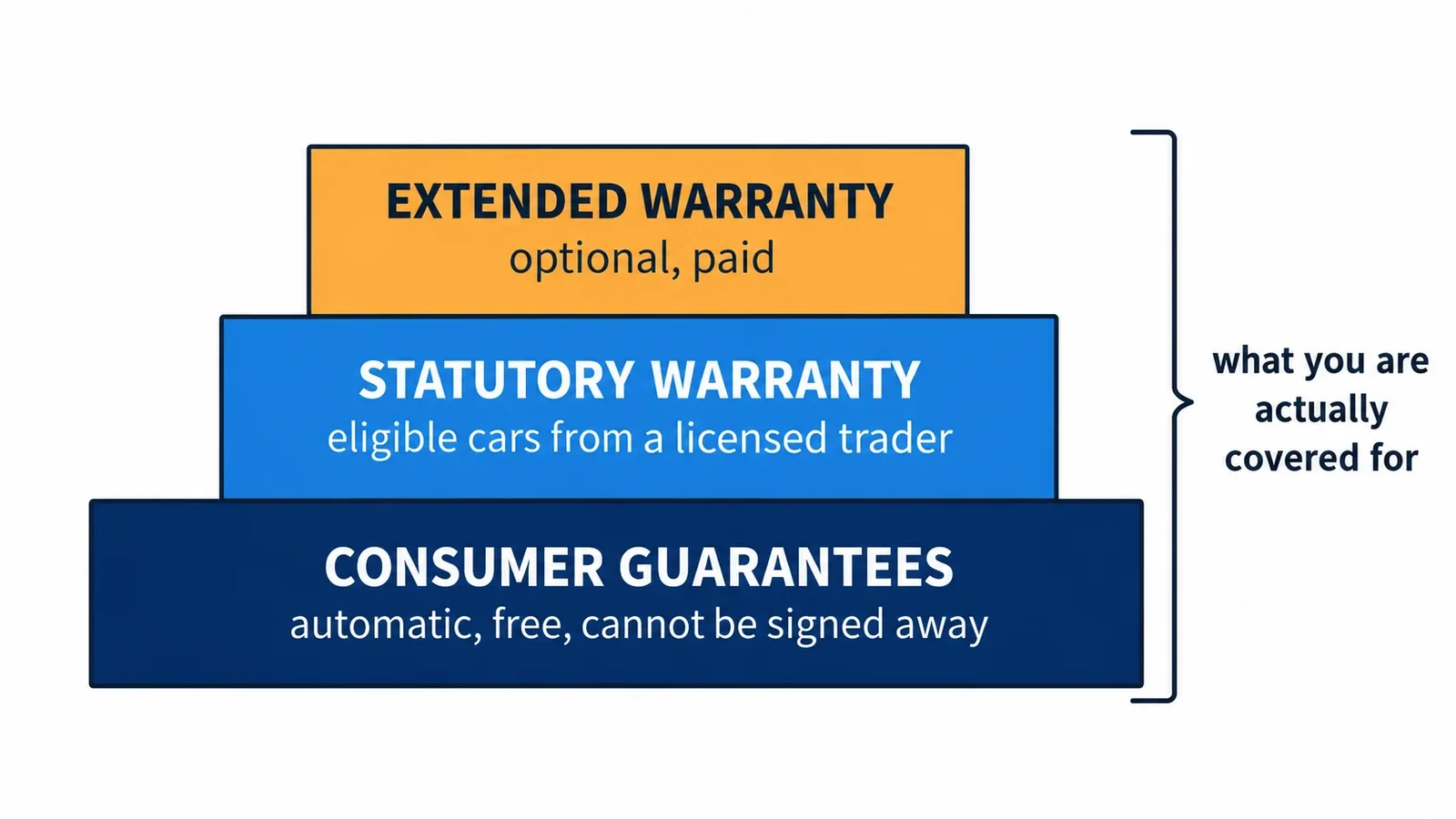
Three different protections can apply to a used car in Victoria. Consumer guarantees apply automatically under Australian Consumer Law and cannot be signed away. A statutory warranty applies to eligible cars bought from a licensed motor car trader. An extended warranty is an optional product you pay for. Knowing which you already have helps you decide whether the third one is worth buying.
You already have consumer guarantees. They are automatic, free and do not expire when a warranty does.
You may also have a statutory warranty. It covers eligible cars under 10 years old and under 160,000 km, bought from a licensed motor car trader. It runs for three months or 5,000 km.
Before buying an extended warranty, ask in writing what it covers beyond your existing rights.
Key Takeaways
Consumer guarantees apply automatically under Australian Consumer Law and cannot be replaced or taken away by a warranty.
The consumer guarantee of acceptable quality can still apply after a warranty expires.
A Victorian statutory warranty covers eligible cars under 10 years old and under 160,000 km for three months or 5,000 km, whichever comes first.
Commercial vehicles, motorcycles and cars sold at public auction are excluded from the Victorian statutory warranty.
Commercial vehicles and cars bought in a company name are also excluded from the three-day cooling-off period.
A defect notice lists faults excluded from the statutory warranty, so read it before signing.
For a major failure, the consumer chooses the remedy. For a minor failure, the business can choose to repair.
An extended warranty should add cover beyond the rights you already receive for free.
Which Protection Applies to Your Car?
Work down this table in order. Consumer guarantees apply to almost every purchase. The statutory warranty is narrower.
Your Situation | What Applies | What to Do |
|---|---|---|
Car under 10 years old, under 160,000 km, bought from a licensed trader | Consumer guarantees plus a statutory warranty | Read the defect notice. Note the purchase date and odometer reading |
Car over 10 years old or over 160,000 km, bought from a licensed trader | Consumer guarantees only | Guarantees still apply, judged against the age and price of the car |
Commercial vehicle such as a work ute or van | Consumer guarantees only. No statutory warranty, no cooling-off | Ask the dealer directly what cover, if any, is offered on that vehicle |
Car bought at a public auction | Consumer guarantees only. No statutory warranty | Inspect carefully. The usual trader protections do not apply |
Car bought in a company or business name | Consumer guarantees may apply. No cooling-off period | Check whether the purchase qualifies as a consumer purchase |
Car bought privately | Limited. Private sellers are not licensed traders | Run a PPSR check and arrange an independent inspection |
Warranty has expired, and a fault appears | Consumer guarantees usually still apply | Raise the fault with the seller. An expired warranty does not end your rights |
Statutory Warranty vs Extended Warranty: The Key Differences
One is automatic and free. One is required by law on eligible cars. One is a product you buy. They stack rather than replace each other.
Statutory warranty
Required by Victorian law for eligible cars
Free and built into the sale
Applies only to eligible vehicles
Runs for three months or 5,000 km
Does not transfer on a private resale
Excludes commercial vehicles
Extended warranty
Optional product
Purchased separately
Cover depends on the contract
Term depends on the contract
Transfer depends on the contract
May duplicate existing consumer rights
Feature | Consumer Guarantees | Statutory Warranty | Extended Warranty |
|---|---|---|---|
Source | Australian Consumer Law | Victorian law, via a licensed trader | A contract you buy |
Cost | Free and automatic | Free, built into the sale | Paid, priced separately |
Can it be signed away | No | No, on an eligible car | Not applicable |
How long | A reasonable time, based on age and price | Three months or 5,000 km | Whatever the contract says |
Who it covers | The consumer who bought the car | The original purchaser | As set out in the contract |
Expiry | Does not expire with a warranty | Fixed period | Fixed term |
Who decides the remedy | You, for a major failure | Trader repairs to reasonable condition | The contract decides |
What Does the Victorian Statutory Warranty Cover?
A licensed motor car trader must provide a statutory warranty on a used car that is less than 10 years old and has travelled less than 160,000 kilometres.
Age is measured from the date on the compliance plate. Both conditions must be met. A nine-year-old car with 170,000 km does not qualify, and neither does an eleven-year-old car with 90,000 km.
Detail | What Victorian Law Requires |
|---|---|
Eligibility | Less than 10 years old and under 160,000 kilometres at the time of sale |
Duration | Three months or 5,000 kilometres after purchase, whichever occurs first |
Standard of repair | The trader must repair covered faults so the car is in reasonable condition for its age |
Parts | Second-hand parts may be used, as long as they are suitable and serviceable |
Repair time | Time taken to repair the car is added to the warranty period |
Towing | If the car cannot be driven due to a warranty defect, the trader must pay towing costs |
Courtesy car | The trader is not obliged to provide a replacement vehicle while yours is repaired |
Transfer on resale | The warranty does not transfer if you sell the car privately during the period |
What the Statutory Warranty Does Not Cover
Three categories of fault sit outside it, plus a specific list of components.
Excluded Category | Detail |
|---|---|
Anything on the defect notice | Faults listed with a reasonable repair cost estimate are excluded by that listing |
Accidental damage after delivery | Damage that happened once the car was yours |
Misuse or negligence after delivery | Damage caused by how the car was driven or maintained |
A list of specific components is excluded as well, whatever caused the fault.
Category | Excluded Items |
|---|---|
Wear items | Tyres and batteries |
Audio and entertainment | Radios, CD, MP3 and MP4 players and docks, DVD players and video display panels |
Navigation and phone | GPS and satellite navigation systems, telephones and in-car telephone kits |
Electrical accessories | Power outlets including cigarette lighter sockets, cigarette lighters, car aerials, clocks, light globes, sealed beam lights and non-standard fog lights |
Security and entry | Non-standard alarms, keyless entry systems and remote keypads |
Other | Non-standard body hardware, and tools other than the jack and wheel brace |
Warning: commercial vehicles get neither the statutory warranty nor the cooling-off period. Consumer Affairs Victoria excludes motorcycles, commercial vehicles and cars sold at public auction from the statutory warranty. Commercial vehicles and purchases in a company name are also excluded from the cooling-off period. If you are buying a work ute or van, ask the dealer directly what cover applies to that specific vehicle.
What Are Consumer Guarantees?
Consumer guarantees apply automatically under Australian Consumer Law. The ACCC states that warranties cannot replace, change or take away a consumer’s basic rights.
The most important guarantee for a used car is acceptable quality: the car must be safe, durable and free from defects. What counts as acceptable is judged in context, not against a fixed standard.
Factor | How It Affects What Is Reasonable |
|---|---|
Age of the vehicle | An older car is not expected to perform like a new one |
Price paid | A lower price lowers what a reasonable buyer would expect |
New or second-hand | Second-hand condition is explicitly part of the test |
Typical lifespan | How long components of that type normally last |
Claims made at sale | What the seller said about durability or condition |
How the car was used | Whether use matched what the vehicle was designed for |
Major Failure or Minor Failure?
This distinction decides who chooses the remedy. For a major failure, you choose. For a minor failure, the business can choose to repair.
Major Failure | Minor Failure | |
|---|---|---|
What it means | The car is unsafe, is very different from its description, has one serious problem or several smaller ones that would have stopped you from buying, or cannot be used normally and cannot easily be fixed in a reasonable time | A problem that can be fixed within a reasonable time |
Remedy | A refund, or a replacement of the same type | The business must fix the problem or repair it free of charge |
Who chooses | You do. The business cannot force a particular remedy | The business. It does not have to offer a refund or replacement, although it can |
Tip: an expired warranty does not end your rights. The ACCC states that after a warranty expires, the consumer guarantee of acceptable quality usually still applies, and that businesses must not mislead consumers into thinking their rights are limited to the timeframe set out in a warranty. If a significant fault appears after the statutory warranty period, raise it anyway.
Is an Extended Warranty Worth Buying?
An extended warranty is an optional product sold separately. The ACCC says it may or may not give a consumer any extra rights.
The regulator is direct on this point: businesses must not mislead consumers into paying for rights in an extended warranty that they already have automatically under the consumer guarantees. That makes one question the centre of the decision.
The question to ask, in writing: What does this extended warranty cover that I do not already have under the consumer guarantees and the statutory warranty? Ask for the answer in writing, and ask for the product disclosure or terms document before you decide.
If you are still considering one, check these eight things in the contract.
What is actually covered. Component lists vary widely. Engine and transmission cover is not the same as full mechanical cover.
What is excluded. Wear and tear, consumables and pre-existing faults are commonly excluded.
Claim limits. Look for a per-claim cap and an overall limit across the term.
Servicing conditions. Many contracts require servicing at set intervals by an approved repairer, with records kept.
Who repairs the car. Check whether you can use your own mechanic or must use an approved network.
Who pays first. Some products reimburse you after you pay the repairer, rather than paying directly.
Excess per claim. An excess can make small claims not worth making.
Transfer and cancellation. Check whether cover transfers if you sell, and whether a refund applies if you cancel early.
Defect Notices and the Cooling-Off Period
Two protections apply before anything goes wrong. Both are easy to miss at signing.
Protection | How It Works |
|---|---|
Defect notice | The trader must list faults not covered by the statutory warranty, with a reasonable estimate of repair cost. Those faults are excluded by being listed, so read it before you sign |
Cooling-off period | Three clear business days after signing, excluding weekends and public holidays, in which you can change your mind |
Cooling-off exceptions | It does not apply if the car is bought in a company or body corporate name, if it is a commercial vehicle, or if you accept delivery within the three days |
Cooling-off cost | The trader may keep $100 or 1% of the purchase price, whichever is greater |
How to use it | Notify the trader in writing before the period ends, and confirm they received it |
How Do You Make a Warranty Claim?
Contact the trader you bought the car from first. Arranging repairs elsewhere before you do can void a statutory warranty claim.
Stop and contact the seller. Under a statutory warranty, arranging your own repairs first may void the claim and leave you with the cost.
Put it in writing. Describe the fault, the date it appeared and the odometer reading. Keep a copy.
Check the defect notice. If the fault is listed there, the statutory warranty does not cover it, though consumer guarantees may still apply.
Gather your records. Contract of sale, defect notice, any extended warranty terms, service records and repair invoices.
Work out whether it is major or minor. This decides whether you choose the remedy or the business does.
Escalate if needed. Consumer Affairs Victoria can help with disputes involving a licensed motor car trader.
Buying With Confidence at J & V Elite Motors
Warranty cover varies by vehicle. The only reliable answer is the one attached to the car you are looking at.
J & V Elite Motors has sold used vehicles from Hammond Road in Dandenong since 2003, which is more than 20 years in the same location. The dealership is family-operated, holds motor car trader licence LMCT 9914, and pre-inspects its vehicle stock through a licensed VicRoads auto repair shop. It runs its own service centre for customers after the sale, and it is an approved Australian Warranty Network Dealer.
Warranty options may be available. Ask J & V Elite Motors about coverage for the vehicle you are considering, including the period, the kilometre limit, what is included and what is excluded. Cover is not the same on every vehicle, so check the individual listing and the paperwork attached to it.
Buyers across Noble Park, Springvale, Keysborough and Mulgrave are within a short drive of the Dandenong dealership. Browse the current used vehicle listings, or contact the team to ask what applies to a specific car before you commit.
Frequently Asked Questions
What Is the Difference Between a Statutory Warranty and an Extended Warranty?
A statutory warranty is required by Victorian law on eligible used cars sold by a licensed motor car trader, and it costs nothing extra. An extended warranty is an optional product you pay for, with cover set by its contract. The statutory warranty runs for three months or 5,000 kilometres. An extended warranty runs for whatever term its contract specifies.
Does Every Used Car Come With a Statutory Warranty in Victoria?
No. The car must be less than 10 years old and have travelled less than 160,000 kilometres, and it must be bought from a licensed motor car trader. Motorcycles, commercial vehicles and cars sold at public auction are excluded. Consumer guarantees under Australian Consumer Law may still apply even when a statutory warranty does not.
Do My Rights End When the Warranty Expires?
No. The ACCC states that after a warranty expires, the consumer guarantee of acceptable quality usually still applies, and that businesses must not mislead consumers into thinking their rights are limited to the timeframe in a warranty. How long the guarantee lasts depends on what is reasonable for a car of that age, price and condition.
Does the Warranty Transfer If I Sell the Car?
A statutory warranty does not. It is provided as part of your contract with the trader, so if you sell the car privately before the three months or 5,000 kilometres are up, it does not pass to the new owner. Whether an extended warranty transfers depends on its contract, so check that clause before you sell.
What Is a Defect Notice and Why Does It Matter?
A defect notice is a document the trader must attach listing faults the statutory warranty will not cover, with a reasonable estimate of what each costs to repair. It matters because listing a fault is what excludes it. Read the notice before you sign, and price the listed repairs into what you are willing to pay.
Can I Change My Mind After Signing?
Usually yes. Victoria gives you three clear business days after signing, excluding weekends and public holidays. It does not apply if the car is bought in a company name, if it is a commercial vehicle, or if you accept delivery within those three days. The trader may keep \$100 or 1% of the purchase price, whichever is greater.
Who Decides Whether I Get a Repair, Refund or Replacement?
It depends on how serious the problem is. For a major failure, you choose between a refund and a replacement of the same type, and the business cannot force a different remedy. For a minor failure, the business must fix the problem free of charge, and it does not have to offer a refund or replacement, although it can.
What Should I Do First If a Fault Appears?
Contact the trader you bought the car from before arranging any repairs. Under a statutory warranty, organising your own repairs first may void the claim and leave you with the bill. Put the fault in writing with the date and odometer reading, and keep your contract, defect notice and service records together.