
How to Check a Used Car’s Service History Before Buying
Key takeaways
|
Terms used in this guide
Service history has its own vocabulary, and listings use abbreviations that mean specific things. The table below defines each term used in this guide.
Term | What it means |
|---|---|
Service history | The documented record of scheduled servicing, maintenance and repairs performed on a vehicle over its life. |
Logbook | The printed service book supplied with the vehicle, stamped by the workshop at each service. |
Digital service record | A service logged electronically against the vehicle identification number instead of stamped in a book. |
Full service history | Every scheduled service completed and documented, with no unexplained gaps. Often abbreviated to FSH. |
Full dealer service history | Every service completed by a franchised dealer for that brand. |
Partial service history | Some services documented and others missing. |
VIN | The vehicle identification number, a unique 17-character code identifying the individual vehicle. |
Logbook service | A service carried out to the manufacturer’s published schedule for that interval. |
Minor and major service | A minor service covers basic items such as oil and filters. A major service adds larger scheduled items. |
PPSR | The Personal Property Securities Register, a national register of security interests in personal property. |
Pre-purchase inspection | An independent mechanical inspection commissioned by the buyer before purchase. |
Roadworthy certificate | The Victorian inspection certificate required to transfer registration. It is a safety check, not a service. |
Odometer tampering | Illegally reducing the displayed distance a vehicle has travelled. |
Can you check a car’s service history online in Australia?
No. Australia has no single public database of vehicle service records. Unlike a registration or PPSR check, there is no website where you enter a VIN and receive a complete servicing record.
That absence shapes everything else in this guide. Service records exist, but they sit in separate places, held by whoever did the work. Verifying a car’s history means gathering evidence from several of those places and checking that the picture is consistent.
Where service records are actually held
The logbook, stamped by hand at each service and held with the car.
The manufacturer’s dealer network, which stores every service done at a franchised dealer for that brand.
Independent workshops, which keep job cards and invoices under the customer or registration.
Digital service records, logged electronically against the VIN by many manufacturers instead of a stamp.
The owner’s own receipts, which may or may not have been kept.
What is a digital service record?
A digital service record is a service logged electronically against the vehicle identification number in the manufacturer’s system, instead of stamped into a paper book. Many brands moved to this method, and on those vehicles there may be no stamps at all.
This matters for two reasons. A digital record is harder to falsify than a stamp book, because the entry sits in the manufacturer’s system rather than on a page anyone can mark. And a recent car described as having “no logbook” may be fully documented digitally.
Ask the question directly before dismissing a car: does it have a digital service history, and which dealer network holds it? A franchised dealer for the brand can pull the record against the VIN.
Do independent workshop services appear in a digital record?
Generally no. A manufacturer’s system records work carried out within its own dealer network. A car properly maintained by a good independent workshop can therefore show an almost empty dealer record while being fully serviced.
This is why the two checks belong together. Use the dealer printout for franchised servicing, and the logbook and invoices for everything else.
How far back can you check a service history?
Franchised dealer records generally go back as far as the manufacturer’s system holds them, which usually covers the vehicle’s life within that network. Independent workshops keep records according to their own retention practices, so older jobs may no longer be retrievable.
In practice, the further back you go, the more the record depends on the logbook and the owner’s invoices rather than any database.
Where do you find the VIN?
The VIN is a unique 17-character code identifying the individual vehicle, and every service history check starts with it. It appears at the base of the windscreen on the driver’s side, on the compliance plate in the driver’s door jamb, on the firewall or engine bay of many vehicles, and on the registration papers and insurance certificate.
Check that the number is identical everywhere it appears. A mismatch between the car and its paperwork is a serious warning sign and a reason to stop.
How do you check a used car’s service history?
Work through five checks in order. Each one is independent of what the seller tells you, and together they give a reliable picture.
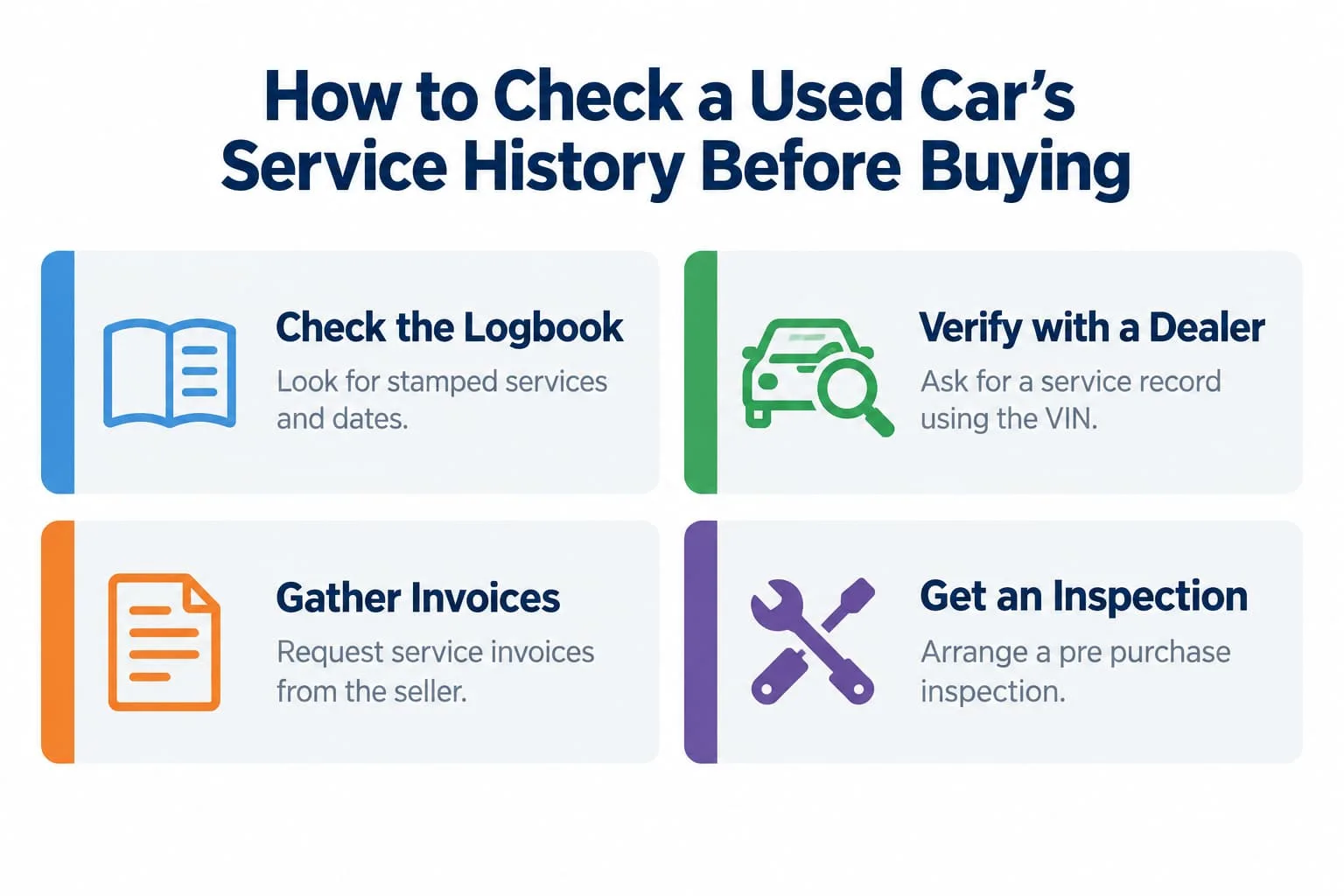
Step one, read the logbook properly
Look for evenly spaced services with no long unexplained gaps, odometer readings that increase logically, and stamps carrying a business name and address. Check that the make, model and any major work listed match the car in front of you.
Photograph every page. A seller who refuses to let you photograph the records has given you useful information.
Step two, call a franchised dealer for that brand
This is the most useful check available and the least used. If the car was ever serviced at a franchised dealer, that work sits in the manufacturer’s national system. Call any dealer for the brand, give them the VIN, and ask for a service history printout.
Most franchised dealers across the mainstream brands will provide this at no cost. The printout typically shows each service event, the date, the odometer reading at the time and the work performed. It is independent of the seller and hard to fake.
Step three: Contact any workshop named in the records
Independent workshops keep job cards and invoices, usually searchable by registration or VIN. If the logbook names a workshop, call it and ask whether the records match. A genuine business will usually confirm.
Step four: ask for the invoices
Receipts prove work that a stamp does not describe. Invoices show what was actually replaced, which matters for interval items such as timing belts, transmission fluid and coolant. Service invoices with detail can be as useful as a stamped logbook, and sometimes more.
Step five, book a pre-purchase inspection
Paperwork tells you what was claimed. An inspection tells you the condition of the car now. A qualified mechanic can identify wear, leaks, previous repair work and fault codes that no record will show, and will spot inconsistencies between the car’s condition and its stated history.
A pre-purchase inspection generally costs between $200 and $450 in Australia, depending on the depth of the inspection, the size of the vehicle and whether the inspector travels to the car. In Victoria, RACV offers inspections through accredited auto care centres, with a 30-day mechanical guarantee for members.
Treat this as the final check rather than an optional extra, particularly where records are incomplete. Set against the cost of one undiagnosed transmission or engine fault, it is the cheapest insurance in the process.
What should a good service history look like?
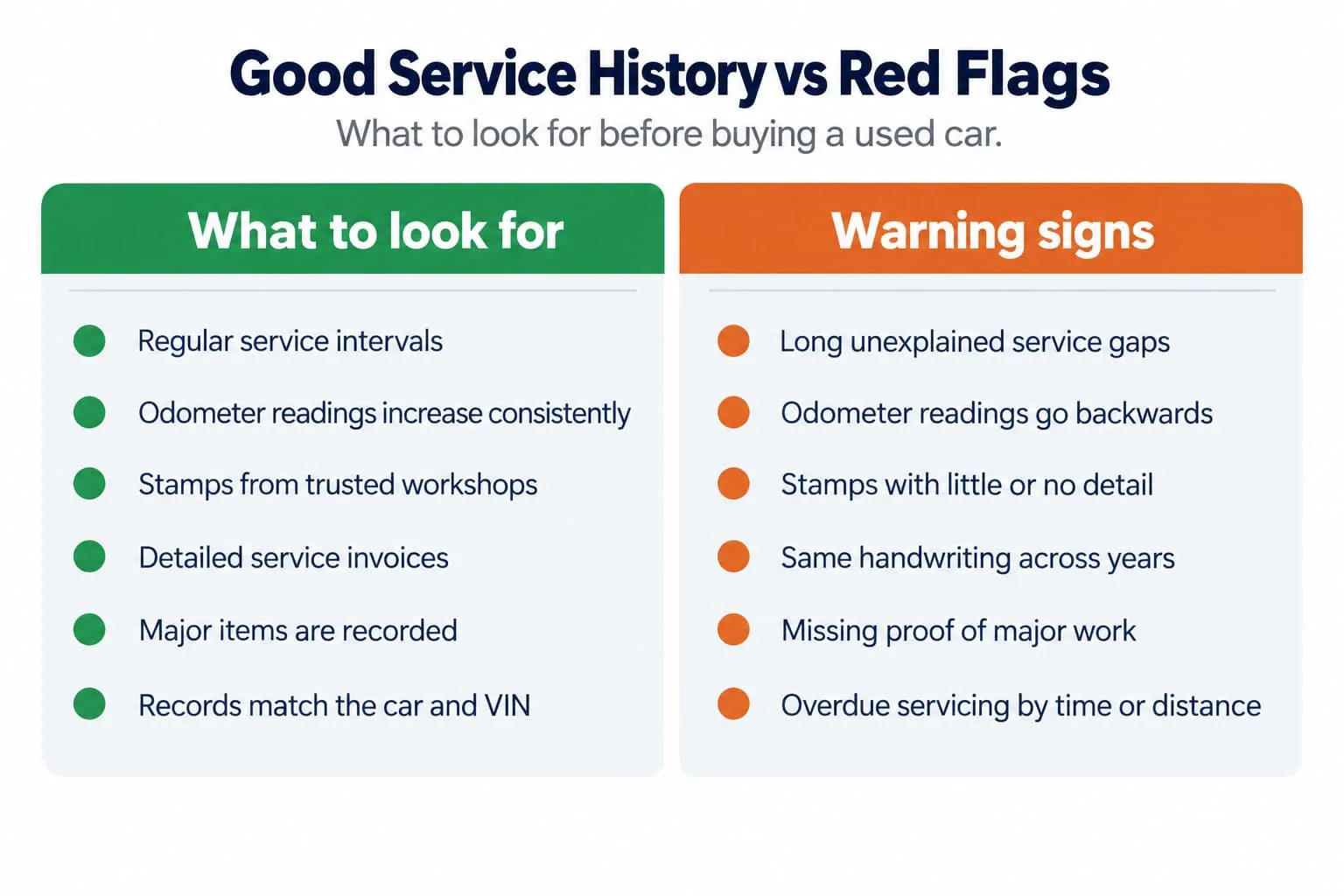
A good service history shows regular services at the manufacturer’s intervals, odometer readings that always increase, stamps or invoices from named licensed workshops, and documentation of major scheduled items.
How often should a car be serviced?
As a general rule, a minor service is due every 10,000 to 15,000 kilometres or every 12 months, whichever comes first, and a major service every 30,000 to 45,000 kilometres. European and performance models often run shorter intervals.
The phrase “whichever comes first” is the part buyers most often misread. A car driven 6,000 kilometres in a year is still due for its annual service, because oil degrades with time as well as use. A logbook showing services only when the distance was reached, on a low-kilometre car, is a gap rather than a saving.
Always check the schedule in that vehicle’s own logbook. The manufacturer’s schedule overrides any general rule, including this one.
 Which major items should appear in the records?
Ask specifically about interval-based items, because these follow a schedule rather than wear and are expensive when skipped.
Timing belt replacement, where the engine uses a belt rather than a chain.
Transmission fluid and filter, particularly on dual-clutch and automatic transmissions.
Coolant and brake fluid, both of which have service lives.
Spark plugs on petrol engines.
Diesel particulate filter work on diesel vehicles.
If the car is at or past the age or distance for any of these and the records do not show them, price the work in or ask the seller to complete it before settlement.
How can you tell if a service logbook is fake?
Look for signs that the stamps were made at one sitting rather than over years. Identical handwriting and ink across services years apart, stamps with no business name or address, dates that do not align with the odometer progression, and a book that looks newer than the car all warrant scepticism.
The strongest verification is external. Call the workshops named in the book. A forged stamp cannot survive a phone call to a business that has no record of the vehicle.
How do you check for odometer tampering?
Compare the current odometer reading against the last reading in the logbook and against any service printout. If the current reading is lower than a past record, treat that as a serious warning sign.
Physical wear is the second check. Heavy wear on the pedal rubbers, steering wheel, driver’s seat bolster and gear selector should be consistent with the distance shown. A car showing modest distance with heavily worn controls does not add up.
Past roadworthy certificates, registration records and service invoices all capture odometer readings at points in time, which is why assembling several sources works better than relying on one.
Does a PPSR check show service history?
No. A PPSR check shows whether money is owing on the vehicle, whether it has been written off, whether it is recorded as stolen, and the registration and vehicle identifiers. It shows nothing about servicing, maintenance or mechanical condition.
The PPSR itself states that a search does not provide all information about a vehicle and its history.
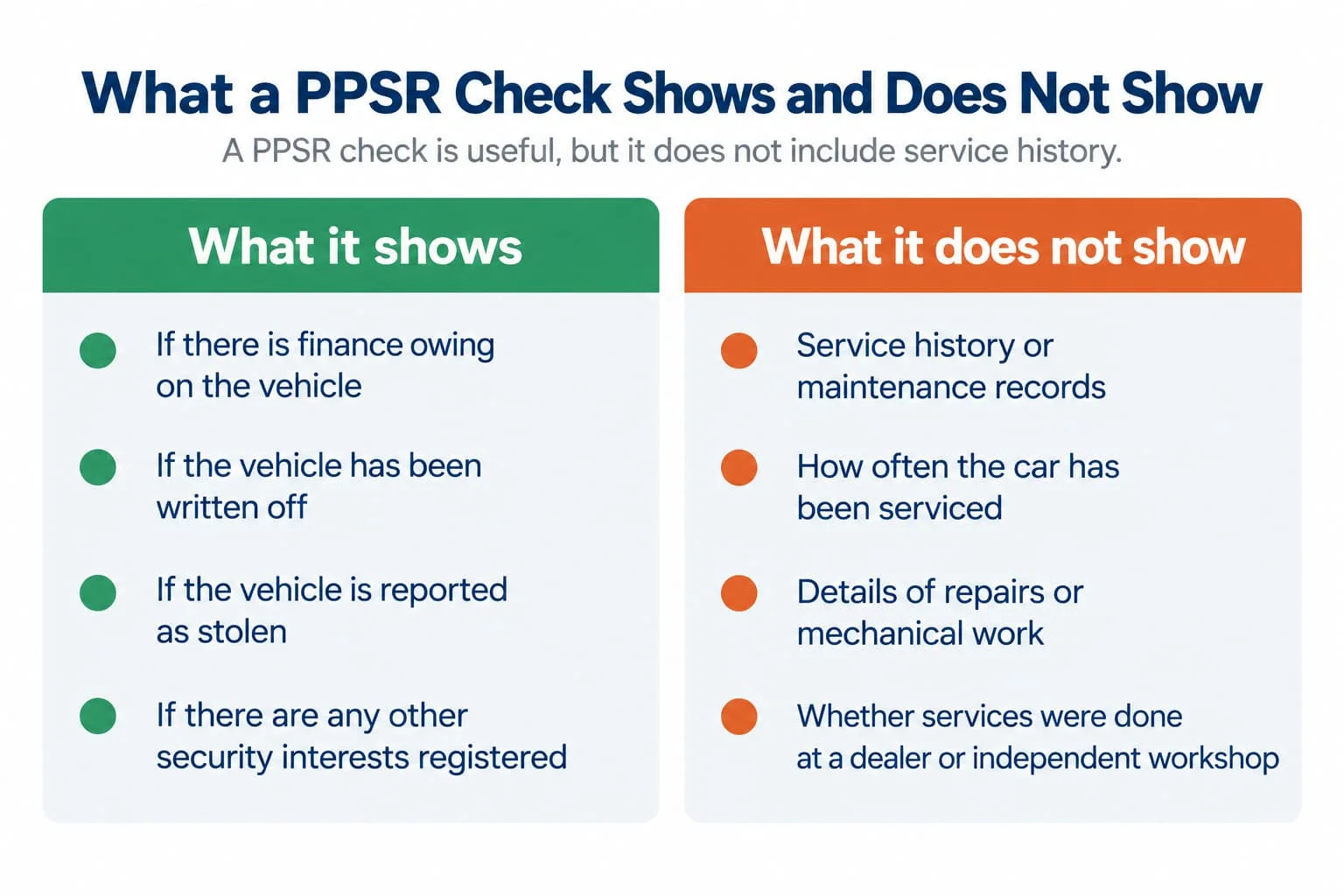 Both checks are worth doing, and neither substitutes for the other. A PPSR check protects you from a legal and financial problem. A service history check protects you from a mechanical one.
Does a roadworthy certificate mean the car has been serviced?
No. A roadworthy certificate is a safety inspection required to transfer registration in Victoria. It confirms that specified safety items met the standard on the day of inspection. It does not confirm that scheduled servicing was ever performed, and it is not a statement about mechanical condition or reliability.
Is a paid vehicle history report worth it?
A paid vehicle history report is usually worth its modest cost, because it bundles the PPSR data with additional checks in one document. It is not a service history report, and no paid product in Australia returns a complete servicing record.
Commercial reports typically add recorded odometer readings captured at registration events, a market valuation, and a summary of registration status alongside the finance, write-off and stolen checks. The recorded odometer readings are the genuinely useful part for this purpose, because they give you independent points to compare against the logbook.
Check | What it covers | What it costs |
|---|---|---|
PPSR search | Finance owing, written-off, stolen, registration details | A small government fee |
Paid vehicle history report | PPSR data plus recorded odometer readings, valuation and registration summary | Modest, varies by provider |
Dealer service printout | Servicing done within that manufacturer’s dealer network | Usually free |
Pre-purchase inspection | Current mechanical condition, wear, repairs and fault codes | Generally $200 to $450 |
Run the PPSR search regardless. Add a paid report when you want the odometer history in one place. Neither replaces the inspection.
What if a used car has no service history?
Missing records are not automatically a reason to walk away, but they change what the car is worth and how carefully you should check it. Try to rebuild the history first, then decide.
 How do you fill gaps in a service history?
Call franchised dealers for the brand with the VIN, contact any workshop the seller can name, and ask the seller whether they have invoices, receipts or emailed booking confirmations. Previous owners sometimes kept records the current seller does not have.
A lost logbook can often be partially reconstructed this way. A car that was genuinely never serviced cannot.
Is a car without service history worth buying?
It depends on the car’s age, price and condition. An older, inexpensive vehicle with no records can still be a fair buy if it inspects well and the price reflects the uncertainty. A near-new vehicle with no records is a warning sign, because recent servicing should be easy to evidence.
Where you proceed, budget for catch-up servicing on interval items, and treat a pre-purchase inspection as essential rather than optional.
How much less should you pay for a car with no records?
There is no fixed discount. Incomplete service history reduces value because it transfers risk to the buyer, and the size of that risk depends on what interval work may be outstanding.
Price it from the work required. Get an inspection, list the items that cannot be evidenced, obtain quotes for the ones due, and negotiate from that figure rather than an arbitrary percentage.
Is dealer service history better than independent servicing?
Full dealer service history means every service was carried out by a franchised dealer for that brand. It is not automatically better maintenance, but it is easier to verify, because the record sits in the manufacturer’s system rather than in one workshop’s files.
For most mainstream cars, a well-documented independent history is worth as much as a dealer one. Under Australian Consumer Law, servicing at a qualified independent workshop does not void a manufacturer warranty, provided the work follows the manufacturer’s schedule and uses fit-for-purpose parts. A logbook service is defined by the work performed, not by the sign above the door.
Two exceptions are worth knowing. Prestige and performance vehicles tend to attract a stronger premium for authorised dealer history, because buyers in that segment place more weight on it. And for a car still inside its warranty period, dealer records remove any argument about whether servicing met specification.
What matters more than who did the work
An independent workshop that issues a detailed itemised invoice gives a buyer more than a dealer stamp with no supporting paperwork. The invoice proves which parts were replaced and what was inspected. The stamp only proves someone attended.
The strongest combination is both: a stamped logbook and the invoices behind it. Where you have to choose, take the documentation with detail.
Does service history affect a car’s value?
Yes. A complete service history supports a higher price and a faster sale, because it removes uncertainty for the next buyer. Industry estimates commonly place the premium at around 10 to 20 per cent on a private sale, though no authoritative Australian figure exists and the real effect varies by vehicle.
The effect is larger where it matters most. Service history counts for more as a car ages, and the odometer climbs, because the risk a buyer is taking on grows. A three-year-old hatchback with low kilometres carries less inherent risk than a seven-year-old SUV, so the documentation moves the price further on the older car.
This works in both directions. As a buyer, incomplete records are a legitimate negotiating point. As an owner, keeping every invoice and stamp is one of the cheapest things you can do to protect resale value.
Should you ask the seller to complete an overdue service?
Asking the seller to complete an overdue service before settlement is often a better outcome than negotiating the price down. You get the work done to the manufacturer’s schedule, the record continues without a gap, and you avoid discovering afterwards that the job cost more than the discount you agreed.
Put it in writing as a condition, and ask for the invoice on completion. Where the seller declines, obtain a quote for the outstanding work and negotiate from that figure rather than an estimate.
What are your rights if problems appear after purchase?
Consumer guarantees under Australian Consumer Law require that a vehicle is of acceptable quality, safe and fit for purpose. Those rights apply regardless of any warranty and cannot be excluded, though what counts as acceptable quality takes account of the vehicle’s age, price and kilometres.
A statutory warranty may also apply where the car was bought from a licensed trader. Raise the issue with the seller first, then Consumer Affairs Victoria if it is not resolved.
Is service history more reliable when buying from a dealer?
A licensed motor car trader carries obligations that a private seller does not, including Australian Consumer Law responsibilities and, on eligible vehicles, a statutory warranty. Consumer Affairs Victoria states that a licensed trader must provide a statutory warranty if the car is less than 10 years old and has travelled less than 160,000 kilometres, lasting three months or 5,000 kilometres.
That does not make a dealer’s records automatically complete. Verify them the same way. The difference is that a licensed trader has more at stake in the accuracy of what they present, and clear recourse exists if something is misrepresented.
What should you ask a private seller about servicing?
Who serviced the car, and can you give me their name and number?
Are there invoices as well as stamps?
Does it have a digital service record with the manufacturer?
When were the timing belt, transmission fluid and coolant last done?
Is anything currently due or overdue?
Do you mind if I photograph the logbook and call the workshop?
The last question is the most revealing. A seller with genuine records has no reason to object.
How J & V Elite Motors can help
J & V Elite Motors is a family-operated used car dealership in Dandenong, Victoria, holding motor car trader licence LMCT 9914. The business was established by Zia Agahi in 2003. Zia worked as a mechanic before starting the dealership, which shaped how the business approaches vehicle selection and customer questions.
Practical support available at the Dandenong dealership includes:
Browsing all current listings and used car brands online before visiting
Inspecting vehicles and reviewing available documentation at 21 to 23 Hammond Road, Dandenong
Test drives arranged by appointment
Vehicle finance enquiries, subject to application, eligibility, lender criteria and approval
Trade-in enquiries on your existing vehicle
Servicing through the dealership’s own service centre after purchase
The website states that stock is pre-inspected through a licensed VicRoads auto repair shop, and the business identifies itself as an approved Australian Warranty Network dealer. Service documentation varies between individual vehicles, so ask what records are available for the specific car you are considering.
Checking before you commit
Start with the logbook, then verify it against a source the seller does not control. A dealer printout against the VIN is the single most useful call you can make, and it is usually free. Where records are thin, rebuild what you can, get an inspection, and let what you find set the price rather than the asking figure.
Browse the current used car listings at J & V Elite Motors, then contact the Dandenong team on (03) 9706 8999 to ask about a specific vehicle or arrange an inspection.
Frequently Asked Questions
Can I check a car’s service history with the VIN number?
Yes, partially. Give the VIN to a franchised dealer for that brand and ask for a service history printout, which covers any work done within that manufacturer’s dealer network. It will not include servicing done by independent workshops, so combine it with the logbook and any invoices.
Is a service history check free?
Often yes. Most franchised dealers provide a service printout against the VIN at no cost, and calling a workshop named in the logbook costs nothing. Paid vehicle history reports and PPSR checks carry a fee, and a pre-purchase inspection is a separate cost.
What does full service history mean?
Full service history means every scheduled service has been completed and documented, with no unexplained gaps. Full dealer service history means all of that work was done by a franchised dealer for the brand. Partial service history means some services are documented, and others are missing.
Do independent workshop services show in the manufacturer’s records?
Generally no. A manufacturer’s system records work done within its own dealer network. Servicing at an independent workshop is documented by that workshop and in the logbook, which is why a dealer printout alone can look incomplete on a car that was properly maintained.
Can a lost logbook be replaced?
A replacement service book can often be obtained, but a blank book proves nothing on its own. What matters is the underlying evidence: dealer printouts, workshop records and invoices. Rebuild the evidence first, then record it.
How much does a pre-purchase inspection cost?
A pre-purchase inspection generally costs between $200 and $450 in Australia, depending on the inspection type, the vehicle and whether the mechanic travels to it. Comprehensive inspections sit at the higher end. In Victoria, RACV offers inspections through accredited auto care centres with a 30-day mechanical guarantee for members.
Do I still need a pre-purchase inspection if the service history is complete?
Yes. A complete history shows what was scheduled and claimed. An inspection shows the vehicle’s condition today, including wear, leaks, accident repair and stored fault codes that no record captures. The two checks cover different risks.