
The Used Car Buying Checklist for Australians: Every Check to Make Before You Buy
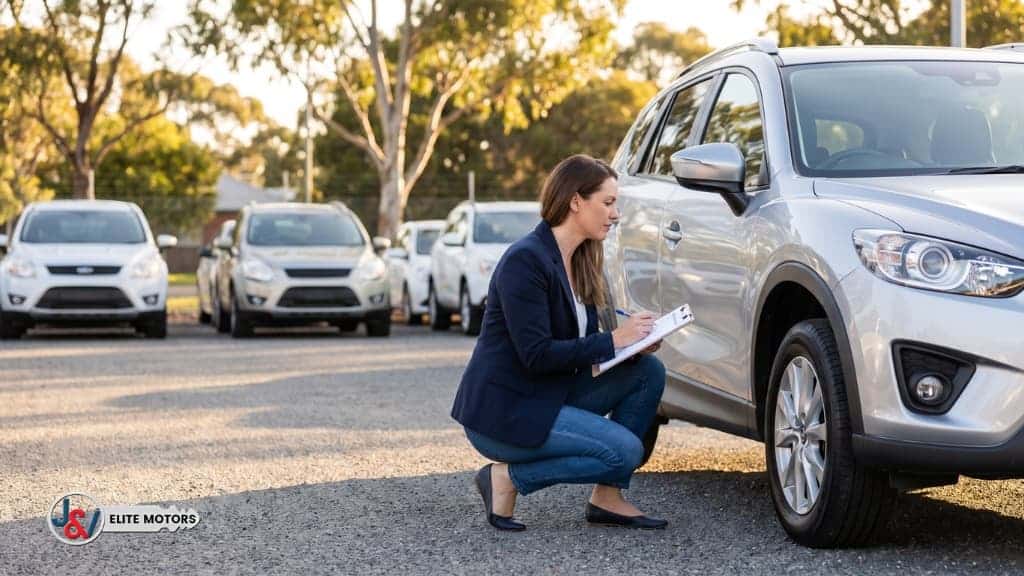
Use our Australian used car buying checklist to inspect, verify and test any car before you pay, PPSR, roadworthy, service history and more. Buy with confidence. Before you buy any used car in Australia, work through five things: run a PPSR check to confirm there’s no money owing, match the VIN and registration, review the full service history, inspect the body and engine for faults, and take a proper test drive. Then confirm your cooling-off rights, statutory warranty and a current roadworthy certificate before you hand over any money. This checklist walks you through every check, in order.
Key takeaways
Do the background checks first. A PPSR check (about $2) reveals money owing, a write-off or a stolen car before you waste time inspecting it.
Match the numbers. The VIN on the car must match the compliance plate, the registration papers and the PPSR result.
Service history is gold. A complete logbook is the single best sign of a well-kept car.
Never skip the test drive. Cold start, brakes, steering, gears, electronics and a proper road, not just the car park.
Know your rights. A licensed dealer gives you a statutory warranty, a roadworthy certificate and (in Victoria) a 3-business-day cooling-off period. Private sales give you almost none of these.
When in doubt, get a pre-purchase inspection from a mechanic or the RACV/NRMA.
Buying a used car is one of the biggest cash purchases most Australians make, and unlike a new car, every used car has a history. Most of that history is good, with a caring owner and a full logbook. But some of it is hidden. Equifax and CarHistory data show that more than 250,000 of the roughly 2.5 million used cars sold in Australia each year, almost 5,000 a week, carry a hidden problem such as being written off, having the odometer wound back, or being reported stolen, at an average cost of about $4,400 to the buyer who gets caught out. The checklist below helps you avoid becoming one of them, whether you’re buying from a dealer or privately. Print it, take it with you, and don’t rush.
What should you check before buying a used car?
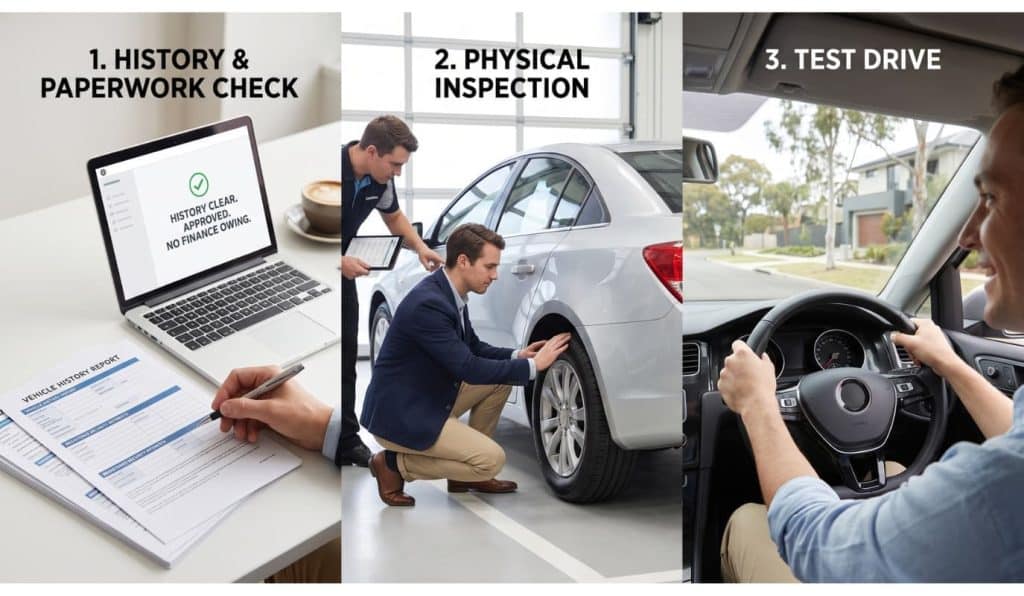
You should check three things, in order: the car’s history and paperwork, its body and mechanical condition, and how it drives.
Start with the background checks, because there’s no point in inspecting a car that turns out to have money owing or a hidden write-off. Think of it as three layers: the paperwork layer confirms the car is legally clean and honestly represented; the physical layer confirms it’s mechanically sound and hasn’t been in a serious smash; the driving layer confirms it feels right on the road. A car has to pass all three before it’s worth your money.
Which checks should you do before you inspect the car?
Do the paperwork and background checks first: a PPSR check, a VIN match and the service history, because they cost little, take minutes and can save you thousands.
There’s no point in driving across town for a car that has money owing on it.
How do you run a PPSR check?
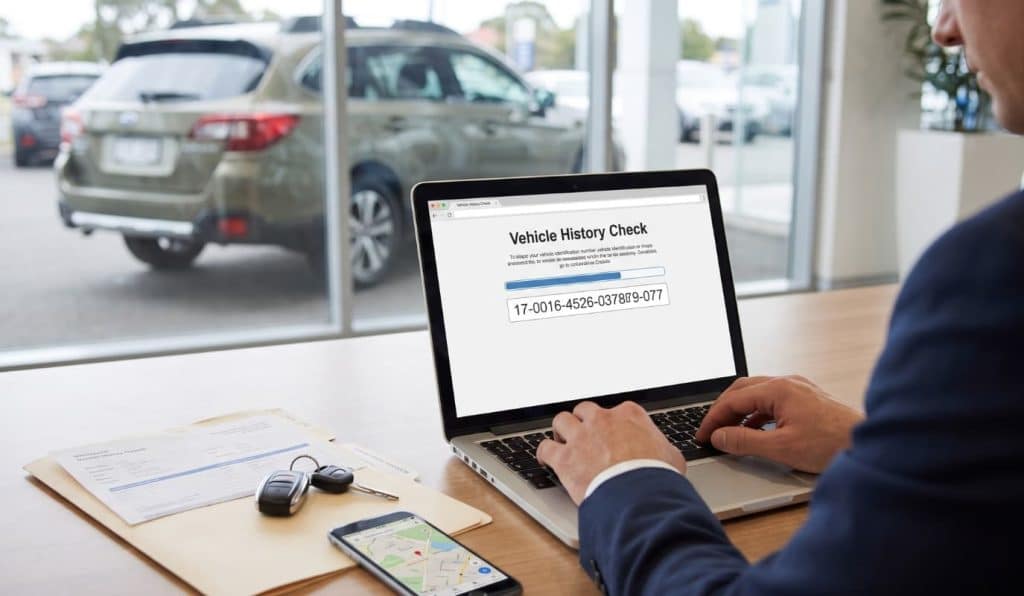
Search the Personal Property Securities Register (PPSR) with the car’s VIN. It costs about $2 and shows whether the car has money owing, has been written off, or has been reported stolen.
Use the official ppsr.gov.au site. This is the most important check you can make, because if you buy a car that still has finance owing, the lender can repossess it even after you’ve paid the seller in full. Your certificate confirms there is no encumbrance, the car is not recorded as a write-off, and it is not listed as stolen. Keep it as proof.
From the yard: We run a PPSR check on every car before it goes on our lot, and we still occasionally find finance flagged against a trade-in the previous owner had forgotten about. If a private seller won’t give you the VIN to check, that’s your answer; walk away.
How do you match the VIN, compliance plate and registration?
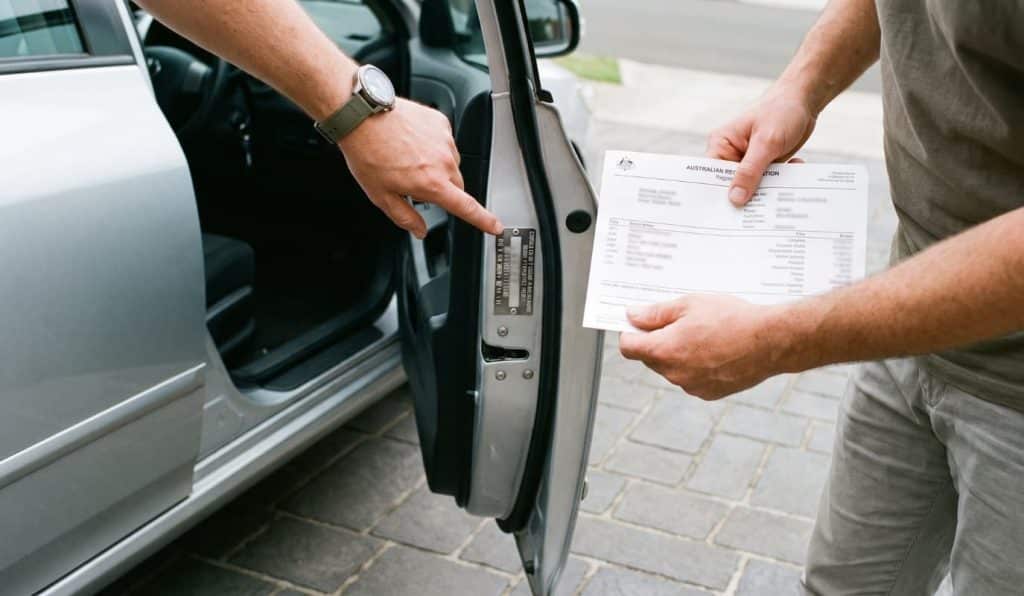
Check that the 17-character VIN is identical on the car’s body, the compliance plate, the windscreen, the registration papers and the PPSR result.
Any mismatch is a serious red flag and can mean a stolen or “re-birthed” car. Find the compliance plate in the engine bay or door jamb. Confirm the registration (rego) is current and in the seller’s name, and check the plates match the papers. You can verify a registration through your state road authority (VicRoads, Service NSW or Queensland’s TMR).
Why does the service history matter?
A complete service history, by the logbook plus receipts, is the single best sign a car has been looked after, and it must line up with the odometer.
Look for regular oil changes and major services done on time,e timing belts and brakes especially. Odometer tampering is real: it accounts for around 6% of the problem cars flagged in the CarHistory data, so treat a reading that doesn’t match the wear as a reason to dig deeper.
How do you inspect a used car's body for damage?
Inspect the car in daylight and when it’s dry, and look for uneven panel gaps, mismatched paint and rust,t the tell-tale signs of past accident repairs.
Rain and dark hide dents, scratches and filler. Check that panel gaps are even on both sides; uneven gaps suggest crash repairs. Look down each panel in the light for ripples or colour differences that reveal repainting or filler. Open and close every door, the bonnet and the boot to check they line up and latch. Look for rust around the wheel arches, sills, door bottoms and under the boot mat, and check the windscreen for chips or cracks. A few cosmetic marks are normal and give you room to negotiate; structural damage, heavy rust or a hidden repair are reasons to walk away.
What should you check inside the car and its electronics?
Check that every electrical feature works, that no warning light stays on, and that the interior wear matches the odometer.
Turn the key to accessory and check that the dashboard warning lights come on and then go out; a light that stays on (engine, airbag, ABS) needs explaining. Test everything electrical: air-conditioning and heating, windows, central locking, indicators, headlights, wipers, the horn, the screen and every speaker. Check the seatbelts retract and latch, and look and smell for damp carpets, which can signal a leak or past flood damage worth remembering, since write-offs and flood damage make up the large majority of hidden-problem cars. Modern safety features such as autonomous emergency braking (AEB) and reversing cameras are worth having to confirm they work.
What should you check under the bonnet?
Check under the bonnet while the engine is cold, and look for oil or coolant leaks, milky oil and clean, healthy fluids.
Checking cold, before the seller “warms it up for you”, is the only way to hear a genuine cold start and spot fresh leaks. Pull the oil dipstick: the oil should be amber to brown, not milky (a milky look can mean coolant mixing with oil, a costly head-gasket sign). Check the coolant is clean and topped up with no oil floating in it. Inspect belts and hoses for cracks. Underneath, look for chassis rust, a damaged exhaust and fresh undercoating that could mask damage. On a diesel, ask about the diesel particulate filter (DPF) and whether the car does enough highway driving to keep it healthy.
From the yard: The most common trick we see when appraising a private-sale car is a spotless engine bay hiding a slow leak the seller degreased the day before. Look at the ground where the car normally parks, not just the engine.
For help weighing up fuel types before you commit, see our used diesel vs petrol cars comparison.
How do you check the tyres, brakes and wheels?
Check all four tyres and the spare for legal tread (a minimum of 1.5 mm) and even wear, and inspect the brake discs for scoring, uneven wear, or points to alignment or suspension problems.
Tyres and brakes are safety items and an easy bargaining point. Check the tyres are a matching, roadworthy brand and size, and note the age from the four-digit date stamp on the sidewall. Look at the brake discs through the wheels for deep scoring or a heavy lip, and listen for grinding or squealing on the test drive. If tyres or brakes are near the end of their life, factor the replacement cost into your offer.
How do you run a proper test drive?
Drive the car for at least 15–20 minutes over suburban streets, a main road and some highway, starting it yourself from cold, and test the brakes, steering, gearbox and every noise.
A quick lap of the car park tells you almost nothing. The engine should start cleanly without heavy smoke; the brakes should pull the car up straight without pulling, grinding or a spongy pedal; the steering should be straight and not vibrate; and the gearbox, auto or manual, should shift smoothly without slipping, jerking or a slipping clutch. Turn the radio and air-conditioning off for part of the drive so you can hear knocks, whines and rattles. Try a full-lock turn both ways to listen for CV-joint clicks, and test the handbrake on a slight hill.
From the yard: After 20 years of appraisals, the fault we notice first is an automatic that hesitates on the 2-to-3 change once it’s warm. If a gearbox feels lazy or jerky when hot, get it inspected before you buy.
Still deciding on a gearbox? Compare manual vs automatic used cars before you test drive.
What are your rights: cooling-off, warranty and roadworthy?
Your protections depend on whether you buy from a licensed dealer or a private seller, and in your state, a dealer gives you far more.
Buying privately means you carry almost all the risk yourself.
Is there a cooling-off period?
In Victoria, a licensed dealer sale gives you three clear business days to change your mind, but you lose it if you take delivery of the car in that time.
The dealer can keep the greater of $100 or 1% of the purchase price if you cancel. Cooling-off rules differ across the country, and there is generally no cooling-off period on private sales or auctions. Always confirm the rules with your state’s consumer affairs body before you sign.
Do you get a statutory warranty?
A licensed dealer must provide a statutory warranty on eligible cars in Victoria and NSW that are cars under 10 years old and under 160,000 km, covered for 3 months or 5,000 km, whichever comes first.
It doesn’t apply to private sales. Thresholds and periods vary by state (Queensland, WA and SA all have their own rules), so check your local requirements. This is separate from your rights under the Australian Consumer Law, which apply to dealer purchases regardless.
Do you need a roadworthy certificate?
Most states require a current roadworthy certificate, a safety certificate in Queensland, or an eSafety “pink slip” inspection in NSW before a used car can be sold or re-registered.
It confirms the car meets minimum safety standards. If you buy privately without one, you may need to arrange and pay for the inspection and any repairs yourself, so factor that in.
If you’re spreading the cost, our guide to how car finance works in Australia explains your options.
Dealer vs private: your rights at a glance
Your protection | Licensed dealer | Private seller |
|---|---|---|
Statutory warranty | Yes (if car is eligible) | No |
Cooling-off period | Yes, in some states (e.g. VIC) | No |
Roadworthy certificate provided | Usually yes | Often, you don’t arrange it |
Guaranteed clear title | Backed by the dealer | You must verify via PPSR |
Australian Consumer Law | Applies | Limited |
Should you get a pre-purchase inspection?
Yes, if you’re not confident mechanically, or the car is expensive or high-kilometre, a pre-purchase inspection is cheap insurance.
For a few hundred dollars,s an independent mechanic or a mobile service such as the RACV, NRMA, RACQ or RAC will put the car on a hoist and find faults a test drive can’t reveal:l worn suspension, oil leaks, brake wear, DPF condition and electronic fault codes. It often pays for itself, either by uncovering a fault that lets you renegotiate or walk away, or by giving you peace of mind to buy. Buying from a dealer with an on-site service centre like J & V Elite Motors makes this easier, because the car can be checked before you commit.
Is it better to buy privately or from a dealer?
A private sale can be cheaper, but a licensed dealer gives you far more protection: a statutory warranty, a roadworthy certificate, verified clear title and often a cooling-off period.
With a private sale,e you get no statutory warranty and no cooling-off period, and you must do every check in this guide yourself. A reputable dealer costs a little more but has already done many of those checks and stands behind the car, with finance and a trade-in available in the one place. You can browse our used cars or shop by brand to see what that looks like.
On a budget? See our picks for the best used cars under $15,000. Buying for the family? Compare the best used family SUVs and 7-seaters.
How do you negotiate and pay safely?
Negotiate using a RedBook valuation and current listings, and pay by bank transfer or bank cheque so there’s a record of never large amounts of cash.
Use anything your inspection turned up, such as worn tyres or an upcoming major service, to justify a lower offer. For a private sale, only pay once you’ve confirmed the PPSR result, matched the VIN, and completed the transfer of registration paperwork so the car is properly in your name. Get a signed receipt showing the price, date, both parties’ details and the car’s details.
Used car checklist: the 12-point run-sheet (printable)
Use this as your run-sheet on the day every item is covered in detail above.
PPSR check done — no money owing, not a write-off, not stolen.
VIN and compliance plate — match the papers and each other.
Registration — current and in the seller’s name.
Service history/logbook is complete and matches the odometer.
Body and paint — even panel gaps, no rust, no hidden repairs.
Interior and electronics are all working; no warning lights stay on.
Under the bonnet — no leaks, healthy oil and coolant.
Tyres and brakes — legal tread, even wear, discs in good shape.
Test drive — clean start, straight brakes, smooth gears, no odd noises.
Your rights confirmed — cooling-off, statutory warranty, roadworthy.
A pre-purchase inspection is booked if there’s any doubt.
Price checked on RedBook and pay safely with a record.
Used car buying terms explained
A quick plain-English glossary of the Australian terms in this guide.
PPSR — the Personal Property Securities Register, the national database that shows whether a car has money owing, is written off, or is stolen. A search costs about $2.
Encumbrance — money still owing on the car from a loan. If you buy an encumbered car, the lender can repossess it.
VIN — the 17-character Vehicle Identification Number unique to every car; used for PPSR and registration checks.
Compliance plate — a metal plate (usually in the engine bay or door jamb) confirming the car met Australian standards when supplied.
Roadworthy certificate (RWC) — confirms a car meets minimum safety standards; called a safety certificate in Queensland and a pink slip in NSW.
Statutory warranty — a used-car warranty that licensed dealers must provide by law on eligible cars; private sales don’t include one.
Write-off — a car an insurer has declared uneconomical to repair, often after a crash or flood; recorded on the PPSR.
Frequently Asked Questions
What should I check before buying a used car in Australia?
Start with a PPSR check to confirm there’s no money owing, then match the VIN and registration, review the full service history, inspect the body and engine, and take a proper test drive. Finish by confirming your cooling-off rights, statutory warranty and a current roadworthy certificate before you pay.
How much does a PPSR check cost?
A PPSR search costs about $2 on the official ppsr.gov.au website and needs only the car’s VIN. It’s the cheapest and most important check you can make, because it reveals money owing, a written-off history or a stolen car.
Is there a cooling-off period when buying a used car?
It depends on the state and the seller. In Victoria, a licensed dealer sale comes with a three-business-day cooling-off period (lost if you take delivery early). There is generally no cooling-off period on private sales or auctions.
Do I get a warranty on a used car?
From a licensed dealer, yes, eligible cars come with a statutory warranty. In Victoria and NSW, that usually means cars under 10 years old and under 160,000 km, covered for 3 months or 5,000 km. Private sales come with no statutory warranty.
Should I get a pre-purchase inspection?
Yes, if you’re not confident mechanically or the car is expensive. An independent mechanic or the RACV/NRMA will check the car on a hoist for faults a test drive can’t reveal, usually for a few hundred dollars.
What are the biggest red flags when buying a used car?
Money owing on a PPSR check, mismatched or tampered VINs, a warning light that stays on, milky engine oil, uneven panel gaps or fresh paint hiding repairs, rust, and a service history that doesn’t match the odometer.
Is it safer to buy from a dealer or privately?
A licensed dealer gives you more protection,n a statutory warranty, a roadworthy certificate, a verified clear title and often a cooling-off period for a slightly higher price. A private sale can be cheaper but carries all the risk.
How do I check if a used car has been in an accident?
Look for uneven panel gaps, paint colour differences, ripples or overspray, and welding or fresh underseal. A PPSR check flags a recorded write-off, and a pre-purchase inspection can confirm structural repairs.