
How Car Finance Works in Australia: The Complete 2026 Guide

How does car finance work in Australia? A plain-English 2026 guide to car loans, rates, credit scores, deposits, novated leases and PPSR checks. Car finance lets you drive away in a car today and pay for it in instalments over time, rather than handing over the full price up front. In Australia, car finance is a regulated credit arrangement, most commonly a secured car loan overseen by ASIC under the National Consumer Credit Protection Act 2009 (NCCP Act). You borrow all or part of the purchase price, then repay it in fixed monthly instalments over a term of one to seven years, plus interest and fees.
This guide explains exactly how car finance works step by step, what interest and comparison rates mean, the credit score you need, the main types of finance available, and how to protect yourself when buying a used car. Whether you are financing your first car or upgrading the family SUV, understanding the process helps you borrow with confidence and avoid paying more than you need to.
Quick answer : Car finance = borrowing money to buy a vehicle and repaying it over time with interest. A secured car loan uses the car itself as collateral, which usually means a lower interest rate than an unsecured personal loan.
What is car finance?
Car finance is any credit product used to pay for a vehicle. In practice, it means a lender pays the seller on your behalf, and you repay the lender over an agreed term. Because it is a form of consumer credit, every lender and finance broker operating in Australia must hold an Australian Credit Licence (ACL) and comply with responsible lending obligations;s they must reasonably verify that repayments will not put you into financial hardship.
If something goes wrong and you cannot resolve it directly with your lender, the Australian Financial Complaints Authority (AFCA) provides a free, independent dispute-resolution service. This regulatory framework, ASIC, the NCCP Act, the ACL and AFCA, is what makes Australian car finance comparatively safe and transparent for consumers.
Secured vs unsecured car loans
The single biggest structural choice is whether your loan is secured or unsecured.
Secured car loan: the car is used as collateral. If you default, the lender can repossess and sell it. Because the lender’s risk is lower, secured loans carry lower interest rates. This is the most common way Australians finance a car.
Unsecured personal loan: no asset is held as security, so you can spend the funds however you like (handy for very old or private-sale cars). Rates are higher and borrowing limits lower because the lender takes on more risk.
How does car finance work, step by step?
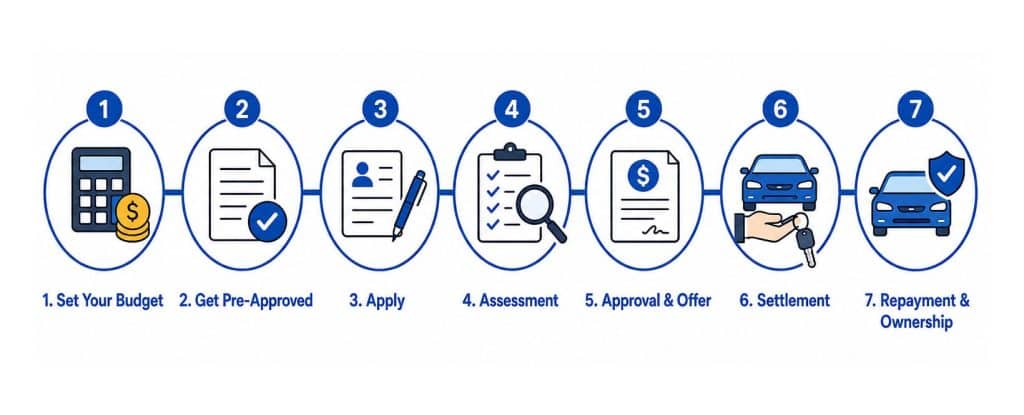
From application to ownership, a typical car finance journey follows seven stages:
Set your budget. Work out what you can comfortably repay each month, factoring in insurance, registration, fuel and servicing, not just the loan.
Get pre-approved. Apply for conditional pre-approval so you know your borrowing limit before you shop.
Apply. Submit a full application with your ID, income and expense details, and the vehicle information.
Assessment. The lender checks your credit score, income, existing debts and living expenses to confirm you can afford the loan.
Approval and offer. You receive a loan contract setting out the amount, interest rate, comparison rate, term, repayments and any fees.
Settlement. The lender pays the dealer or seller, and (for a secured loan) registers its interest against the car on the PPSR.
Repayment and ownership. You repay in instalments over the term. Once the final payment (and any balloon) is made, the lender’s security is removed, and the car is fully yours.
What is pre-approval and why does it matter?
Pre-approval is a conditional green light from a lender that tells you how much you can borrow before you start shopping. It usually takes anywhere from a few hours to a couple of business days, is typically valid for 30–90 days, and gives you the confidence of a buyer with cash in hand. That makes it easier to negotiate on price. Browsing the range of quality used cars at Elite Motors with a pre-approval in place means you can move quickly when you find the right vehicle.
Car finance interest rates and comparison rates explained.
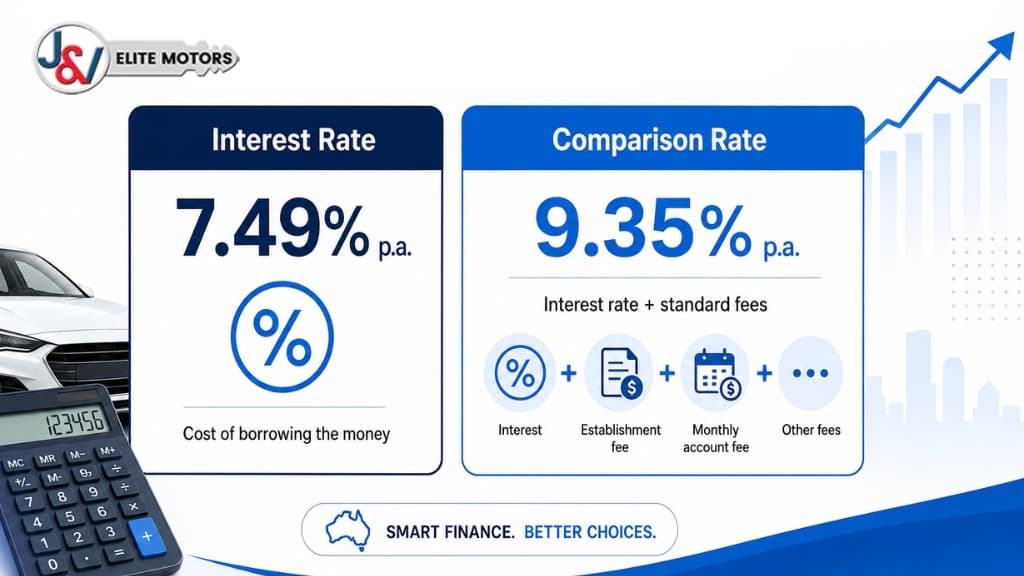
Your interest rate is the single biggest factor in what a car loan actually costs. As of mid-2026, the most competitive secured car loan rates start from around 5.66% p.a. for borrowers with excellent credit, while the broader market for new cars generally ranges from about 5.1% to 10% p.a. The average secured car loan rate for prime borrowers sits near 7.5% p.a., with the all-borrower average closer to 8.9% p.a. Rates edged up through the first half of 2026, so it pays to compare current offers rather than rely on an old quote.
The rate you are offered depends on your credit score, whether the loan is secured or unsecured, whether the car is new or used, the loan term, and the size of your deposit.
What is a comparison rate?
A comparison rate rolls the interest rate together with most standard fees into a single percentage, so you can compare loans on a like-for-like basis. By law, it is calculated on a standard $30,000 loan over five years. Always compare loans by their comparison rate, not the headline rate. A low advertised rate paired with a large establishment fee can produce a comparison rate that is more than a full percentage point higher.
Fixed vs variable interest rates
Fixed rate: your rate and repayments stay the same for the whole term, making budgeting easy. This is the most common choice for car loans.
Variable rate: your rate can rise or fall over the term. Repayments may drop if rates fall, but they can also increase, and your budget needs to allow for that.
What credit score do you need for car finance?
There is no single cut-off score, but a higher credit score unlocks lower interest rates and easier approval. In Australia, Equifax scores run on a 0–1,200 scale (Experian and illion use similar bands). The national average sits around 760, in the “Very Good” range.
Equifax band | Score range | What it means for car finance |
|---|---|---|
Excellent | 853 – 1,200 | Access to the lowest advertised rates |
Very Good | 735 – 852 | Competitive rates from mainstream lenders |
Good | 661 – 734 | Standard products at most lenders |
Average | 460 – 660 | Approval is likely, but at higher rates |
Below Average | 0 – 459 | Specialist or bad-credit lenders only |
Can you get car finance with bad credit?
Yes. Specialist and non-bank lenders (such as Pepper Money and others) offer bad-credit car finance, though you can expect higher interest rates and may need a larger deposit or a guarantor. If your situation allows, checking your credit report, correcting any errors and reducing existing debts before applying can noticeably improve the rate you are offered.
Deposits, loan terms and repayments
How much deposit do you need for a car loan?
Many lenders offer car finance with no deposit at all, funding up to 100% of the purchase price. That said, a deposit of even 10–20% reduces the amount you borrow, lowers your total interest, and can improve both your approval odds and your rate. A trade-in can serve as all or part of your deposit.
How long can you finance a car in Australia?
Car loan terms typically run from one to seven years. A longer term lowers your monthly repayment but increases the total interest you pay over the life of the loan; a shorter term costs more each month but less overall. Choose the shortest term you can comfortably afford.
What is a balloon (residual) payment?
A balloon, also called a residual, is a lump sum, often 0–50% of the car’s price, left owing at the end of the loan. Because you defer part of the principal, your monthly repayments are lower. The trade-off is that you pay interest on that deferred amount for the whole term, so a balloon increases the total interest you pay. When the balloon falls due, you can pay it out, refinance it, or (with some products) trade the car in. Balloons are common on chattel mortgages and novated leases and less so on standard consumer loans.
Types of car finance in Australia
Beyond the basic secured loan, several finance products suit different buyers. Here are the main ones.
Secured car loan
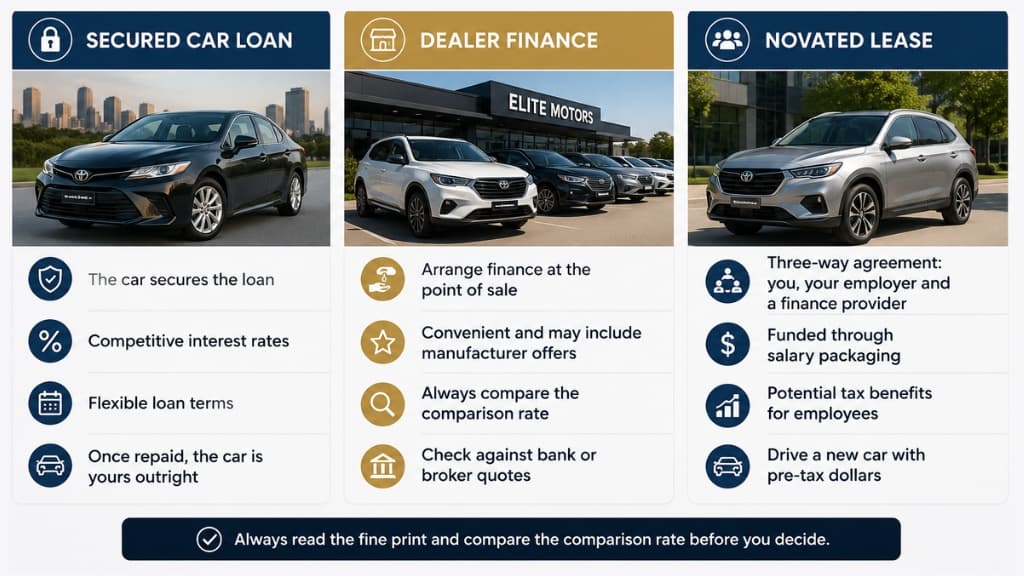
The standard choice for most private buyers. The car secures the loan, rates are competitive, terms are flexible, and once you make the final repayment, the car is yours outright.
Dealer finance
Dealer finance is arranged at the point of sale, letting you choose the car and sort the loan in one visit. It is convenient, and dealers can sometimes access manufacturer offers, but always compare the comparison rate against a bank or broker quote before signing so you know it is genuinely competitive.
Novated lease
A novated lease is a three-way arrangement between you, your employer and a finance provider, funded through salary packaging so repayments come from your pre-tax income. It can be very tax-effective for employees.
 EV buyers, take note: The Electric Vehicle FBT exemption still applies in 2026. Eligible battery-electric and hydrogen fuel-cell vehicles priced under the luxury car tax threshold ($91,387 for 2026–27) can be novated free of Fringe Benefits Tax. Plug-in hybrids have not qualified since 1 April 2025, and a phased wind-back begins in April 2027, but a lease signed now on an eligible EV keeps the exemption for its full term. Always confirm your position with a tax adviser.
Chattel mortgage (for businesses and ABN holders)
A chattel mortgage suits sole traders, companies and other ABN holders using the vehicle mainly for business. You own the car from day one while the lender holds security over it, which means a GST-registered business can generally claim the GST credit on the purchase up front on its next BAS. Eligible small businesses (aggregated turnover under $10 million) may also use the $20,000 instant asset write-off now legislated permanently from 1 July 2026 for qualifying vehicles. Speak to your accountant about how these apply to your circumstances.
Hire purchase and finance lease.
With hire purchase, you hire the car and take ownership after the final payment; with a finance lease, the financier owns the vehicle, and you lease it, often with a residual to buy it out at the end. Both are used more by businesses than private buyers today.
Bank, broker or dealer: where should you get car finance?
Each channel has trade-offs. The right choice depends on your credit profile, how much time you have, and how much you value convenience versus shopping around.
Channel | Best for | Watch out for |
|---|---|---|
Bank/credit union | Existing customers wanting a familiar lender | Only offers its own products |
Finance broker | Comparing many lenders, tricky or bad-credit cases | May charge a broker fee, ask up front |
Dealer finance | Convenience — car and loan in one place | Compare the comparison rate before signing |
Buying a used car on finance: the PPSR check
Before you buy any used car, run a PPSR (Personal Property Securities Register) check. For a couple of dollars, it reveals whether the vehicle still has money owing on it, an “encumbrance.” This matters because if you buy a car that another party has financed, that financier could repossess it even though you paid for it in good faith. A PPSR search also flags if a car has been written off or reported stolen.
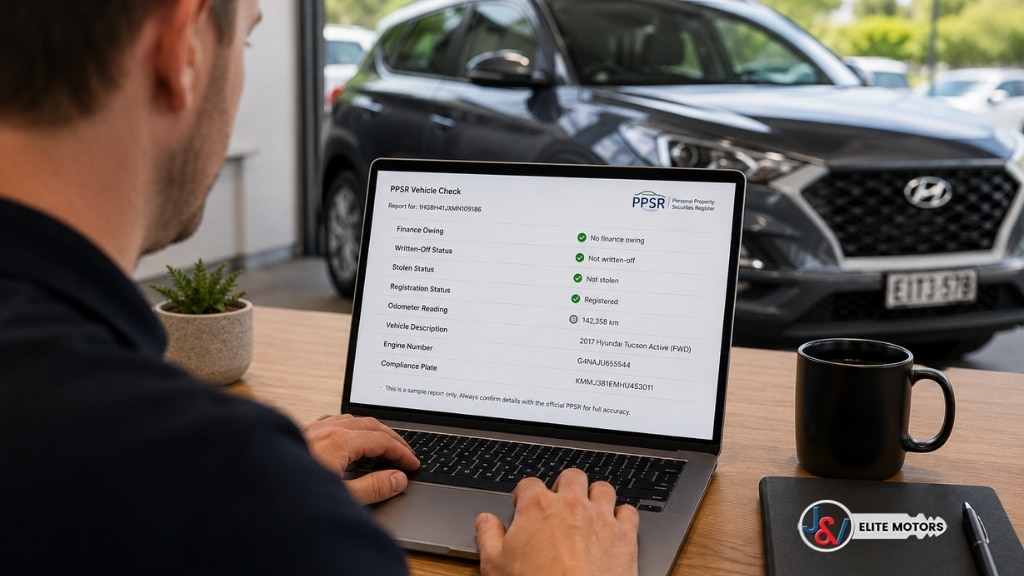 Buying with peace of mind: Reputable dealers provide vehicles with a clear title. When you buy from Elite Motors, the encumbrance and history checks are handled for you, so you are not left carrying someone else’s debt.
What documents do you need to apply for car finance?
Having your paperwork ready speeds up approval. Most lenders ask for:
Proof of identity — driver’s licence and often a second ID
Proof of income — recent payslips, or tax returns and bank statements if self-employed
Employment details and residential history
A summary of your living expenses and existing debts
Vehicle details — make, model, year, VIN and purchase price
For a chattel mortgage: your ABN and business financials
Costs and fees to watch
The interest rate is not the whole story. Keep an eye on:
Establishment fee: typically $250–$600 to set up the loan.
Monthly account fee: a small ongoing charge on some loans.
Early repayment or exit fees: fixed-rate loans may charge a break cost if you pay out early.
Balloon interest: remember you pay interest on any deferred residual for the full term.
Because the comparison rate captures most of these, it remains your best single tool for comparing the true cost of competing loans.
Ready to find your next car?
Understanding how car finance works puts you in control of the deal. When you are ready to put that knowledge to work, explore the latest used cars for sale at Elite Motors and talk to the team about finance options that suit your budget.
Frequently Asked Questions
Is car finance the same as a car loan?
A car loan is one type of car finance. “Car finance” is the umbrella term covering secured and unsecured loans, novated leases, chattel mortgages, dealer finance and hire purchase. A car loan usually refers specifically to a secured or unsecured instalment loan.
Do you need a deposit for car finance?
Not always. Many lenders finance up to 100% of the price with no deposit, but putting money down reduces your interest and can improve your approval and rate.
Can I pay out my car finance early?
Yes. You can pay out a car loan early, though fixed-rate loans may charge an early repayment or exit fee. Ask your lender for a payout figure and check the contract for any break costs before you commit.
How do I check if a car is under finance?
Run a PPSR check using the car’s VIN. It shows whether a lender has a registered security interest (money owing) against the vehicle. Always do this before buying privately.
How long does car finance approval take?
Conditional pre-approval can come through in a few hours, while full approval typically takes from the same day up to about three business days once you have supplied all documents.
What happens at the end of a car loan?
Once you make the final repayment (and pay any balloon), the lender releases its security interest on the PPSR, and you own the car outright. If there is a balloon you cannot pay, you can usually refinance it or trade the car in.