
Trade-In vs Private Sale: What Actually Pays More?
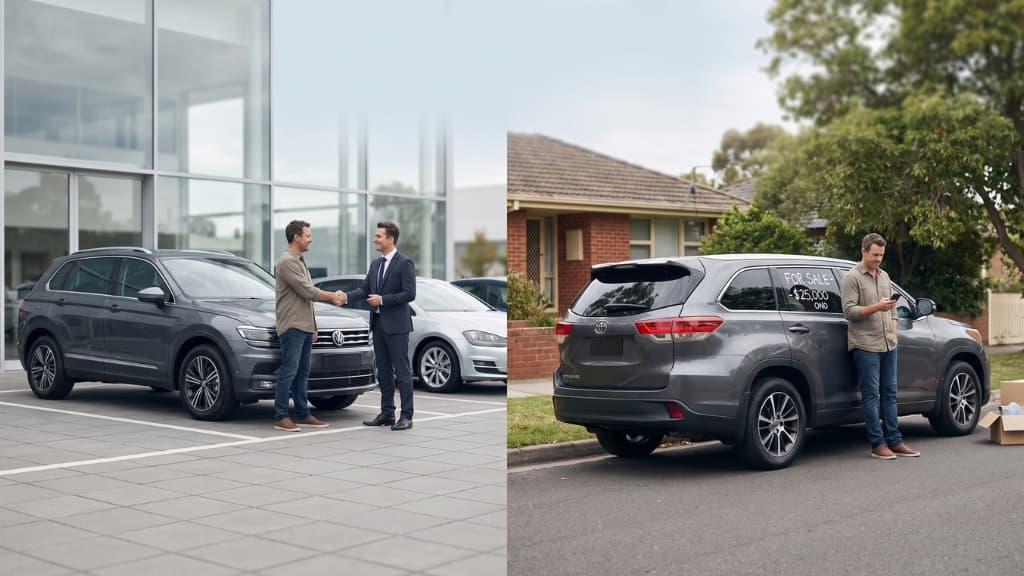
Trade-in vs private sale: a private sale usually pays 10–15% more, but a trade-in is faster and easier. Compare the real costs and get a trade-in quote. A private sale almost always pays more than a trade-in, usually about 10–15% more, which can mean an extra $2,000–$3,000 on a mid-priced car. But a trade-in pays you the same day, with no ads, no strangers and no roadworthy certificate. So the real question in the trade-in vs private sale decision isn’t only which pays more; it’s whether the extra cash is worth the extra time and effort. Getting ready to upgrade? Start with our guide to choosing the right used car.
Key takeaways
Private sale pays more in cash — typically 10–15% more, often a few thousand dollars on a family car.
Trade-in pays more in convenience — it’s same-day, safe, and the dealer handles all the paperwork.
The real gap shrinks once you subtract a roadworthy certificate, advertising, your time and weeks of depreciation.
An instant online offer is a middle option: fast and hassle-free, but rarely beats a well-run private sale.
In Australia, trading in does not usually reduce the stamp duty on your next car.
Rule of thumb: get a trade-in quote first, then judge it against a realistic private price minus your selling costs.
Does a trade-in or private sale pay more?
A private sale pays more money; a trade-in saves more time. Selling privately typically returns around 10–15% more than a dealer trade-in for the same car, roughly $2,000–$3,000 extra on a $20,000 car. A trade-in pays less, but it’s faster, safer and simpler. The right choice depends on how much your time is worth and how quickly you need the money.
How much more does a private sale pay?
As a general guide, expect a private sale to beat a trade-in by 10–15%, which is usually a few thousand dollars on a typical family car. In our experience at J & V Elite Motors in Dandenong, the gap on popular, well-kept models is often narrower than that headline number once a seller factors in a roadworthy certificate, a few weeks of advertising and the time spent showing the car. The premium is real, but it’s a gross figure, not what lands in your pocket.
Why is a trade-in offer lower?
A dealer offers a wholesale price, not a retail price. We have to recondition the car, back it with a statutory warranty, cover it while it sits on the lot, and still resell it at a margin. That’s the reason a trade-in figure sits below what the same car might fetch privately: it isn’t a lowball; it’s the cost of a fast, guaranteed, hands-off sale.
How big is the price gap, really?
The gap is genuine but often smaller than it first looks. Once you count the costs of selling privately, a $3,000 headline difference can quietly become $1,500 or less.
Worked example: the true net difference
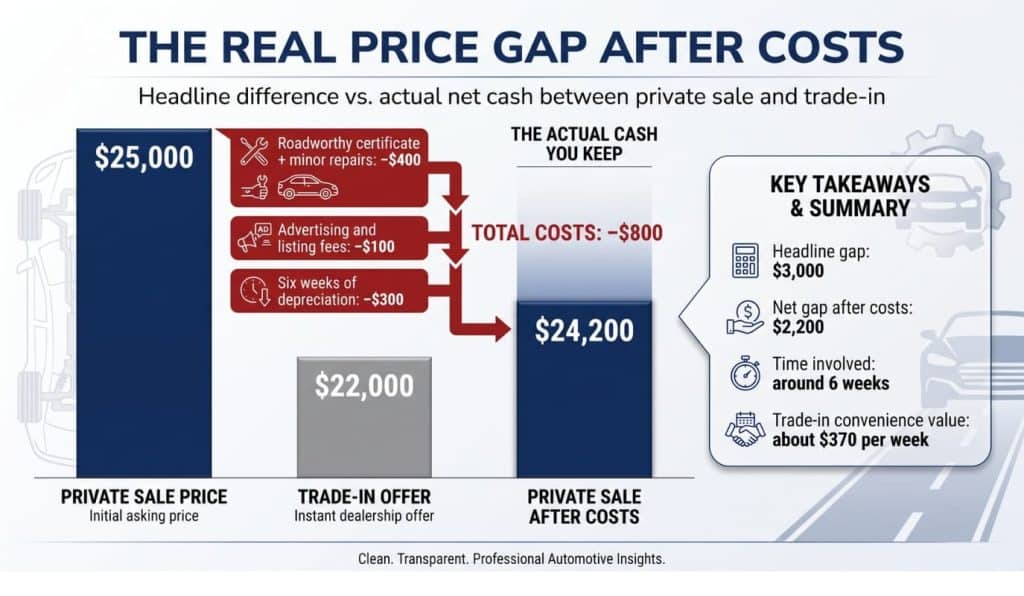
Numbers make the trade-off concrete. Say your car is worth $25,000 privately, and a dealer offers $22,000 to trade in, a $3,000 gap on paper. Now subtract the real costs of selling it yourself:
Roadworthy certificate + minor repairs: −$400
Advertising and listing fees: −$100
Six weeks of depreciation while it’s listed: −$300
Your time (say 12 hours of calls, messages and test drives): your call
That $3,000 gap becomes about $2,200 in cash, spread over six weeks of effort. If the money matters more than the time, sell privately. If not, the same-day trade-in is worth roughly $370 a week in convenience — and many sellers happily take that.
What eats into your private-sale premium
Several costs shrink that premium: an inspection certificate where your state requires one (see the table below), advertising fees, the hours you spend on enquiries and test drives, and the value the car keeps losing while it’s unsold. Net it all out, and the headline gap narrows every week the car sits in the driveway.
Trade-in vs private sale: side-by-side comparison
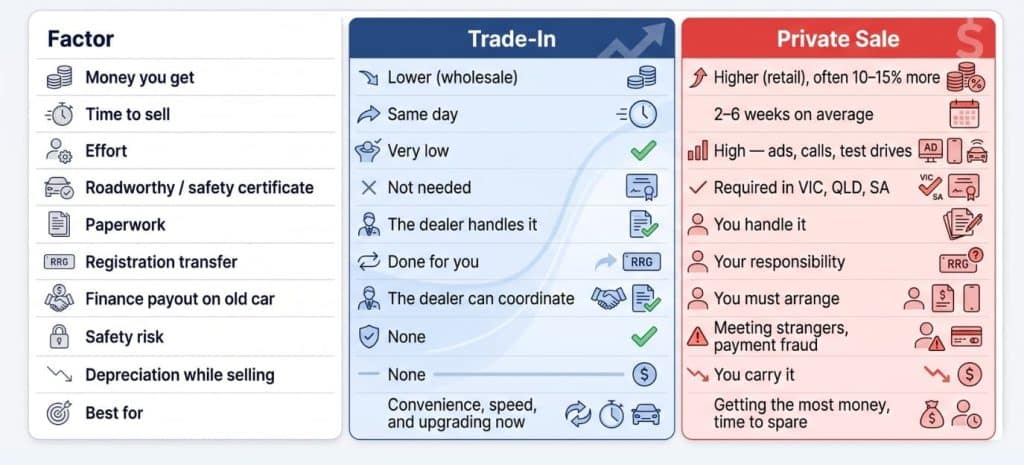
In short: trade-in wins on speed and simplicity; private sale wins on final price. Use the table to weigh what matters most to you.
Factor | Trade-In | Private Sale |
|---|---|---|
Money you get | Lower (wholesale) | Higher (retail), often 10–15% more |
Time to sell | Same day | 2–6 weeks on average |
Effort | Very low | High — ads, calls, test drives |
Roadworthy / safety certificate | Not needed | Required in VIC, QLD, SA |
Paperwork | The dealer handles it | You handle it |
Registration transfer | Done for you | Your responsibility |
Finance payout on old car | The dealer can coordinate | You must arrange |
Safety risk | None | Meeting strangers, payment fraud |
Depreciation while selling | None | You carry it |
Best for | Convenience, speed, and upgrading now | Getting the most money, time to spare |
How does a trade-in work, and who is it for?
A trade-in is a single transaction: you hand your car to a dealer and put its value straight towards your next car. It suits sellers who value speed and simplicity over squeezing out the last dollar.
The upside of trading in
The win is speed and ease. You skip advertising, buyer screening and test drives. The dealer manages the registration transfer and, if you still owe money, can coordinate the finance payout on your old car. No strangers visit your home, and there’s no roadworthy certificate to arrange, because the dealer takes the car as-is. Browsing for your next car? View the used cars for sale at J & V Elite Motors in Dandenong.
The downside of trading in
You get a wholesale figure, not retail. Trade-in numbers are also easy to blur inside a bigger deal, where a strong trade figure can hide a weaker discount on the car you’re buying. Always agree on the price of the new car first, then negotiate the trade-in as a separate number.
How does a private sale work, and who is it for?
A private sale means advertising the car yourself and selling directly to a buyer, keeping the full retail value minus your costs. It suits sellers who have time and want the most money.
The upside of selling privately
More money is the obvious draw; you capture the retail value a dealer would otherwise keep. You also control the price, the terms and the timing. For popular, well-kept models, private buyers will often pay close to full market value.
The downside of selling privately
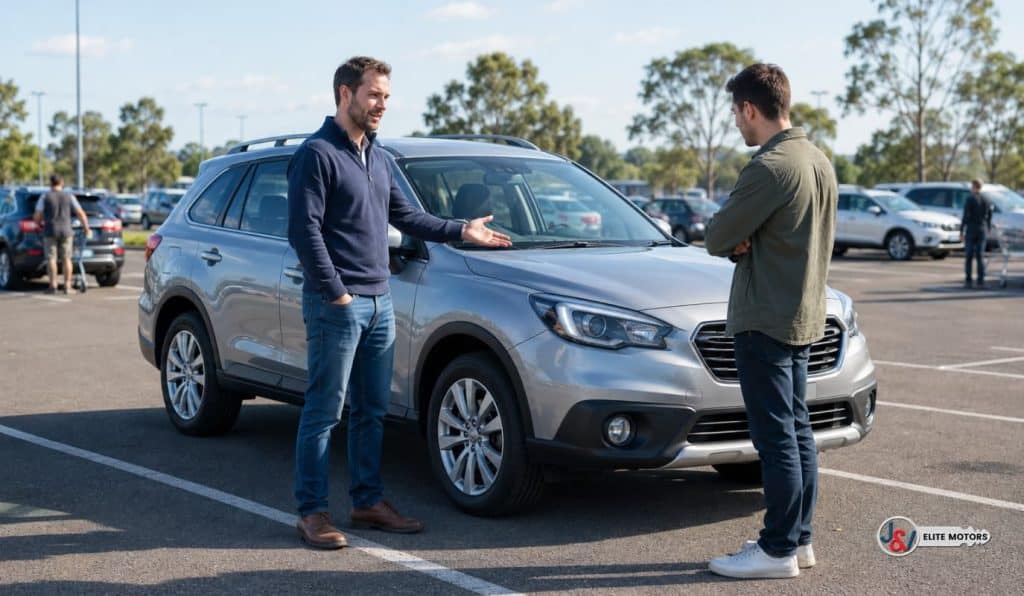
It takes time and effort. A private sale commonly takes two to six weeks, sometimes longer. You’ll handle enquiries, no-shows and lowball offers, and carry the safety and payment risks of dealing with strangers. Meet buyers in a public place in daylight, and only hand over the keys once a bank transfer has fully cleared. The paperwork inspection certificate, registration transfer and any finance owing are yours too.
What about an instant online offer?
Instant online offers are a middle path,h quicker than a private sale, and sometimes a little more than a straight trade-in. Services that buy your car outright will value it online and can pay within 24–48 hours, handling the paperwork for you.
The catch is that, like a trade-in, they still buy at a wholesale price, so the offer usually lands below a well-run private sale. They also work best on mainstream, in-demand models. Treat an instant offer as a useful benchmark: get one, get a dealer trade-in quote, and compare both against a realistic private price. If you’re upgrading anyway, a dealer trade-in has one edge an instant-cash buyer doesn’t: it rolls straight into your next car and can reduce the amount you need to finance.
What costs and paperwork do most sellers forget?
Four hidden factors decide the real winner: the inspection certificate, GST, stamp duty and depreciation. Counting them is the only fair way to compare.
Do you need a roadworthy certificate? (state by state)
Whether you need an inspection certificate to sell privately depends on your state. A trade-in skips this everywhere the dealer takes the car as-is and handles reconditioning.
State | Certificate needed for a private sale? | Local name |
|---|---|---|
VIC | Yes | Roadworthy Certificate (RWC), under 30 days old |
QLD | Yes | Safety Certificate |
SA | Yes | Inspection certificate (for transfer) |
NSW | No (only at rego renewal for older cars) | eSafety check / “pink slip” |
WA | No, if registration is current | Vehicle examination (only if unregistered) |
TAS | No general requirement | — |
NT | No general requirement | — |
ACT | No, if already registered | Inspection only for unregistered vehicles |
In Victoria, where our yard is based, an RWC costs roughly $150–$250 for the inspection, plus any repairs it flags, and those repairs become your bill in a private sale. Always confirm the current rule with your state road authority before you list.
GST and your tax position
As a private seller who isn’t registered for GST, you don’t charge GST on the sale. A licensed dealer builds GST and margin into the retail price, which is part of why a trade-in offer sits below retail. For most people selling a personal car, there’s no capital gains tax, but check your situation if the car was used for business.
Stamp duty on your next car
Here’s a common myth worth clearing up. In Australia, stamp duty on the car you buy is generally calculated on its full price, not the amount after your trade-in. Unlike some overseas systems, trading in usually does not cut the duty on your new car. Rates and rules vary by state, so confirm with your state revenue office.
Depreciation while you wait
Every week your car sits unsold, it keeps losing value. A private sale that drags on for two months can quietly erode part of the premium you were chasing. A same-day trade-in locks in today’s value with no depreciation risk.
How do you get the best price, either way?
You can narrow the gap from both sides, as a well-prepared trade-in and a well-run private sale each earn more.
How to boost a trade-in offer
Present the car clean and serviced, with the full service history and both keys. Know its market value first using a valuation guide, so you can judge the offer. Negotiate the price of your new car separately from the trade-in, and get more than one dealer to quote. A dealer who wants the sale has room to sharpen the figure.
How to maximise a private sale
Price it against comparable listings, not wishful thinking. Take clear, well-lit photos and write an honest, detailed ad. Fix cheap, obvious faults, and have your inspection certificate, registration papers and service records ready. A car that looks cared-for and comes with proof of servicing sells faster and holds its price.
So which actually pays more — the verdict
Private sale pays more in cash; trade-in pays more in convenience. Choose a private sale if you have the time and patience, and the extra money matters most. Choose a trade-in if you value your time, want to avoid strangers and paperwork, or are upgrading right now.
For many sellers, the smart move is to get a trade-in quote first, then weigh it against a realistic private price minus your selling costs and a few weeks of effort. If the gap is small, convenience usually wins. When you’re ready, the team at J & V Elite Motors in Dandenong can value your car for trade-in and show you what you could upgrade to, and car finance can help bridge any difference.
Frequently Asked Questions
Is it better to trade in or sell my car privately?
It depends on your priorities. A private sale usually pays 10–15% extra but takes weeks of effort. A trade-in pays less but is faster, safer and comes with no paperwork or roadworthy certificate to organise.
How much more do you get selling a car privately?
As a general guide, around 10–15% more than a dealer trade-in, which is often a few thousand dollars on a mid-priced car. That premium shrinks once you subtract selling costs like a roadworthy certificate, advertising and your time.
Why is a trade-in offer lower than the private sale value?
A dealer pays a wholesale price because they need to recondition, warrant and resell your car at a profit. You’re trading some of that value for a fast, hassle-free sale with the paperwork handled for you.
Do I need a roadworthy certificate to trade in my car?
No. When you trade in, the dealer takes the car as-is and handles reconditioning. You generally only need a roadworthy or safety certificate when selling privately in states that require one: VIC, QLD and SA.
Are instant online car offers better than a trade-in?
Sometimes slightly, but not always. Instant buyers still pay a wholesale price, so they usually land below a well-run private sale. They’re fast and easy,y a good benchmark to compare against both a trade-in and a private price.
Does trading in my car reduce the stamp duty on my new car?
Usually no. In Australia, stamp duty is generally calculated on the full price of the car you buy, not the amount after your trade-in. Rules vary by state, so check with your state revenue office.
Do I pay GST when I sell my car privately?
If you’re a private seller who isn’t registered for GST, you don’t charge GST on the sale. Dealers include GST and margin in their retail pricing, which is one reason their trade-in offer sits below retail value.
How long does it take to sell a car privately in Australia?
Most private sales take about two to six weeks, and sometimes longer for slow-moving models. A trade-in, by contrast, is done the same day.
How do I get the best trade-in price?
Clean and service the car, bring the full service history and both keys, and know its market value first. Agree on the price of your new car separately, and get quotes from more than one dealer.
Is it safe to sell a car privately?
It can be, with care. Meet buyers in a public place during daylight, take someone with you, and only hand over the keys once payment has fully cleared into your account.
Can I trade in a car I still owe money on?
Yes. A dealer can coordinate the finance payout and roll any remaining balance into your new purchase. Confirm the payout figure with your lender first, so you know exactly where you stand.