
Buying a Used Hyundai i30: What to Watch Out For on J & V Elite Motors.
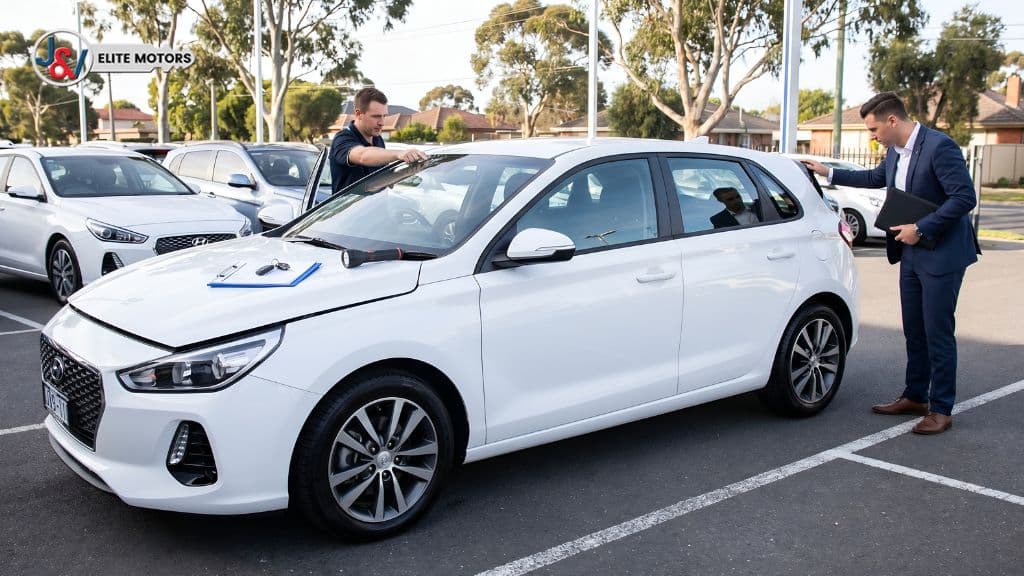
Buying a used Hyundai i30? Learn the common problems, best years, DCT and diesel issues, what to check and how many kilometres is too many - a buyer’s guide. The Hyundai i30 is one of Australia’s most popular small cars, and a used one can be excellent value – if you buy the right example. Most i30s are reliable, cheap to run and backed by a long factory warranty, but a few engines and one transmission have well-documented faults that can turn a bargain into a money pit. This guide walks through the common problems, the best years to buy, and exactly what to check before you hand over any money.
If you’re shopping in Melbourne’s south-east, you can browse our used Hyundai range or view all our current stock to see what’s available.
Key takeaways
Generally reliable: most i30s are well-built and cheap to run, but reliability depends on the variant and service history.
Know the bad combos: avoid uncertainty around the 2.0L Theta II petrol (GD) and test the 7-speed DCT auto for low-speed shudder.
Diesel only for highway drivers: the 1.6 CRDi’s DPF can clog on short city trips – most buyers should choose petrol.
Best buy: a post-2018 PD with the 2.0L petrol and 6-speed auto, with a full logbook.
Always: run a PPSR check, get a pre-purchase inspection and confirm remaining factory warranty (5 years, unlimited km).
Is a used Hyundai i30 reliable?
Yes – the i30 is generally a reliable, well-built small car, and reliability improved with each generation. It consistently rates well with Australian owners for low running costs, a comfortable ride and strong safety. The catch is that a handful of specific engine and transmission combinations have known issues, so reliability depends heavily on which variant you choose and how well it has been serviced.
How long does a Hyundai i30 last?
A well-maintained i30 will comfortably reach 250,000-300,000 km. The petrol engines are robust when serviced on time, and the body and electronics hold up well. Longevity comes down to service history far more than age – a higher-kilometre car with a full logbook is usually a safer bet than a low-kilometre car with no records.
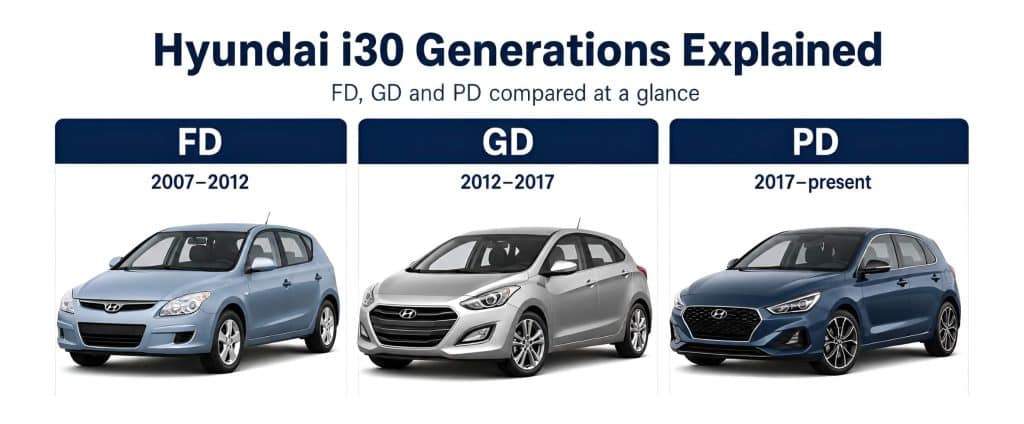
Hyundai i30 generations explained (FD, GD, PD)
The generation you’re looking at determines the engines, features, safety rating and price. There are three to know:
Generation | Years | What to know |
|---|---|---|
FD | 2007-2012 | First i30. 2.0L petrol or 1.6 CRDi diesel. Simple and durable but now old; expect higher wear and basic safety. |
GD | 2012-2017 | Smaller 1.8L petrol replaced the 2.0L. Watch the 2.0L Theta II petrol for engine concerns (see below). |
PD | 2017-present | Current model. Adds 1.4L turbo petrol, 7-speed dual-clutch auto and the sporty N Line / i30 N. Best tech and safety. |
Common Hyundai i30 problems to watch out for
Most i30 faults are tied to a particular engine or gearbox. Here are the ones worth knowing before you inspect a car.
2.0-litre Theta II petrol engine (GD)
The 2.0-litre Theta II petrol used in some second-generation (GD) cars has a known defect: metal debris left from manufacturing can block oil passages and starve the bearings, leading to a knocking noise or, in worst cases, sudden engine failure. Hyundai issued recalls and extended engine coverage in several markets, and the issue is the subject of an Australian class action. If you’re looking at a 2.0L GD, check the VIN against any outstanding recall or coverage and listen carefully for engine knock on a cold start.
7-speed dual-clutch (DCT) shudder
The 7-speed dry dual-clutch automatic (DCT) in PD models can shudder, hesitate or feel jerky at low speed. It’s most noticeable pulling away from a stop or crawling in traffic, and worsens in hot weather. Software updates improved it, but a car that still shudders badly may need clutch work, which is expensive. The 6-speed conventional automatic and the manual don’t have this issue – if you do mostly city driving, they’re the safer choice. Always test drive a DCT car in stop-start traffic before buying.
1.6 CRDi diesel and DPF clogging
The 1.6-litre CRDi diesel is economical and torquey, but its diesel particulate filter (DPF) can clog if the car only does short suburban trips and never gets a highway run to regenerate. A blocked DPF triggers a warning light and limp mode and can be costly to clear. A used i30 diesel suits high-kilometre or regular highway drivers; for short city commutes, a petrol is the smarter buy.
Oil consumption (1.8 petrol and 1.4 turbo)
Some 1.8L (GD) and 1.4L turbo (PD) engines use more oil than expected – sometimes half a litre or more between services. Ask the owner whether they top up oil between services and check the dipstick during inspection. It isn’t always a deal-breaker, but it signals you’ll need to monitor oil levels.
Smaller niggles on PD models
On the current PD i30, owners report the occasional front suspension clunk over bumps, air-conditioning faults, boot-lock failures and infotainment glitches. None are common or catastrophic, but listen and test everything on the test drive.
Are used Hyundai i30 diesels worth buying?
A used i30 diesel is worth it only if you drive long distances regularly. The 1.6 CRDi returns excellent fuel economy and strong mid-range pull, which suits country or highway commuters. But for short, stop-start city trips the DPF can clog and maintenance costs climb. Most buyers are better off with a petrol i30 unless they’re consistently covering high kilometres.
Which Hyundai i30 year is best to buy used?
For the best balance of price, safety and reliability, a post-2018 PD i30 with the 2.0-litre petrol and 6-speed automatic (rather than the DCT) is a strong pick. Among older cars, the GD i30 with the 1.8-litre petrol is sound value – just avoid uncertainty around the 2.0L Theta II engine. Whatever the year, a full service history matters more than the model year itself.
How many kilometres is too many for a used i30?
There’s no hard cut-off. An i30 with 150,000-200,000 km and a complete service history can be a better buy than one with 80,000 km and no records. As a rough guide, an average car covers about 15,000 km a year, so use that to judge whether the odometer reading looks reasonable for the car’s age. Past roughly 150,000 km, budget for wear items like the timing belt (on diesels), suspension bushes, tyres and battery.
What to check when buying a used Hyundai i30
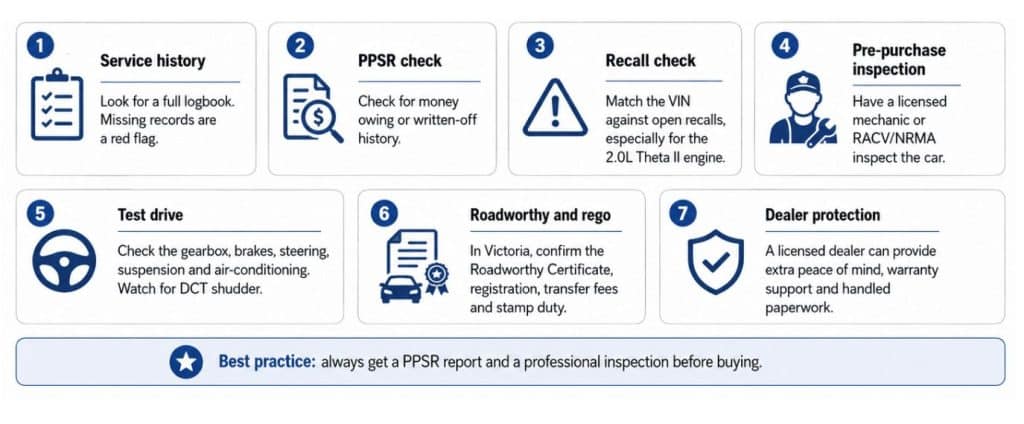
Work through this checklist before you commit to any used i30:
Service history – look for a full logbook. Hyundai’s capped-price servicing makes records easy to verify, and gaps are a red flag.
PPSR check – a Personal Property Securities Register report (a few dollars online) reveals any money owing on the car or whether it’s been written off.
Recall/coverage check – match the VIN against open recalls, especially for the 2.0L Theta II engine.
Pre-purchase inspection – have a licensed mechanic (or RACV/NRMA) inspect the car. It’s the single best way to uncover hidden faults.
Test drive – test the gearbox in traffic (watch for DCT shudder), the brakes, steering, suspension and air-conditioning. Listen for engine knock and check for a DPF/engine warning light on diesels.
Roadworthy and rego – in Victoria the car must be sold with a Roadworthy Certificate (RWC). Confirm registration status and factor in transfer fees and stamp duty.
Buying from a licensed dealer adds protection a private sale can’t. At our Dandenong dealership, every car is sold drive-away with roadworthy, stamp duty and transfer fees handled, plus Australia-wide warranty and an on-site service centre.

Does a used Hyundai i30 still have warranty?
Hyundai’s factory warranty is 5 years with unlimited kilometres, and it transfers to subsequent owners for the remainder of the period. So a 2022 i30 may still have a couple of years of factory cover left. Always confirm the build date and that servicing was done on schedule, as missed services can affect warranty claims. Cars bought from a licensed dealer also come with statutory used-car warranty protection depending on age and kilometres.
How much does a used Hyundai i30 cost in Australia?
Prices vary widely by generation, variant and condition. Older FD and GD hatches typically start in the low-to-mid teens, while newer PD models and well-equipped Elite or Premium grades sit higher. The sporty i30 N Line and i30 N command a clear premium and hold their value well. Check a pricing guide like RedBook to benchmark a fair figure, and remember to budget for insurance, servicing and on-road costs on top of the purchase price.
If finance would help, you can explore our car finance options before you start shopping so you know your budget.
Is the Hyundai i30 a good first car?
Yes. The i30 is one of the better first cars on the used market: it’s easy to drive, cheap to run, well-equipped and has a strong ANCAP safety rating on newer models. For a first car or young driver, look for a petrol automatic (6-speed auto over the DCT) with a clean history and remaining factory warranty.
Looking for a used Hyundai i30?
Do your homework, insist on a service history and inspection, and the i30 is one of the safest used buys around. Browse our used Hyundai stock or get in touch to book an inspection at our Dandenong dealership – we’ll help you find an i30 that’s right for you.
Frequently Asked Questions
Is the Hyundai i30 dual-clutch (DCT) transmission reliable?
The 7-speed dry DCT can shudder or hesitate at low speed, particularly in traffic and hot weather. Software updates help, but if you do mostly city driving, choose the 6-speed automatic or manual instead. Always test a DCT car in stop-start conditions.
Is a diesel or petrol used i30 better?
Petrol suits most buyers, especially for city and short-trip driving. Diesel makes sense only if you regularly cover long distances on the highway, where its economy shines, and the DPF can regenerate properly.
Do I need a pre-purchase inspection on a used i30?
Yes – it’s strongly recommended. A licensed mechanic or RACV/NRMA inspection can reveal engine, transmission or accident issues that aren’t obvious on a test drive, and it gives you leverage to negotiate or walk away.
Can I check a used i30 for accident or finance history?
Yes. A PPSR report shows whether the car has money owing or has been recorded as a write-off, and a vehicle history check can flag past accident damage. Always run these before buying privately.