
What Documents Do You Need to Buy a Used Car in Victoria? (2026 Guide)

Quick answer
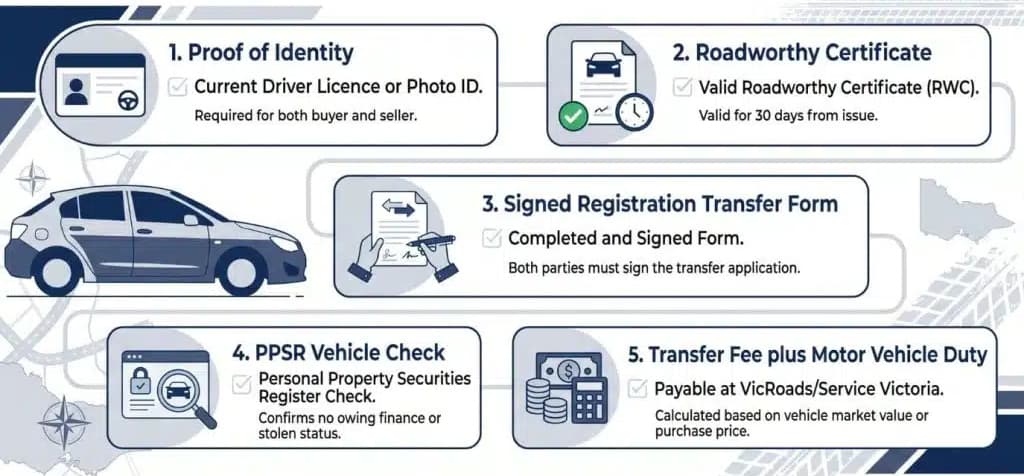
To buy a used car in Victoria, you need proof of identity, the seller's roadworthy certificate (valid for 30 days), a signed transfer of registration form, and payment for the transfer fee and motor vehicle duty. If you're buying from a licensed dealer, you'll also get a contract of sale and statutory warranty. You must transfer registration within 14 days of purchase.
Proof of identity (licence or VicRoads customer number)
Roadworthy certificate (valid 30 days)
Signed transfer of registration form
PPSR check
Transfer fee + motor vehicle duty
This guide covers paperwork specifically. For the full buying process, inspections, test drives, and negotiating,g see our used car buying checklist.
What documents does the buyer need to bring?
Before you hand over any money, get your own paperwork sorted. VicRoads (part of the Department of Transport and Planning) needs to confirm who you are before it will register a car in your name.
Proof of identity
You’ll need either a Victorian driver’s licence or a VicRoads customer number. If you have neither, you’ll need to bring full evidence-of-identity documents, such as a passport and a Medicare card, to a VicRoads Customer Service Centre.
VicRoads customer number
If you’ve registered a vehicle in Victoria before, you’ll already have a customer number. It speeds up the transfer process because your identity is already on file.
Finance payout letter (if applicable)
If you’re trading in a financed car or taking out a loan for the new one, keep your finance payout letter or pre-approval handy. Elite Motors’ finance team can talk you through what paperwork your lender will need.
What documents must the seller provide?
The seller carries most of the legal responsibility for handing over clean paperwork.
Roadworthy certificate (RWC)
Unless the vehicle is exempt, the seller must give you an original roadworthy certificate issued no more than 30 days before the sale date. Without it, VicRoads won’t process the transfer of registration.
Signed transfer of registration form
Both parties fill in and sign the transfer form (or complete it online through myVicRoads). The seller enters the sale details; you add your buyer details.
Guarantee of clear title
This confirms the car isn’t stolen and has no money owing on it under a finance agreement. Licensed dealers are legally required to provide this guarantee; private sellers should confirm it verbally and in writing as part of the contract of sale.
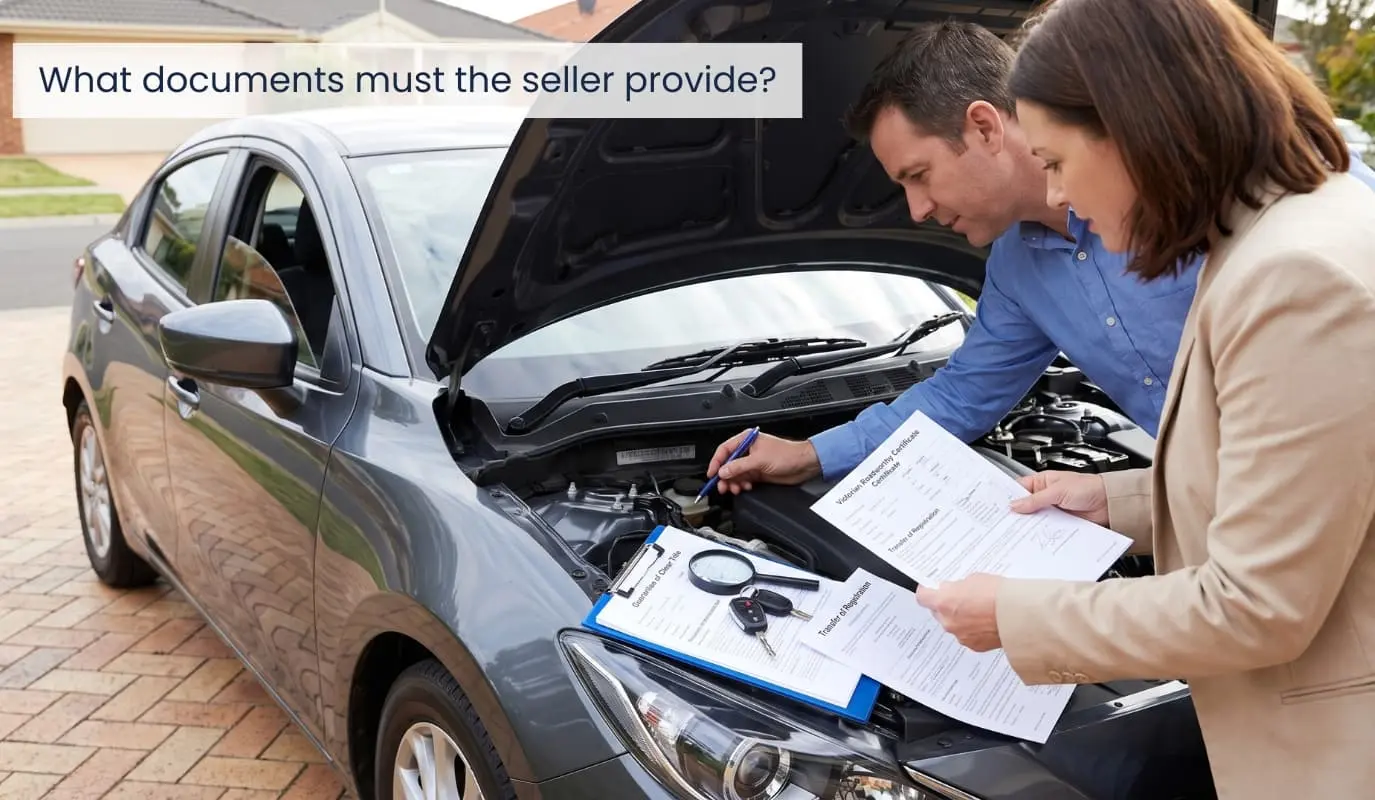
Tip: always check that the vehicle identification number (VIN) on the paperwork matches the VIN plate on the car itself before you sign anything.
How does the roadworthy certificate work?
A roadworthy certificate (RWC) is an independent inspection confirming the car meets minimum safety standards for registration.
How long is it valid?
An RWC is valid for 30 days from the inspection date, and it must still be current on the day you complete the transfer.
When you don't need one
Some transfers are RWC-exempt, such as transfers between spouses or transfers where no change of registered operator occurs. If you’re unsure whether your purchase qualifies, check with VicRoads before settlement.
How do you transfer registration in Victoria? (5 steps)
Once you’ve got the roadworthy certificate and signed paperwork, transferring registration is a straightforward five-step process.
Get the roadworthy certificate from the seller (unless the transfer is exempt). Check the issue date; it must be no more than 30 days old on settlement day.
Complete the transfer of registration form together, either on paper or online through myVicRoads, with the seller entering sale details and you entering buyer details.
Lodge the transfer within 14 days of the purchase date. This is a legal deadline, not a suggestion. Late lodgement can mean fees and ongoing liability for fines linked to the car.
Pay the transfer fee and motor vehicle duty, calculated on the car’s market value using the State Revenue Office’s tiered rates.
Wait for confirmation, which usually takes about seven days, and keep a copy of every document until it comes through.
Should you check the PPSR before buying?
Yes. The Personal Property Security Register (PPSR) tells you whether a car is recorded as stolen or written off, and whether there’s still money owing on it under a finance agreement. A quick search at ppsr.gov.au only takes a couple of minutes and protects you from buying someone else’s debt.
From the yard: in our experience selling used cars in Dandenong, the PPSR check is the step private buyers skip most often, and it’s the one that causes real grief after settlement if there’s finance still owing. Dealers build it into every sale; if you’re buying privately, don’t skip it.
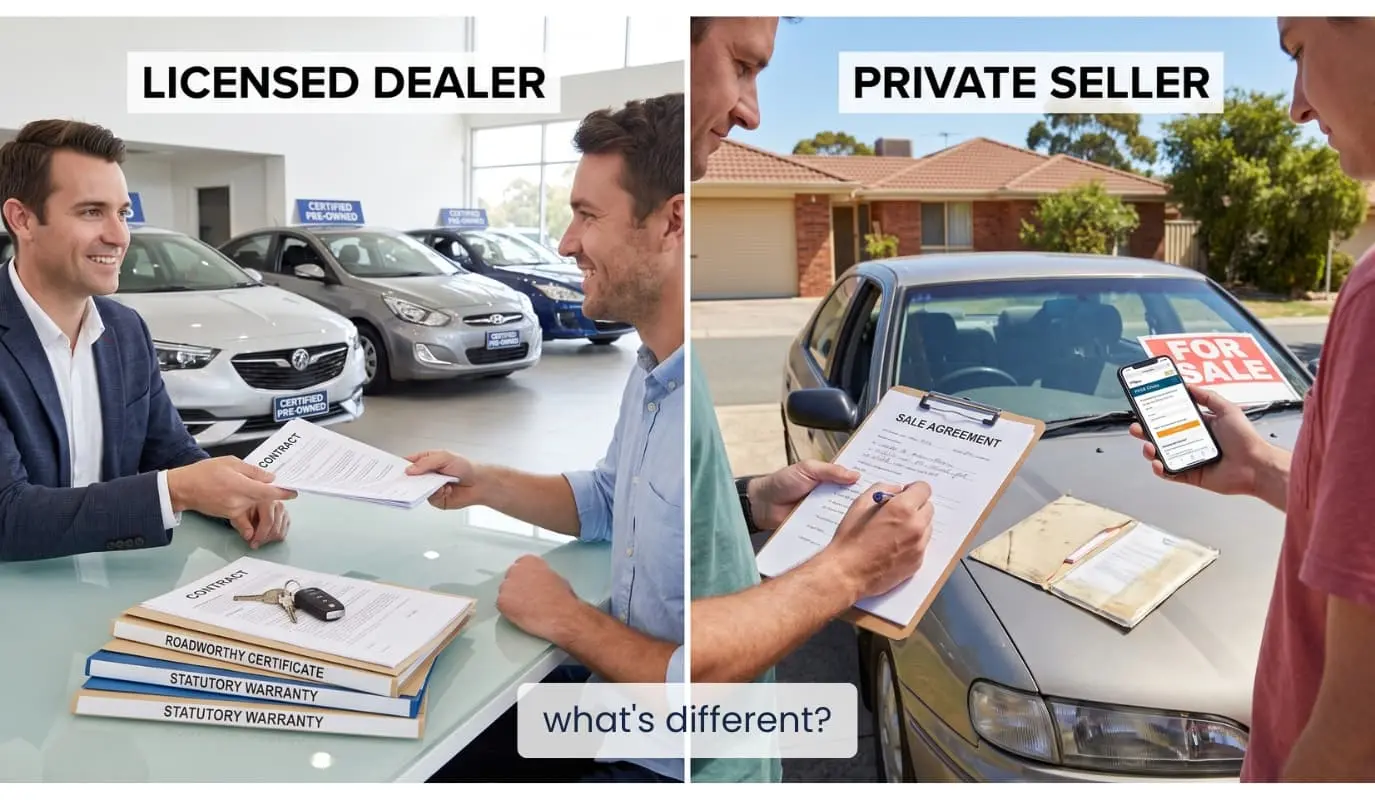
Buying from a dealer vs a private seller: what's different?
Requirement | Licensed dealer | Private seller |
|---|---|---|
Roadworthy certificate | Provided by dealer | Seller must supply (unless exempt) |
Contract of sale | Formal written contract required | Recommended but not legally mandatory |
Statutory warranty | Required (cars under 10 years / 160,000km) | Not required |
Cooling-off period | 3 business days | Not applicable |
Guarantee of clear title | Legally required | Should be confirmed in writing |
PPSR check | Usually done by the dealer | Buyer’s responsibility |
What extra documents matter if you're financing the car?
If you’re taking out a car loan, keep these on hand too: your loan pre-approval or finance contract, comprehensive car insurance details (most lenders require this before settlement), and your ID documents for the lender’s own checks. Sorting finances before you start browsing listings makes settlement day much smoother. Read our guide on how car finance works in Australia for the full picture.
Frequently Asked Questions
What documents do I need to buy a used car in Victoria?
Proof of identity, the seller’s roadworthy certificate, a signed transfer of registration form, and payment for the transfer fee and motor vehicle duty. Dealer purchases also include a contract of sale and statutory warranty.
How long is a roadworthy certificate valid in Victoria?
30 days from the date it’s issued, and it must still be valid on the day the transfer is completed.
Do I need a roadworthy certificate when buying from a licensed dealer?
Yes, unless the vehicle is exempt. Dealers arrange this as part of the sale.
How much does it cost to transfer registration in Victoria?
You’ll pay a transfer fee plus motor vehicle duty, which is calculated on the car’s market value using the State Revenue Office’s tiered rates.
Is there a cooling-off period for used cars in Victoria?
Yes, but only for dealer purchases for three business days. Private sales don’t include a cooling-off period.
What is a PPSR check and why does it matter?
It’s a search of the Personal Property Security Register that shows if a car is stolen, written off, or still has money owing on it.
What happens if I don't transfer registration within 14 days?
You may face late fees, and you could remain linked to fines or liabilities associated with the vehicle under the previous owner’s details.
Do I need my driver's licence to buy a car?
You need either a Victorian driver’s licence or a VicRoads customer number to complete the registration transfer.