
Buying a Used Car vs New: Pros, Cons and Costs
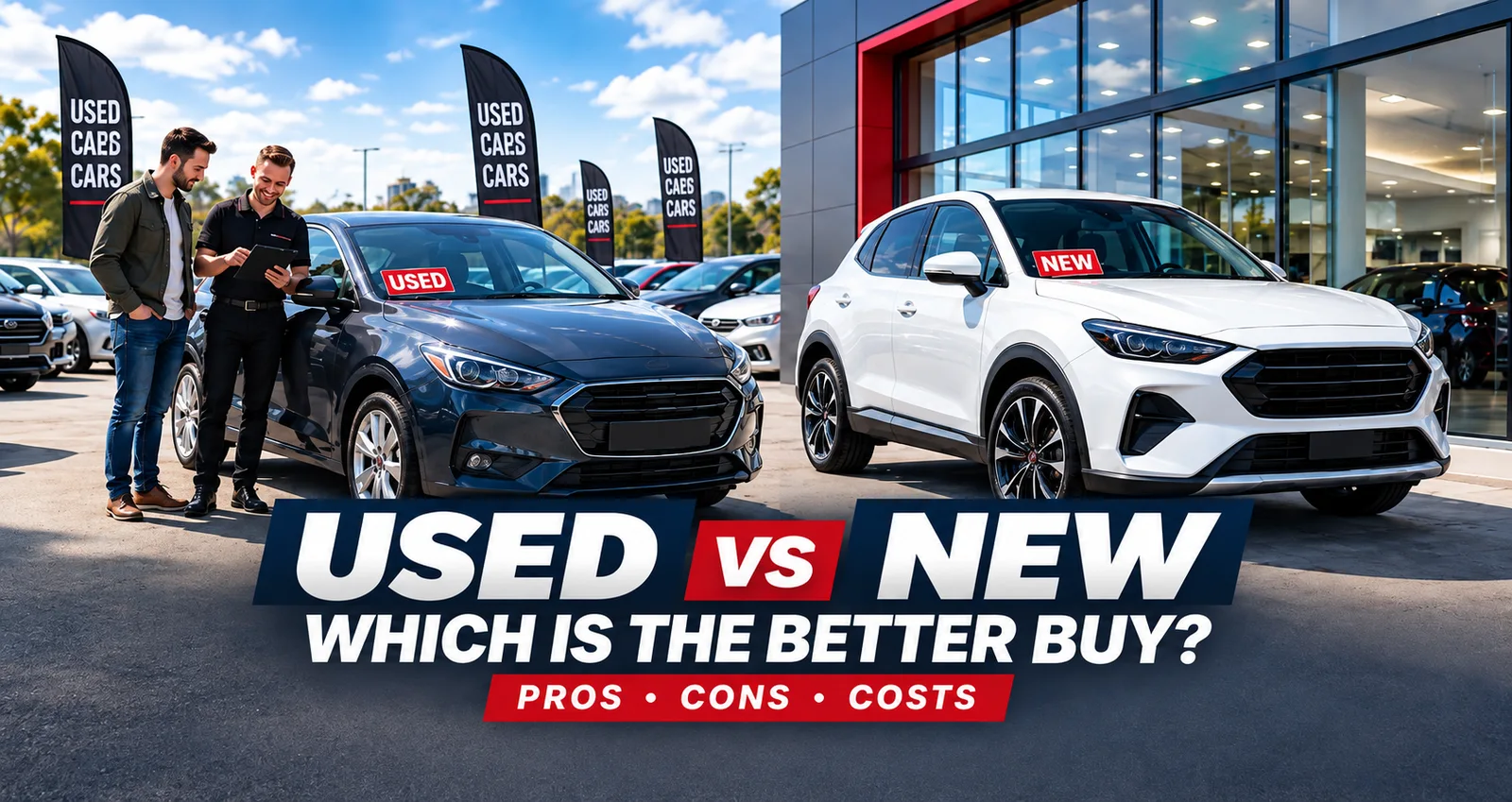
Buy used if you plan to keep the car several years and your budget is set by the total cost of ownership, because the first owner has already absorbed the steepest depreciation. Buy new if you need full warranty certainty, a specific specification, or you cover very high annual kilometres. Depreciation is the highest cost in new car ownership, and the entire reason used cars are cheaper.
Key takeaways
- Depreciation is the highest cost of new car ownership, and the entire reason used cars are cheaper.
- A car three years old has passed the steepest part of the curve, which is why near-new is often the value sweet spot.
- Victorian stamp duty is the same rate new or used: $8.40 per $200 on a passenger car up to $80,809. Buying used lowers the duty because the value is lower, not the rate.
- Compare cost per year, not purchase price. On the worked example in this guide, the used car costs about $11,840 less across five years.
- The main risk of used is unknown history. A PPSR check, service records and a pre-purchase inspection remove most of it.
- A licensed trader brings protections a private seller does not, including a statutory warranty on eligible vehicles.
- Demonstrator, ex-fleet and near-new sit between the two and are often overlooked.
Terms used in this guide
The new versus used decision involves tax, warranty and pricing terms that mean specific things. The table below defines each one.
| Term | What it means |
|---|---|
| Depreciation | The reduction in a vehicle’s value over time. It is a real cost even if you never sell the car. |
| Total cost of ownership | Purchase price plus depreciation, finance, insurance, fuel, servicing, repairs and registration across the time you own the car. |
| Dutiable value | The higher of the purchase price or market value, used to calculate motor vehicle duty. |
| Motor vehicle duty | The Victorian state tax, often called stamp duty, paid when a vehicle is registered or transferred. |
| On-road costs | Duty, registration, the TAC charge and transfer or delivery fees added to the advertised price. |
| Drive-away price | A price that already includes on-road costs. Definitions vary between sellers, so confirm what is included. |
| Luxury Car Tax | A Commonwealth tax of 33 per cent on the portion of a car’s GST-inclusive value above the ATO threshold. |
| Statutory warranty | The warranty a licensed Victorian motor car trader must provide on an eligible used car. |
| PPSR | The Personal Property Securities Register, which shows money owing, written-off status and stolen records. |
| Demonstrator | A vehicle driven by the dealership and already registered, so legally a used car. |
| Near-new | Generally a vehicle one to three years old with low kilometres. |
| LMCT | Licensed Motor Car Trader, the licence a Victorian car dealer must hold. |
| Consumer guarantees | Rights under Australian Consumer Law that apply regardless of any warranty and cannot be excluded. |
| Capped price servicing | A manufacturer programme fixing the price of scheduled services for a set period or number of services. |
| Extended warranty | An optional paid product sold separately from the manufacturer warranty and from consumer guarantees. |
| ANCAP | The Australasian New Car Assessment Program, which publishes crash-test safety ratings. |
| Autonomous emergency braking | A system that brakes automatically when a collision is likely, abbreviated to AEB. |
| Repairable write-off | A vehicle an insurer has written off but which may be repaired and re-registered, subject to state rules. |
| Comparison rate | A loan rate that includes fees, allowing a fairer comparison than the advertised interest rate. |
Why is a used car cheaper than a new one?
A used car is cheaper because depreciation has already happened to it. Depreciation is the highest single cost of owning a new car, larger than fuel, servicing or insurance, and the first owner absorbs most of it.
Australian industry estimates put first-year depreciation at roughly 15 to 25 per cent of the purchase price, with a total loss of around 40 to 50 per cent by the end of year three. Published figures vary widely between sources, brands and models, so treat any single number with caution.
For a government-anchored figure, the Australian Taxation Office applies a depreciation rate of 22.5 per cent on a diminishing value basis for cars used for business purposes. That is a tax rule rather than a market valuation, but it sits inside the range the commercial sources report.
What the sources agree on is the shape rather than the size. The loss is steepest in the first three years and flattens noticeably after that.
Is a three-year-old car the sweet spot?
A car around three years old often represents the best value, because the first owner has absorbed the steepest depreciation while the vehicle still has modern safety equipment and, in many cases, some manufacturer warranty remaining.
This is a general pattern rather than a rule. A three-year-old car with no service history is a worse buy than a five-year-old car with complete records. Judge the individual vehicle.
Do used cars still depreciate?
Yes. A used car continues to lose value, but more slowly, because it is further along the curve. That matters if you plan to resell. It matters less if you intend to keep the car for many years, in which case the annual cost of depreciation is spread thinner the longer you own it.
What do you give up on safety and technology by buying used?
Buying used means accepting the safety and efficiency standards of the car’s build year. This is the strongest argument for buying new, and it is a real trade-off rather than a marketing point.
Safety equipment has changed substantially across recent decades, and the change is not gradual. Certain features became common or mandatory at identifiable points, so a car’s build year tells you a great deal about what it carries.
| Feature | Availability on used cars |
|---|---|
| Anti-lock brakes | Mandatory on new cars in Australia from 2003, so standard on almost anything newer |
| Electronic stability control | Widespread on passenger cars built from the early 2010s onward |
| Curtain and side airbags | Common on later models, but not universal on older or base variants |
| Autonomous emergency braking | Appears on many cars built from the late 2010s, increasingly standard since |
| Lane keeping and blind spot monitoring | Largely confined to newer and higher-specification vehicles |
Check the ANCAP rating for the exact build year rather than the model. Ratings are date-stamped, and a five-star result from 2010 was awarded against a far less demanding standard than a five-star result from 2023.
Fuel efficiency follows the same pattern. A newer car of the same size generally uses less fuel, which offsets part of the price difference over high annual kilometres. That offset is rarely large enough to close the depreciation gap for an average private driver, but it grows with distance travelled.
Are electric vehicles depreciating faster than petrol cars?
Electric vehicles are currently depreciating faster than petrol and hybrid vehicles in Australia. Industry reporting attributes this to frequent manufacturer price cuts on new models and rapid improvements in battery and charging technology, which make earlier EVs less desirable.
For a used buyer, this cuts both ways. Faster depreciation means a used EV can represent unusually good value on purchase price. It also means resale is harder to predict, and battery condition and remaining battery warranty become important checks that do not apply to a petrol car.
This is a fast-moving part of the market. Verify the current position before making a decision based on it.
Which cars hold their value best?
Vehicles with strong reputations for reliability, affordable servicing and steady demand hold value best. In the Australian market, that generally means popular Toyota, Mazda, Hyundai and Kia models, along with in-demand utes and large SUVs.
Several factors beyond the badge affect resale.
Popularity of the specification. Common colours and mainstream variants sell faster than unusual ones.
Kilometres. Above-average distance for the vehicle’s age reduces value.
Service history. A complete logbook is worth real money at resale.
Options. An expensive options package rarely returns its cost when you sell.
Value retention matters in both directions. A car that holds value well costs you less in depreciation, but it also costs more to buy used, because everyone else can see the same thing.
What are the pros and cons of buying used?
Buying used lowers the purchase price and the duty payable, and lets the same budget buy a larger or better-equipped car. It costs you certainty about the vehicle’s history and some or all of the manufacturer's warranty.
| Buying used | Buying new | |
|---|---|---|
| Purchase price | Lower for equivalent specification | Highest |
| Depreciation | Absorbed by the previous owner | You absorb the steepest part |
| Warranty | Remaining factory warranty; statutory warranty may apply | Full manufacturer warranty |
| History | Requires checking and verification | Known from new |
| Safety technology | Depends on build year | Latest available |
| Specification | Limited to what is available | Your choice of colour and options |
| Availability | Immediate | May involve a wait |
| Duty rate in Victoria | Same rate, lower value | Same rate, higher value |
The strongest arguments for buying new
Buying new makes sense when warranty coverage and predictability matter more than price. A full manufacturer warranty with capped price servicing removes most unexpected repair costs for several years. The safety equipment is the newest available, which matters for high-kilometre drivers and families.
New also removes history risk entirely. There is no previous owner, no unknown accident repair and no question about whether the logbook is complete.
The strongest arguments for buying used
Buying used makes sense when the same money buys a materially better car. A budget that reaches an entry-level new small car will often reach a larger, better-equipped used vehicle a few years old.
The savings are not only the sticker price. Lower value means lower duty and often lower comprehensive insurance. Buying from a licensed trader adds protections back, including a statutory warranty on eligible vehicles.
What does a new or used car cost beyond the purchase price?
The advertised price is rarely the amount you pay. Motor vehicle duty, registration, the TAC charge and transfer or delivery fees sit on top unless the price is genuinely drive-away.
How much is stamp duty on a car in Victoria?
Victorian motor vehicle duty on a passenger car is charged per $200 of dutiable value, rounded up to the nearest $200. From 1 July 2026, the rate is $8.40 per $200 for a passenger car valued up to $80,809, which works out to an effective rate of 4.2 per cent.
Higher bands apply above that threshold: $10.40 per $200 between $80,809 and $100,000, $14.00 per $200 between $100,000 and $150,000, and $18.00 per $200 above $150,000. Green passenger cars, meaning those with combined tailpipe emissions of 120 grams per kilometre or less, pay $8.40 per $200 at every value.
Do you pay less stamp duty on a used car?
You usually pay less duty on a used car, but not because the rate is lower. For a passenger car under the threshold, the rate is identical whether the vehicle is new or used. The duty is lower simply because the dutiable value is lower.
This is worth understanding, because it means the duty saving scales with the price difference rather than arriving as a separate discount. A $25,000 used car attracts $1,050 in duty. A $45,000 new car attracts $1,890.
How much are on-road costs in Victoria?
Victorian registration combines a registration fee with the Transport Accident Commission charge, which doubles as compulsory injury cover, so there is no separate CTP insurance to buy. The registration fee is broadly consistent between passenger cars. The TAC charge is the part that moves, because it is set by the risk zone where the vehicle is garaged.
Metropolitan Melbourne sits in the highest risk zone, outer suburbs in the middle, and rural postcodes are the lowest. Reported 2026-27 totals for a 12-month private passenger car registration generally fall between roughly $800 and $960 depending on zone. Use the VicRoads renewal fee estimator for your own postcode rather than relying on a published average.
A transfer fee also applies when a used vehicle changes hands, and a new car purchase may carry a dealer delivery charge.
What is the Luxury Car Tax and does it affect used buyers?
Luxury Car Tax is a Commonwealth tax of 33 per cent applied to the portion of a car’s GST-inclusive value above the ATO threshold, not to the whole value. For the 2025-26 financial year, the threshold was $80,567 for most vehicles and $91,387 for fuel-efficient vehicles.
It is remitted by dealers and importers rather than charged separately to a private buyer, and the thresholds are indexed each financial year. Verify the current threshold with the ATO rather than relying on any article, including this one.
Which costs more over five years, new or used?
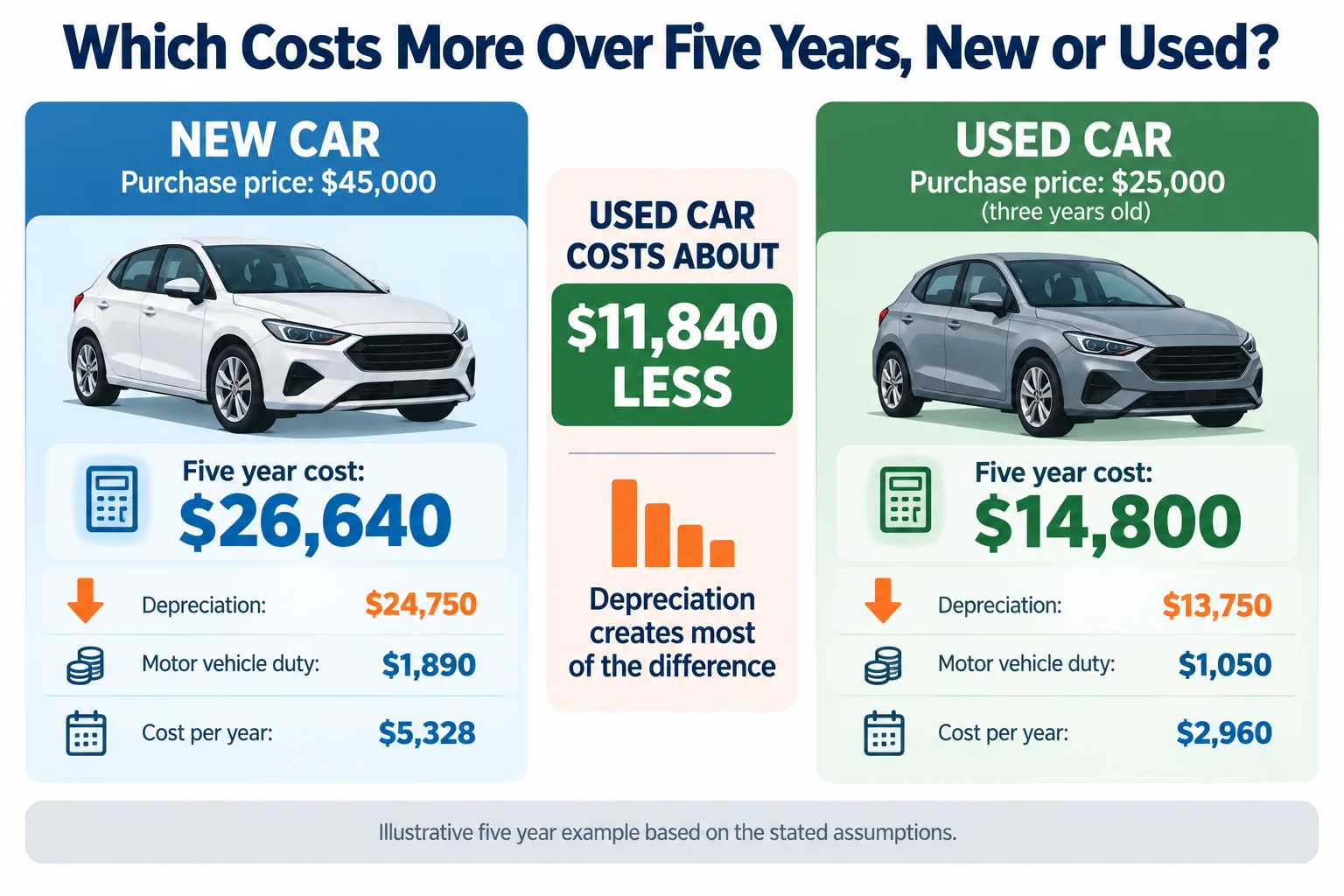
On a like-for-like comparison, a used car usually costs less across five years, and depreciation is what decides it. The example below sets out the arithmetic with every assumption stated.
| Cost across five years | New at $45,000 | Used at three years, $25,000 |
|---|---|---|
| Value retained after five years | $20,250 | $11,250 |
| Depreciation | $24,750 | $13,750 |
| Motor vehicle duty | $1,890 | $1,050 |
| Total | $26,640 | $14,800 |
| Cost per year | $5,328 | $2,960 |
On these assumptions, the used car costs about $11,840 less across five years. Depreciation accounts for $11,000 of that and duty for the remaining $840.
Three caveats matter. The used car will generally cost more in servicing and repairs, which narrows the gap without usually closing it. The new car is under warranty for part of the period, which caps repair risk. And every figure above is an assumption, so changing the retention rate or the purchase prices changes the answer.
The purpose of the example is not the total. It is to show that the sticker price difference of $20,000 is not the real difference, and that depreciation, rather than purchase price, is the number that decides this question.
What to include in your own comparison
Work out each of the following across the period you expect to own the car, then divide by the number of years.
Depreciation, the difference between what you pay and what you could sell it for.
Finance, including interest across the full loan term.
Insurance, which generally falls as vehicle value falls.
Fuel, where a newer vehicle may be more efficient.
Servicing and repairs, where a new car under warranty carries less risk.
Registration and the TAC charge, which apply either way.
A new car usually wins on fuel, servicing certainty and repair risk. A used car usually wins by a wider margin on depreciation. For most private buyers keeping a car several years, the depreciation difference is the larger number.
The exception is high-kilometre drivers. Someone covering very large distances may find warranty coverage and fuel efficiency outweigh the depreciation saving.
What are the risks of buying a used car, and how do you reduce them?
The main risk of buying used is unknown history: previous accident damage, incomplete servicing, money owing on the vehicle, or a written-off record. Each risk has a specific, inexpensive check that removes most of it.
What does a PPSR check show?
A PPSR check searches the Personal Property Securities Register and reveals whether a vehicle has money owing on it, has been written off, or has been reported stolen. Buying a car with finance still owing risks the financier repossessing it, even after you have paid the seller.
Licensed dealers clear this before sale. A private buyer should always run the check personally.
Should I buy from a dealer or a private seller?
A private sale may have a lower asking price, but it comes without a statutory warranty, without a cleared PPSR check, and often without a roadworthy certificate. A licensed motor car trader handles all three and carries obligations under Victorian law.
Price the difference before comparing. Arranging those checks and repairs yourself costs money and carries risk that a dealer absorbs.
What are the red flags when buying used?
Treat the following as reasons to walk away or investigate further: a seller unwilling to allow a pre-purchase inspection, no service history at all, a price well below comparable listings, reluctance to meet at a residential address, or pressure to pay a deposit quickly.
Odometer tampering is harder to spot than it once was, but inconsistencies give it away. Compare the odometer against the service records, the wear on the pedals, steering wheel and driver’s seat, and the kilometres noted on past roadworthy or service invoices.
A repairable write-off is a vehicle an insurer has written off that may be repaired and re-registered under state rules. A PPSR check reveals written-off status. Some repairable write-offs are sound, but they carry lower resale value and warrant an especially thorough inspection.
What warranty protection do you get, new or used?
A new car carries a full manufacturer warranty. A used car may carry the balance of that warranty, a statutory warranty from a licensed trader, or both. Underneath either sits Australian Consumer Law, which applies regardless of any warranty and cannot be excluded.
Does a new car warranty transfer to the next owner?
A manufacturer warranty in Australia generally attaches to the vehicle rather than the original buyer, so the balance usually transfers to a subsequent owner. That is a genuine advantage when buying a car one to three years old, because a five-year warranty can still have years left to run.
Conditions apply. Warranties commonly require servicing to be carried out on schedule to the manufacturer’s specification, and gaps in the logbook can affect a claim. Confirm the start date, the remaining term and the servicing requirements with the manufacturer for the specific vehicle, rather than assuming.
Consumer guarantees under Australian Consumer Law also apply independently of any manufacturer warranty, and cannot be excluded.
Does servicing outside the dealership void your warranty?
No. The ACCC states that an independent repairer can service a vehicle without affecting the consumer guarantees, and warns businesses against misleading statements that consumers must service at a dealer or lose their rights.
Conditions still apply. The work must follow the manufacturer’s schedule, be carried out by a suitably qualified repairer using fit-for-purpose parts, and be documented in the logbook. Warranty repairs themselves, and manufacturer recall work, are generally handled by the dealer.
This matters to the new versus used decision, because independent servicing lowers the running cost of an out-of-warranty used car without weakening your legal position.
What is capped price servicing?
Capped price servicing is a manufacturer programme that fixes the price of each scheduled service for a set period or number of services. It removes uncertainty rather than reducing the total, and it typically applies for a defined term from first registration.
A used car may still be inside that period. Ask whether the programme applies and when it ends, because it affects the running cost comparison.
Is an extended warranty on a used car worth it?
An extended warranty is a separate paid product, not the same thing as a manufacturer warranty or your consumer guarantees. Consumer guarantees under Australian Consumer Law apply regardless of whether you buy one, and can apply after a manufacturer warranty has expired.
Read the exclusions, the claim limits and the servicing obligations before buying. Compare the cost against the realistic repair risk on that specific vehicle, and remember you are not required to buy one to have rights.
What are your rights if a used car breaks down after purchase?
Consumer guarantees under Australian Consumer Law require that goods, including vehicles, are of acceptable quality, safe and fit for purpose. Those rights sit above any warranty, cannot be excluded, and may last longer than a manufacturer warranty.
What counts as acceptable quality takes account of the vehicle’s age, price and kilometres, so the standard applied to a ten-year-old car differs from a near-new one. A statutory warranty from a licensed trader may also apply. Raise the issue with the seller first, then Consumer Affairs Victoria if it is not resolved.
Can you negotiate the price of a used car?
Used car prices are more often negotiable than new car prices, because each vehicle is unique and the seller’s position varies. Research comparable listings for the same model, year and kilometres first, so the conversation starts from evidence rather than a figure you have picked.
Negotiate the total, not the monthly repayment. A lower repayment achieved by extending the loan term or adding a balloon payment can cost more overall. Where a trade-in is involved, ask for the purchase price and the trade-in figure separately, so you can see what each is actually worth.
How many kilometres is too many on a used car?
There is no single figure. Australian private cars often average somewhere around 12,000 to 15,000 kilometres a year, so comparing the odometer against the vehicle’s age gives a rough sense of whether it is high or low for its age.
Condition and documentation matter more than the number. A highway car with complete records at 150,000km can be in better shape than a neglected city car at 80,000km, because highway kilometres are gentler on the driveline and brakes. Judge the records first and the odometer second.
Is a used car cheaper to insure?
A used car is usually cheaper to insure than a new one of the same model, because comprehensive premiums reflect the cost of repairing or replacing the vehicle. A lower value generally means a lower premium.
The savings are not automatic. Repair cost, parts availability, the driver’s age and where the car is garaged all affect the premium, and some older vehicles are expensive to repair relative to their value. Get a quote on the specific car before assuming a saving.
What is the middle ground between new and used?
Demonstrator, ex-fleet and near-new vehicles sit between a brand new car and an older second-hand one. They are frequently overlooked and often represent the best value in the market.
Are ex-demo cars a good buy?
A demonstrator is a vehicle the dealership has registered and driven, usually with low kilometres. Because it has been registered, it is legally a used car, and that has one important consequence: the manufacturer warranty generally started at first registration rather than at your purchase date.
Ask exactly when the warranty began and how much remains. A demonstrator with a year already elapsed is a different proposition to one registered last month.
Are ex-fleet or ex-rental cars worth buying?
Ex-fleet vehicles often carry higher kilometres than a private car of the same age, which is why they are cheaper. The offsetting advantage is that fleet operators usually service strictly on schedule and keep records, because their contracts require it.
Ask for the service history. A documented ex-fleet car with complete records can be a better buy than a private car with gaps.
Is it harder to finance a used car?
Used car finance is widely available, though lenders may apply different terms based on the vehicle’s age. Some lenders limit loan terms on older vehicles or restrict finance beyond a certain age at the end of the loan.
Compare the comparison rate rather than the advertised interest rate, because the comparison rate includes fees. Check whether a balloon payment applies, since it lowers the repayment but leaves a lump sum owing at the end.
How does a novated lease compare with buying used?
A novated lease is an arrangement where an employer makes vehicle payments from an employee’s pre-tax salary. Whether it beats buying a used car outright depends on your marginal tax rate, the vehicle chosen, the residual value at the end of the term, and whether your employer offers the arrangement at all.
It is a tax and salary-packaging question rather than a straightforward price comparison, and the outcome varies significantly between individuals. Seek advice from a qualified adviser or your employer’s salary packaging provider before comparing it with an outright purchase.
Finance is subject to application, eligibility, lender criteria and approval. This is general information and not financial advice.
How should you decide between new and used?
Answer four questions in order. The answers usually settle the decision without further debate.
How long will you keep the car? The longer you keep it, the more depreciation favours buying used.
Does your budget cover the total cost of ownership, or only the purchase price?
How much does warranty certainty matter to your circumstances?
Are you willing to complete the history checks a used purchase requires?
A buyer keeping a car for five or more years, with a budget set by total cost, is usually better served buying used or near-new. A buyer who needs maximum warranty certainty, wants a specific specification, or covers very high annual kilometres has a stronger case for buying new.
How J & V Elite Motors can help
J & V Elite Motors is a family-operated used car dealership in Dandenong, Victoria, holding motor car trader licence LMCT 9914. The business was established by Zia Agahi in 2003. Zia worked as a mechanic before starting the dealership, which shaped how the business approaches vehicle selection and customer questions.
Practical support available at the Dandenong dealership includes:
Browsing all current listings and used car brands online before visiting
Inspections and test drives at 21 to 23 Hammond Road, Dandenong
Vehicle finance enquiries, subject to application, eligibility, lender criteria and approval
Trade-in enquiries on your existing vehicle
Warranty options, which vary by vehicle
Servicing through the dealership’s own service centre after purchase
The website states that stock is pre-inspected through a licensed VicRoads auto repair shop, and the business identifies itself as an approved Australian Warranty Network dealer.
Pricing terms vary between individual listings, so confirm for any specific vehicle whether the advertised price is drive-away or excludes government charges before comparing it with another car.
Buyers in Noble Park, Springvale, Keysborough and Mulgrave are all a short drive from the dealership. You can read more about the dealership, or compare specific models through the used Toyota and used Mazda pages.
Making the decision
Start from the total cost of ownership rather than the advertised price, then decide how much certainty you are buying. Depreciation is the highest cost in new car ownership and the entire reason used cars are cheaper, but the discount comes attached to history risk that only checking removes.
Browse the current used car listings at J & V Elite Motors, then contact the Dandenong team on (03) 9706 8999 to arrange an inspection and test drive.
Frequently Asked Questions
Is it better to buy a new or used car in Australia?
Neither is better in every case. Buying used is better value for buyers keeping a car for several years, because the first owner has absorbed the steepest depreciation. Buying new is better for buyers who need full warranty certainty, a specific specification, or the newest safety technology. Compare cost per year of ownership rather than purchase price.
How much does a new car lose in value in the first year?
Australian industry estimates generally place first-year depreciation between about 15 and 25 per cent of the purchase price. Estimates vary widely by source, brand, model and demand, so treat any single figure as indicative rather than precise.
Do used cars come with a warranty in Victoria?
They can. Consumer Affairs Victoria states that a licensed motor car trader must provide a statutory warranty if the car is less than 10 years old and has travelled less than 160,000 kilometres. The warranty lasts three months or 5,000 kilometres, whichever comes first, and excludes items such as tyres, batteries and audio equipment. Remaining manufacturer warranty may also transfer.
What does drive-away price actually include?
A drive-away price is intended to include the on-road costs, meaning motor vehicle duty, registration, the TAC charge and any transfer or delivery fee. Definitions vary between sellers and individual listings, so ask which charges are included before comparing two advertised prices.
Are used cars more expensive to maintain?
Older vehicles generally need more maintenance than new ones, because wear items reach the end of their life. That cost is usually smaller than the depreciation a new car buyer absorbs over the same period. Service history matters more than age, and a documented car of any age is the cheaper long-term choice.
Does servicing at an independent mechanic void a car warranty?
No. The ACCC states that an independent repairer can service a vehicle without affecting the consumer guarantees, provided the work follows the manufacturer’s schedule, is done by a suitably qualified repairer using fit-for-purpose parts, and is recorded in the logbook. Warranty repairs and recall work are generally still handled by the dealer.
Can I trade in my current car when buying used?
Yes. A trade-in is appraised on age, condition, kilometres, service history and market demand, and the value offsets the purchase price. Ask for the trade-in figure and the purchase price separately, so you can see what each is actually worth.