
Best Used Volkswagen Models: Golf, Tiguan and Passat
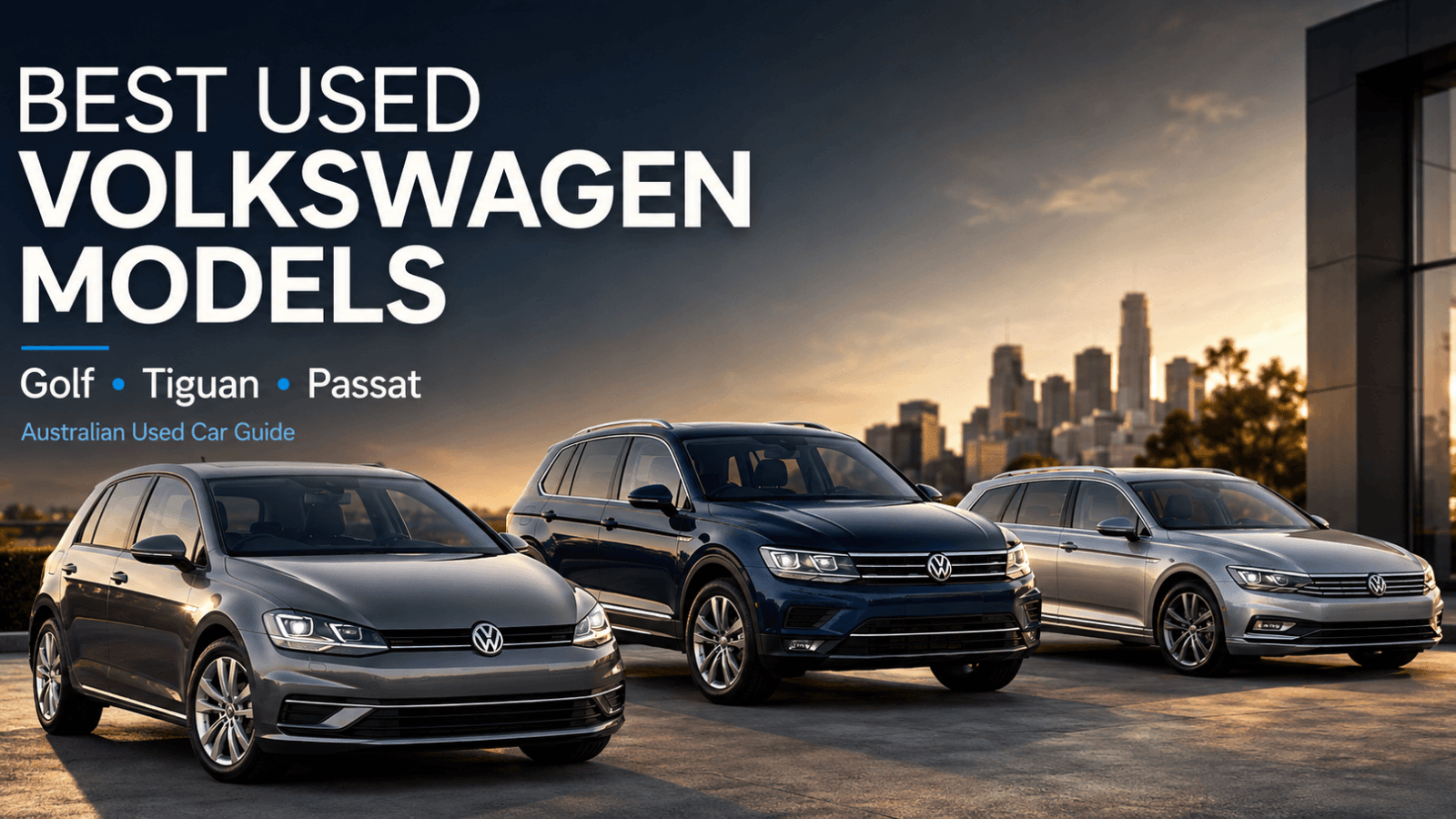
The three best used Volkswagen models for Australian buyers are the Golf, a small hatchback suited to commuting and first cars; the Tiguan, a medium SUV suited to families; and the Passat, a sedan and wagon suited to highway driving and large loads. All three share Volkswagen Group engines and transmissions, so the service history of the individual car decides its quality more than the badge. |
Key takeaways
|
Which used Volkswagen should you buy?
Choose the Golf for the lowest running costs and easiest parking. Choose the Tiguan for a raised driving position and family space. Choose the Passat for the largest boot and the most comfortable highway ride. The table below sets out the trade-off each model asks you to accept.
Model | Body type | Best for | Key strength | Main trade-off |
|---|---|---|---|---|
Golf | Small hatchback | First cars, commuting, city parking | Low running costs, easy to park | Least rear seat and boot space |
Tiguan | Medium SUV | Families, higher seating, towing | Space with a raised driving position | Uses more fuel than a Golf |
Passat | Sedan or wagon | Highway driving, long trips, large loads | Very large boot in wagon form | No longer sold new, so supply is fixed |
These are general strengths of each model line. Individual cars vary by year, variant, condition and history.
Volkswagen terms defined
Volkswagen uses a set of engine, transmission and trim codes that appear on badges and in listings. The table below defines each term used in this guide.
Term | What it means |
|---|---|
TSI | Turbocharged petrol engine. The number before it is power in kilowatts, so 110TSI produces 110kW. |
TDI | Turbocharged diesel engine, named the same way as TSI. |
DSG | Direct Shift Gearbox, Volkswagen’s dual-clutch automatic transmission. |
4MOTION | Volkswagen’s all-wheel drive system. |
MQB | The vehicle platform underpinning the Golf Mk7 onward, the second-generation Tiguan and the Passat B8. |
Allspace | The longer, seven-seat version of the Tiguan. |
Alltrack | The raised Passat wagon with 4MOTION as standard. |
EA189 | The engine code of the 1.6 and 2.0 litre diesel engines involved in the emissions issue. |
Statutory warranty | The warranty a licensed Victorian motor car trader must provide on an eligible used car. |
Roadworthy certificate | The Victorian inspection certificate required to transfer registration. |
PPSR | The Personal Property Securities Register, which shows money owing, written-off status and stolen records. |
Are used Volkswagens reliable?
A used Volkswagen is as reliable as its maintenance record. These are mainstream European cars with known issue areas rather than unusually fragile ones, and the cars that cause trouble are almost always the ones with gaps in their service history. Servicing generally costs more than a comparable small Japanese car, because parts are European and some jobs take longer.
Three things matter more than the model you choose.
Complete service records, showing the work was done on time with the correct oil specification.
Interval-based items, such as the timing belt, DSG fluid and coolant, which follow a schedule rather than luck.
Recall status, which is free to check and free to fix.
Known issue areas
The following are areas worth inspecting, reported across Volkswagen Group petrol and diesel engines of this era. They are not faults present on every car, and a well-maintained example may show none of them.
Timing chain tensioner on some older 1.4-litre petrol engines, heard as a rattle in the first seconds of a cold start.
Water pump and thermostat housing leaks, visible as coolant residue or a dropping coolant level.
Ignition coils, which show up as a misfire, rough idle or flashing engine light.
Oil consumption between services, particularly on higher-output petrol variants.
Diesel particulate filter blockage on diesels used only for short trips.
DSG mechatronic faults, most often on cars whose transmission fluid was never changed.
The two recalls to check on any used Volkswagen
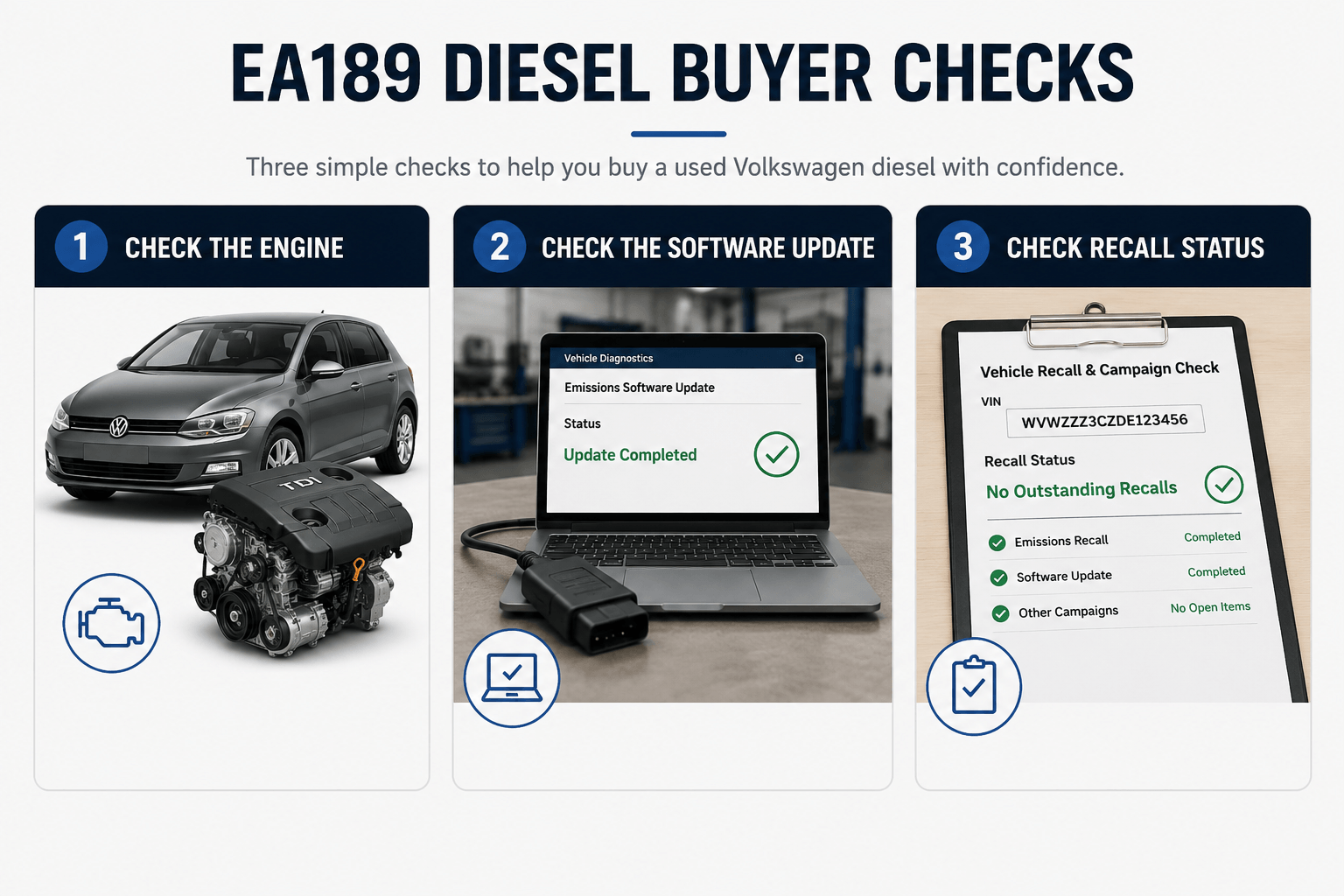
Check the Takata airbag recall and the EA189 diesel emissions programme before buying. Both are free to resolve, and both are checked using the vehicle identification number.
The Takata airbag recall was compulsory. The Assistant Minister to the Treasurer issued a compulsory recall notice on 27 February 2018 for all vehicles with defective Takata airbags, following an ACCC safety investigation. Volkswagen was among the affected brands, alongside Ford, Holden, Mercedes-Benz, Tesla, Jaguar Land Rover, Audi and Skoda. More than 35,800 airbags fitted to the Golf Mk6 built between 2009 and 2013 were covered, and Volkswagen confirmed just over 106,800 of its Australian vehicles were affected. Manufacturers reached a 99.9 per cent completion rate, though the ACCC noted some vehicles remain in the community.
Most cars have long since been fixed. Confirming it costs nothing and takes minutes.
What is the EA189 diesel emissions issue?
EA189 is the engine code of the 1.6 and 2.0 litre Volkswagen Group diesel engines fitted with software that changed emissions behaviour during testing. It affects diesel models only. A petrol Golf, Tiguan or Passat is not involved.
Around 100,000 Australian vehicles across 21 Volkswagen, Audi and Skoda models were affected. The affected Volkswagen models include the Golf, Polo, Jetta, Passat, Passat CC, Eos and Tiguan, along with Skoda’s Octavia, Superb and Yeti. For Volkswagen specifically, the diesel Golf built between 2009 and 2013, and the diesel Tiguan built between 2008 and 2015 were among the vehicles listed.
Volkswagen addressed it and paid for it. The company provided a software update in Australia in December 2016 that removed the two-mode software, and the Federal Court later ordered Volkswagen to pay $125 million in penalties, the highest total penalty ever made by the Court for contraventions of the Australian Consumer Law. A separate class action settled when the Federal Court approved it on 1 April 2020, with Volkswagen paying approximately $120 million to eligible Australian motorists.
What this means for a buyer today
Ask whether the emissions software update was carried out, and ask for proof. The update was free, and most affected cars received it years ago. The settlement is now closed, so a buyer today cannot claim compensation, and the issue should be treated as a service-record question rather than a reason to avoid diesels entirely.
Volkswagen Golf: the small hatch for first cars and commuting
The Volkswagen Golf is a small hatchback and the easiest model in the range to live with day to day. It suits new drivers, single-car households and short suburban trips. Boot space is modest, but the cabin feels solid, and the ride is comfortable for a small car.
Which Golf generation should you look at?
Australian buyers will mostly see three generations on the used market.
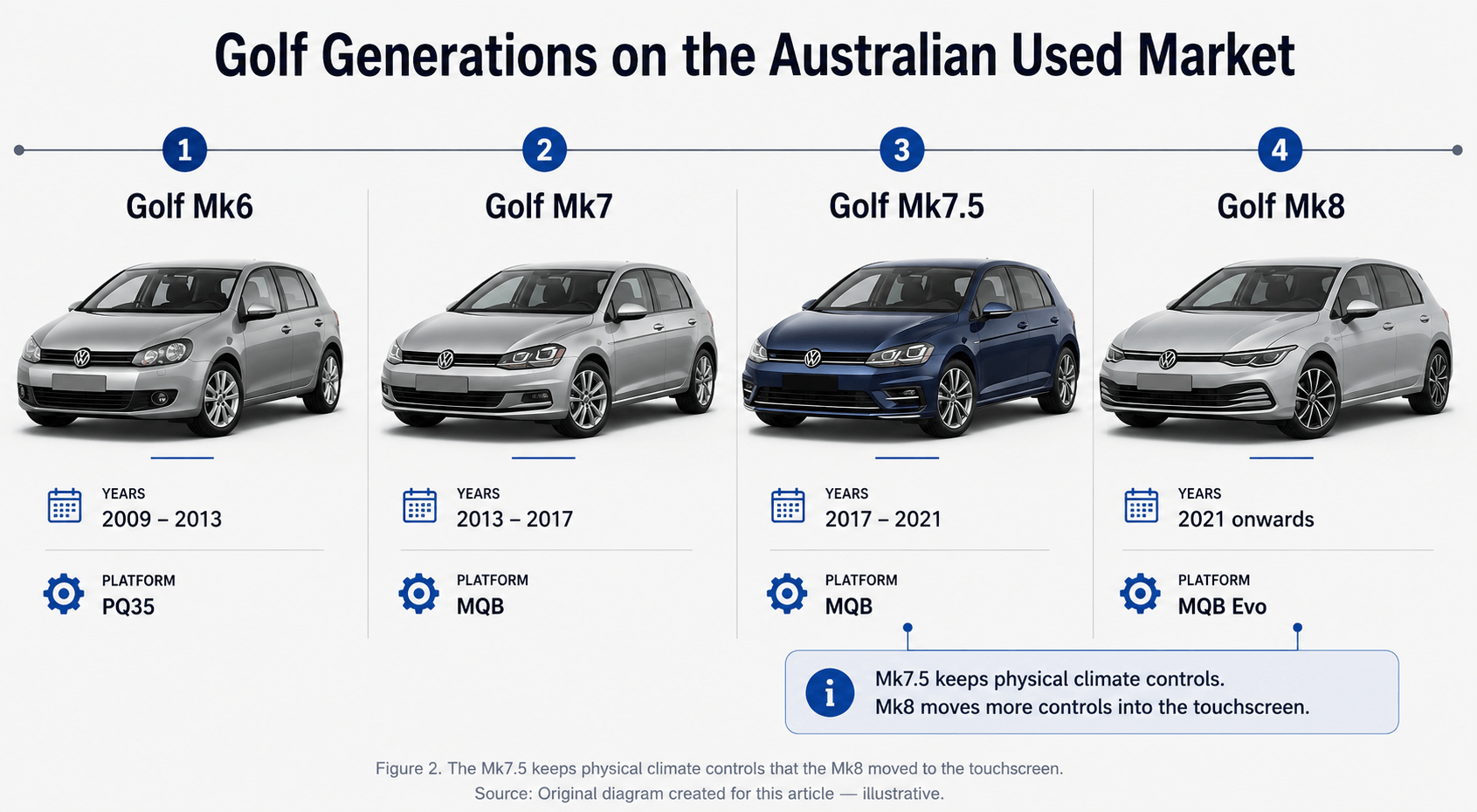
Golf Mk6 (roughly 2009 to 2013). The oldest and cheapest option, built on the earlier PQ35 platform. Many now fall outside statutory warranty age limits, and this is the generation covered by the Takata airbag recall.
Golf Mk7 (2013 to 2020). The first Golf on the MQB platform. Every model in the Australian Mk7 range achieved a five-star ANCAP rating, and an updated version known as the 7.5 arrived in 2017.
Golf Mk8 (2020 onward). Newer technology and a more digital cabin, with most controls moved to the touchscreen.
The Mk7.5 update is often the sweet spot. It is newer than the early Mk7 cars but keeps physical climate controls.
What the Golf badges mean
Volkswagen names variants by engine power in kilowatts. A 110TSI produces 110kW from a turbocharged petrol engine. In the Mk7 range, entry-level cars produced 90kW and were renamed 92TSI from 2015, while the 2.0-litre turbo-diesel produced 110kW. The diesel option disappeared from the Australian Golf range in 2018.
Higher grades such as Comfortline and Highline add equipment rather than power. Check the actual features on the car in front of you, because option packages were common.
Golf GTI and Golf R
The GTI and R are performance versions of the same car. Both use a 2.0-litre turbo petrol engine, and the R adds 4MOTION all-wheel drive. Running costs are higher because tyres, brakes and insurance all cost more. Modified examples carry extra risk, so ask whether the car is standard.
Volkswagen Tiguan: the medium SUV for families
The Volkswagen Tiguan is a medium SUV and the most practical of the three for growing families. It offers a higher seating position, easier access for child seats and more luggage room than a Golf. Petrol and diesel versions were sold in both front-wheel drive and all-wheel drive.
First generation compared with second generation
The first-generation Tiguan is the older, smaller car. The second and current generation arrived in 2016 to compete with family favourites such as the Mazda CX-5 and Toyota RAV4. It moved onto the MQB platform and gained more interior space and newer safety equipment.
The current-generation Tiguan earned a five-star ANCAP safety rating when assessed in 2016, scoring 96 per cent for adult occupant protection. That rating has expired from 2023 onwards under ANCAP’s date-stamping rules. The original test result has not changed, but the rating is no longer treated as current.
Tiguan Allspace and the seven-seat question
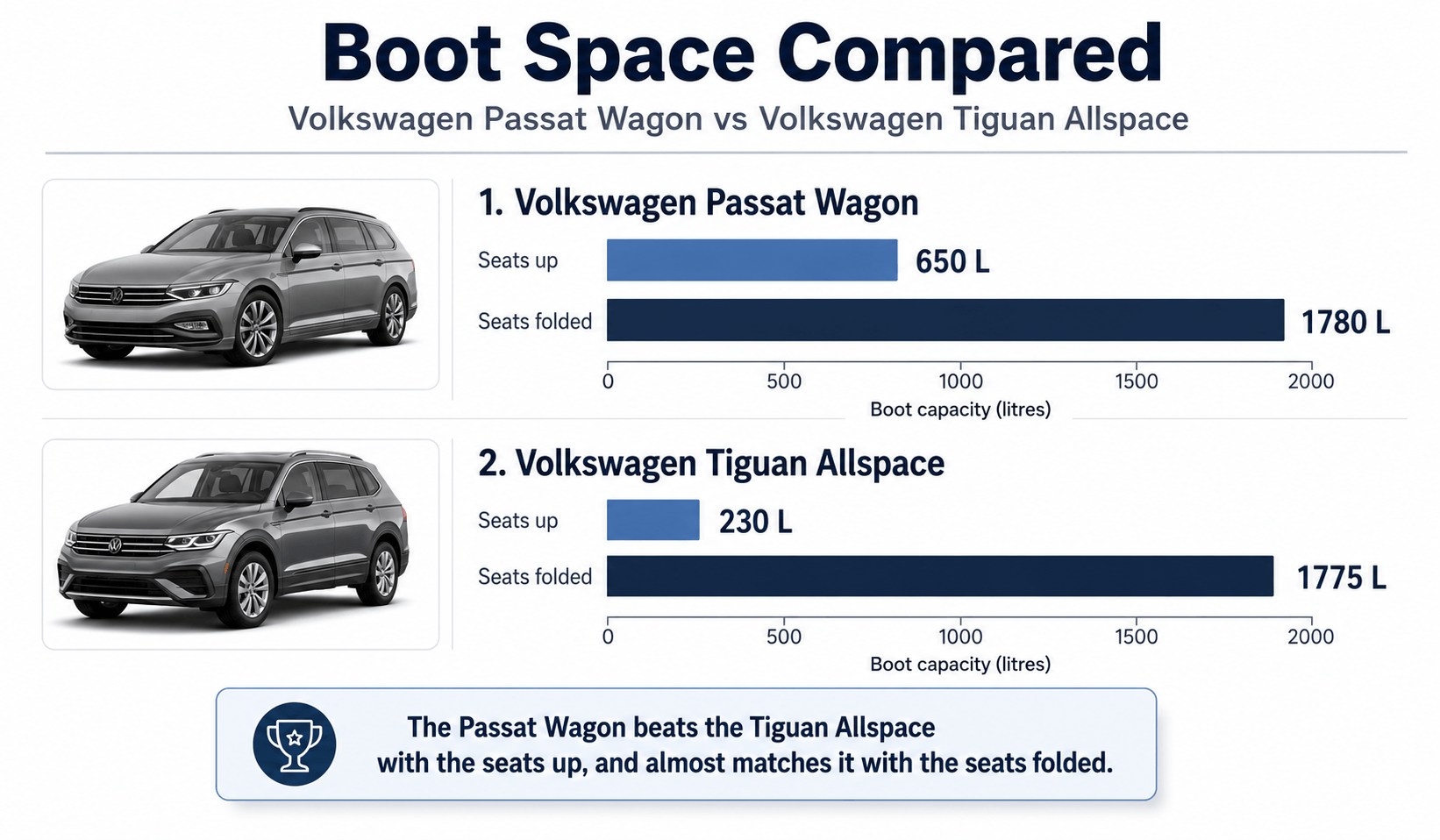
The Allspace is a longer version of the Tiguan with a third row, about 200mm longer than the standard five-seat car. Boot space is 230 litres with all seven seats in use, 700 litres with the third row folded, and 1,775 litres with the second and third rows folded.
Treat the third row as occasional seating. It suits children and short trips rather than adults on long journeys. Buyers who need genuine seven-seat room every day should look at a larger SUV instead.
Towing and 4MOTION
The second-generation Tiguan 132TSI was rated at 2,500kg braked towing capacity, though the effective figure is closer to 1,000kg once the 100kg towball download limit is applied. A high headline number does not always mean you can legally tow a heavy caravan.
4MOTION sends drive to all four wheels. It helps in wet weather and on gravel, adds servicing points and uses slightly more fuel. Confirm the towing capacity and drivetrain on the specific vehicle before making plans.
Volkswagen Passat: space and comfort for highway drivers
The Volkswagen Passat is a medium to large sedan and wagon built for long-distance comfort. It is quiet at highway speed and carries more luggage than most medium SUVs. The wagon is the standout for families who want space without a tall body.
Passat B7 and B8
The B7 is the older model. The B8 was built from 2014, uses the MQB platform, and shares its underpinnings with the Skoda Superb and the Volkswagen Arteon. The B8 feels noticeably more modern inside and offers more driver assistance features on later cars.
Boot space is the Passat’s headline advantage. The Passat wagon offers a 650-litre boot that expands to 1,780 litres with the rear seats folded. Very few medium SUVs match that.
Passat Alltrack
The Alltrack is a raised Passat wagon with 4MOTION all-wheel drive as standard. It suits buyers who want wagon practicality with better traction on unsealed roads. It is not a serious off-road vehicle, so treat it as an all-weather wagon.
Why used Passat supply is limited
The Passat is no longer sold new in Australia. Volkswagen Australia discontinued the entire Passat sedan and wagon range in 2023, along with the Arteon and the Golf wagon, to reduce range complexity. The following-generation Passat wagon was not brought to Australia.
Good examples can therefore hold their value, because supply is fixed. It also means the used market is now the only way to buy one.
TSI or TDI: should you buy petrol or diesel?
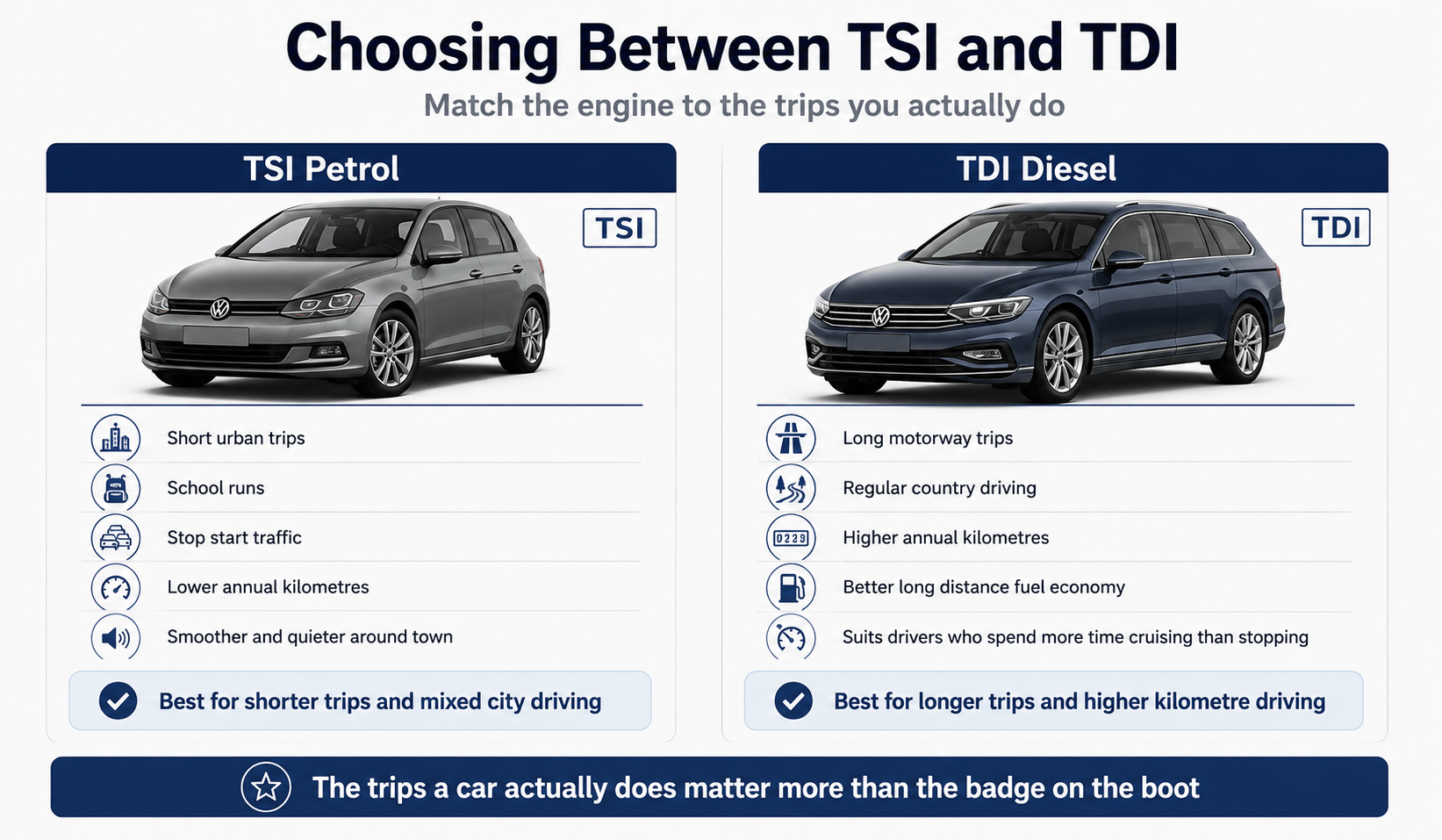
Choose petrol for short suburban trips and choose diesel for regular highway driving. TSI badges indicate turbocharged petrol engines and TDI badges indicate turbocharged diesel engines.
Choose petrol (TSI) for school runs, city commuting and stop-start traffic.
Choose diesel (TDI) for country trips, long-distance driving or towing.
Diesel models use a diesel particulate filter, which needs regular longer drives at higher speed to clean itself. A car used only for short trips can block the filter. Ask about the previous owner’s driving pattern, and ask about the EA189 software update on diesels of the affected years.
Some higher-output petrol variants require premium unleaded. The Tiguan Allspace 132TSI and 162TSI both require 95 RON fuel. Check the fuel flap and the owner’s handbook on the individual car, because the requirement varies by engine.
What is a DSG and should you buy one?
A DSG is Volkswagen’s dual-clutch automatic transmission. It changes gears quickly and uses less fuel than a traditional automatic. It behaves differently at low speed, and some drivers notice slight hesitation when pulling away in traffic.
Two types were used. Six-speed versions generally run a wet clutch. Seven-speed versions in smaller petrol engines generally run a dry clutch. Both need their fluid and filter changed on schedule.
Service records are the important part. Skipped transmission services are a common reason for later problems, and repairs to the mechatronic unit can be expensive. On a test drive, a DSG should pull away smoothly and change gears without shuddering or clunking.
How the Golf, Tiguan and Passat compare with other used cars
Each Volkswagen competes against well-regarded Japanese and Korean alternatives, and J & V Elite Motors stocks a range of brands. The comparison below sets out what you gain and give up by choosing the Volkswagen.
Volkswagen | Common alternatives | What the Volkswagen offers | What the alternative often offers |
|---|---|---|---|
Golf | Mazda3, Hyundai i30, Toyota Corolla | A more settled ride and a solid cabin feel | Lower servicing costs and simpler transmissions |
Tiguan | Mazda CX-5, Toyota RAV4, Kia Sportage | Sharper handling and the seven-seat Allspace option | Longer warranty history and strong resale demand |
Passat | Toyota Camry, Skoda Superb | A very large wagon boot and quiet highway manners | Wider availability and easier parts supply |
Test drive more than one. The right answer depends on how the car feels to you and what condition the individual vehicle is in.
What determines the price of a used Volkswagen?
The price of a used Volkswagen is set by variant, age, kilometres, condition, service history and current demand rather than by the model name alone. Two cars of the same year can sit far apart on price for good reasons.
The main factors are:
Variant and engine. A 110TSI Highline sits above a 92TSI Trendline of the same year.
Transmission and drivetrain. DSG and 4MOTION variants generally sit above manual, front-wheel-drive cars.
Kilometres and condition, including tyres, brakes and panel condition.
Service history. Complete records with the correct oil and a documented DSG service support a higher price.
Roadworthy and registration status, and how much registration remains.
Warranty position, including whether the car still falls inside statutory warranty limits.
Supply. The Passat is no longer sold new, so good examples hold value.
Compare like with like before judging whether a price is fair. Browse current listings to see how these factors play out across the vehicles available today.
Common things to check on a used Volkswagen
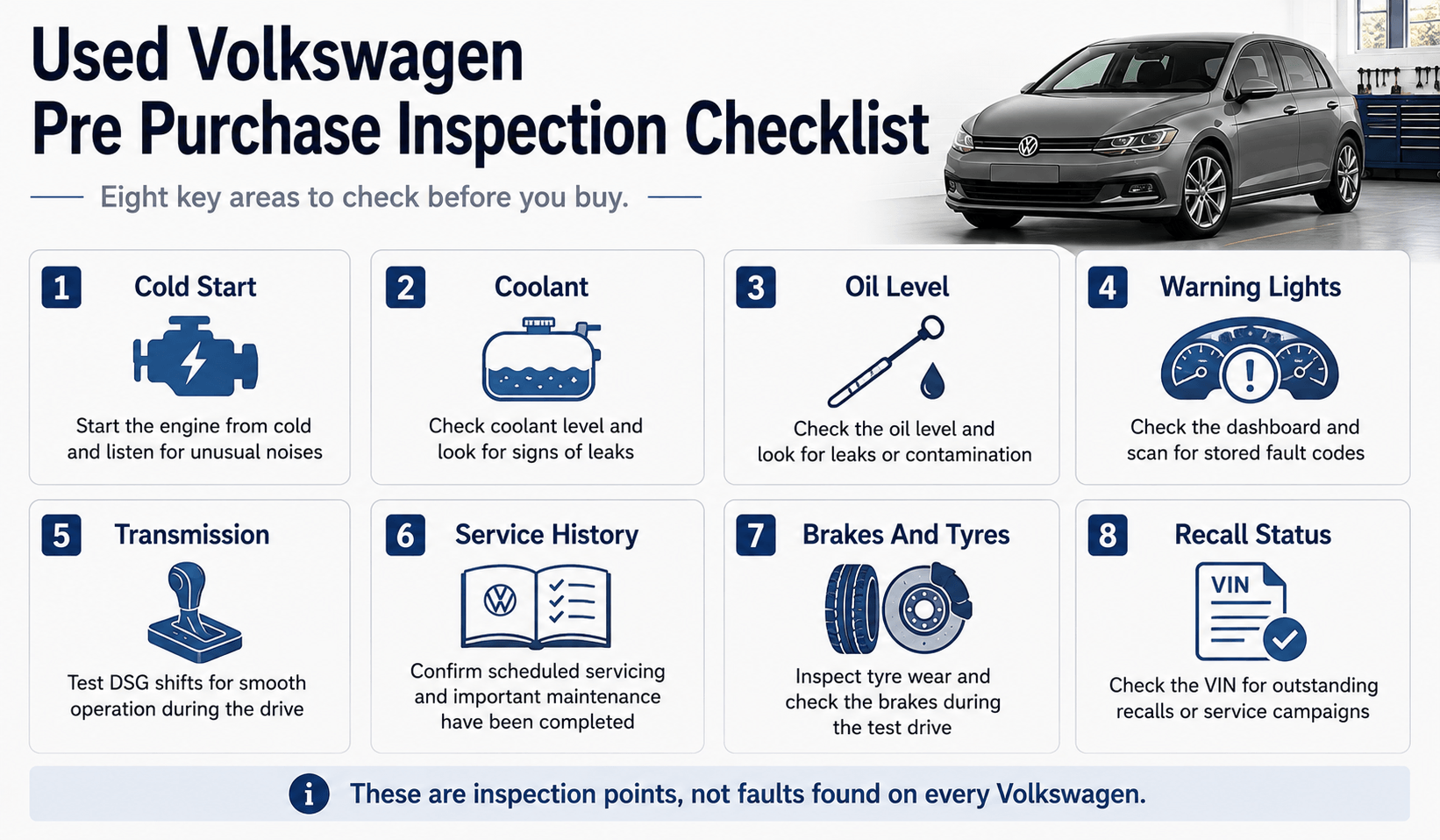
Inspect the eight areas below on the individual car. None of these faults is present on every vehicle.
Timing chain noise on cold start. A rattle in the first few seconds on older 1.4-litre TSI engines is worth investigating.
Water pump and thermostat housing. Look for coolant residue or a low coolant level.
Oil consumption. Ask whether the car uses oil between services.
Ignition coils. A misfire, rough idle or flashing engine light can point to a failed coil.
DSG service history. Confirm the transmission fluid has been changed at the specified interval.
Diesel particulate filter. Ask about warning lights and whether the car does regular longer trips.
Water in the footwell. On cars with a sunroof, check that the carpet is dry.
Outstanding recalls. Check the vehicle identification number for the Takata airbag recall and, on diesels, the EA189 emissions update.
The order to work through it
Follow these steps in sequence. Each one is cheap or free, and each can stop you spending money on the next.
Read the listing and note the build date, variant, transmission, kilometres and stated features.
Ask for the service records and check that interval items such as the timing belt and transmission fluid have been done.
Check the vehicle identification number for outstanding recalls, including Takata and, on diesels, the emissions update.
Run a PPSR check for money owing, written-off status and stolen records.
Inspect the car from cold, before it has been warmed up for you.
Test drive it at both low speed and highway speed, listening to the transmission.
Book a pre-purchase inspection with a mechanic familiar with Volkswagen Group cars.
Confirm the roadworthy certificate and what warranty applies to that specific vehicle.
Registration, roadworthy and warranty in Victoria
Buying from a licensed motor car trader in Victoria gives you protections a private sale does not.
A statutory warranty may apply. Consumer Affairs Victoria states that a licensed motor car trader must provide a statutory warranty if the car is less than 10 years old and has travelled less than 160,000 kilometres. The warranty lasts for three months or 5,000 kilometres after purchase, whichever occurs first. It does not cover items such as tyres, batteries, audio equipment or navigation systems, and it does not cover faults already listed on a defect notice.
Because the Passat and older Golf models are now several years old, check whether a specific vehicle still falls within those age and kilometre limits.
A current roadworthy certificate is required to transfer registration in Victoria. Registration transfer and duty are handled through the Victorian Government. Confirm the roadworthy and registration position for the individual vehicle rather than assuming it is included.
How J & V Elite Motors can help
J & V Elite Motors is a family-operated used car dealership in Dandenong, Victoria, holding motor car trader licence LMCT 9914. The business was established by Zia Agahi in 2003. Zia worked as a mechanic before starting the dealership, which shaped how the business approaches vehicle selection and customer questions.
Practical support available at the Dandenong dealership includes:
Browsing used Volkswagen cars and all current listings online before visiting
Inspections and test drives at 21 to 23 Hammond Road, Dandenong
Vehicle finance enquiries, subject to application, eligibility, lender criteria and approval
Trade-in enquiries on your existing vehicle
Warranty options, which vary by vehicle
Servicing through the dealership’s own service centre after purchase
The website states that stock is pre-inspected through a licensed VicRoads auto repair shop, and the business identifies itself as an approved Australian Warranty Network dealer. Stock changes regularly, so check current listings for what is available today.
Buyers in Noble Park, Springvale, Keysborough and Mulgrave are all a short drive from the dealership. You can read more about the dealership, or compare used Skoda cars, which share much of their engineering with Volkswagen.
Choosing your next used Volkswagen
Match the model to your driving first, then judge the individual car. The Golf works for commuting and first cars, the Tiguan for families who want SUV space, and the Passat for highway kilometres and large loads. Once you have chosen the body type, decide on service history, recall status and inspection results rather than kilometres alone.
Browse the current used Volkswagen range at J & V Elite Motors, then contact the Dandenong team on (03) 9706 8999 to arrange an inspection and test drive.
Frequently Asked Questions
Which used Volkswagen model is the most practical?
The Passat wagon carries the most luggage, with 650 litres of boot space expanding to 1,780 litres with the seats folded. The Tiguan Allspace is more practical if you need occasional extra seats. The Golf is the most practical choice for city driving and parking.
Should I avoid a used Volkswagen diesel because of the emissions issue?
No, but check the specific car. The issue affects 1.6 and 2.0 litre diesels built roughly 2008 to 2015. Volkswagen provided a free software update from December 2016, so ask for proof it was applied. Petrol models are not affected at all.
How many kilometres is too many for a used Volkswagen?
There is no single figure. A car with complete service records and mostly highway use can be in better condition at 150,000km than a neglected car at 80,000km. Focus on service history, condition and whether interval-based items such as the timing belt and DSG fluid have been done.
Is the Golf Mk7 better than the Mk8?
They suit different buyers. The Mk8 is newer and has more technology, but more functions have been moved to the touchscreen. The Mk7 and Mk7.5 keep physical climate controls, which many drivers find easier to use while driving. Drive both and decide which cabin you prefer.
Does a used Volkswagen come with a warranty?
H3: Can I trade in my current car and arrange finance? Yes, both are handled as enquiries at the dealership. Trade-in offers depend on the
Can I trade in my current car and arrange finance?
Yes, both are handled as enquiries at the dealership. Trade-in offers depend on the vehicle’s age, condition, kilometres and market demand. Finance is subject to application, eligibility, lender criteria and approval.