
Best Used Mercedes-Benz Models for Affordable Luxury
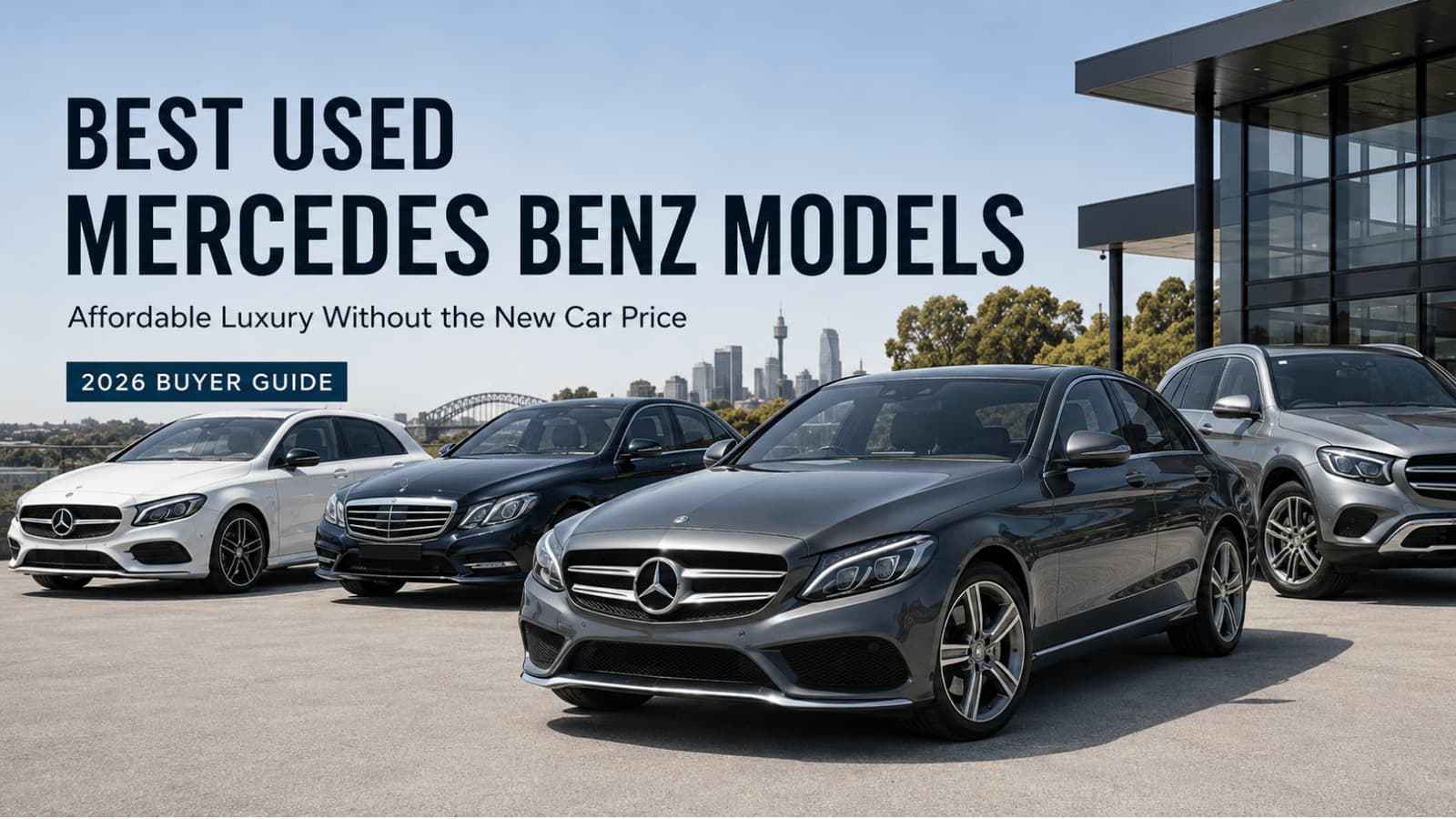
The best used Mercedes-Benz models for affordable luxury are the C-Class for the strongest all-round balance, the A-Class and CLA for the lowest entry price, the GLC for a family prestige SUV, and the E-Class for the most car per dollar. Affordable luxury comes from first-owner depreciation, which lowers the purchase price. It does not lower servicing, parts or repair costs. |
Key takeaways
|
Which used Mercedes-Benz should you buy?
Choose the A-Class or CLA for the lowest entry price, the C-Class for the best balance of prestige and running costs, the E-Class for space and highway comfort, and the GLA, GLB or GLC for SUV practicality. The table below sets out the trade-off each model asks you to accept.
Model | Body type | Best for | Key strength | Main trade-off |
|---|---|---|---|---|
A-Class | Small hatchback | First luxury car, city driving | Lowest entry price into the brand | Least rear seat and boot space |
CLA | Four-door coupe | Style-focused buyers | Sharper looks than the A-Class | Lower roofline cuts rear headroom |
C-Class | Medium sedan or wagon | The widest range of buyers | Best all-round balance, widest supply | Costs more to run than a mainstream sedan |
E-Class | Large sedan or wagon | Highway and long-distance driving | Most space and comfort per dollar | Heavier depreciation and higher repair exposure |
GLA | Small SUV | SUV height in a compact footprint | Easy to park, raised seating | Tight rear seat and boot |
GLB | Compact seven-seat SUV | Families needing occasional seven seats | Boxy shape maximises interior room | Third row suits children and short trips |
GLC | Medium SUV | Families wanting a prestige SUV | Shares its engineering with the C-Class | Strong demand keeps used prices firm |
These are general strengths of each model line. Individual cars vary by year, variant, condition and history.
Mercedes-Benz terms defined
Mercedes-Benz uses model codes, transmission names and trim labels that appear throughout used listings. The table below defines each term used in this guide.
Term | What it means |
|---|---|
Affordable luxury | A prestige car bought at a mainstream price because depreciation has reduced its value, not because it is cheap to own. |
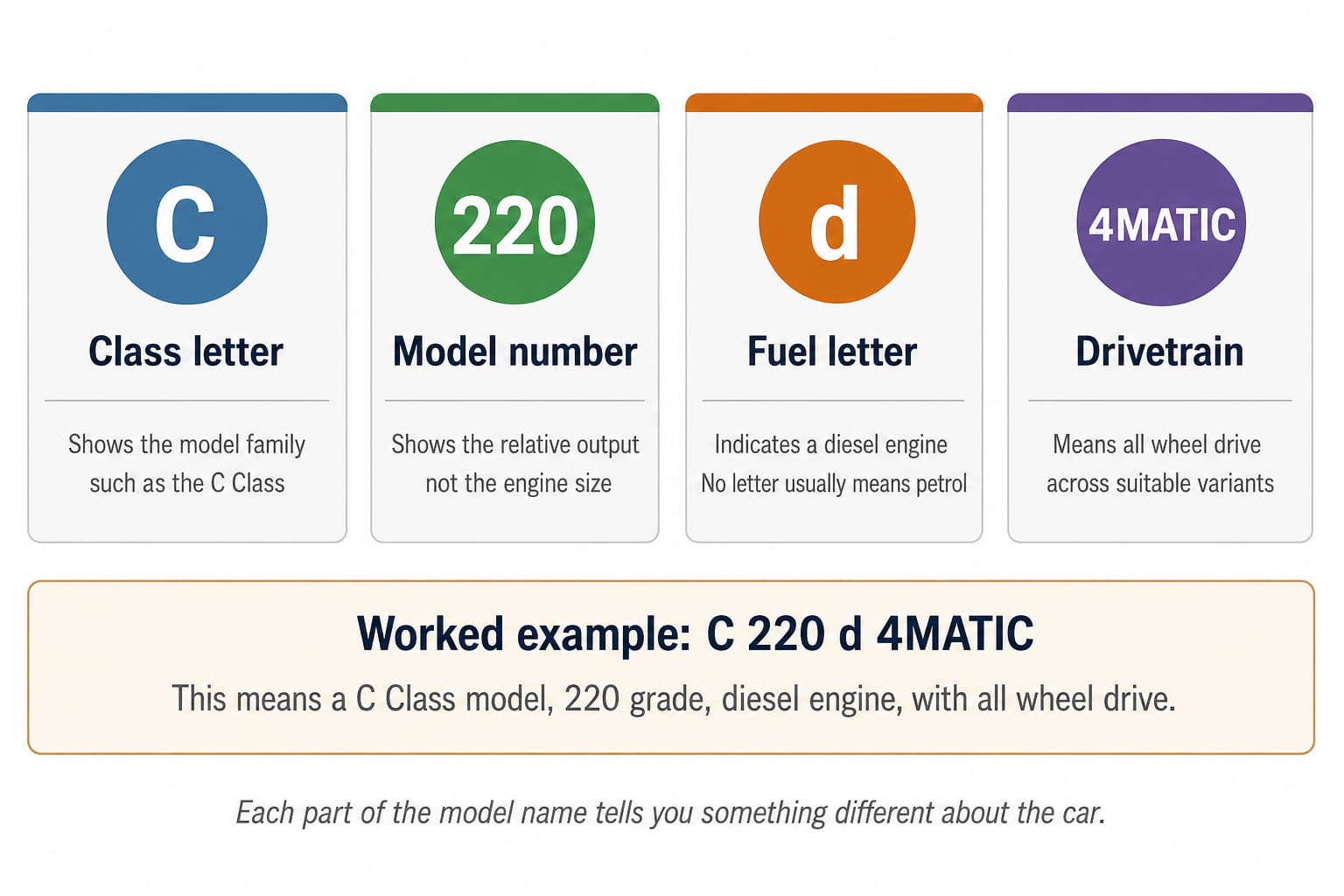
Class letter | The size and body family. A is the smallest, S is the largest. |
Model number | Relative engine output, not engine capacity in litres. A C 250 sits above a C 200. |
d or CDI | A diesel engine. No letter generally indicates petrol. |
4MATIC | Mercedes-Benz all-wheel drive. |
AMG Line | A styling and trim package. It is not a Mercedes-AMG performance car. |
Mercedes-AMG | The performance division, badged 35, 43, 45, 53 or 63, with higher running costs. |
W-number | The factory generation code, such as W204 or W205 for the C-Class. |
7G-Tronic and 9G-Tronic | Conventional automatic transmissions used in rear-wheel drive models. |
7G-DCT | A dual-clutch transmission used in front-wheel drive models such as the A-Class. |
AIRMATIC | Air suspension fitted to some larger models. It improves ride comfort and is expensive to repair. |
Service A and Service B | The alternating minor and major services in the Mercedes-Benz schedule. |
Statutory warranty | The warranty a licensed Victorian motor car trader must provide on an eligible used car. |
PPSR | The Personal Property Securities Register, which shows money owing, written-off status and stolen records. |
What does affordable luxury actually mean?
Affordable luxury means buying a prestige car after its steepest depreciation has already happened. The engineering, the parts and the labour rates stay exactly where they were. Only the purchase price has moved.
The scale of that drop is what creates the opportunity. The W205 C-Class range launched in Australia in 2014 starting just above $60,000 and extending beyond $150,000 for the Mercedes-AMG C 63 sedan. Cars that sold at those prices new now sit within reach of a mainstream budget.
The same source is direct about the catch. Even in the lowest models of the W205 series, the C-Class is a prestige car and needs to be maintained in accordance with its quality.
That single sentence is the whole argument of this guide. The badge lowers in price. The maintenance standard does not.
Are used Mercedes-Benz cars reliable?
A used Mercedes-Benz is reliable when it has been serviced on schedule and unreliable when it has not. These are complex cars built to a high standard, and the deciding factor is the maintenance record rather than the badge or the model.
Three things predict how a specific car will behave.
A complete service record. Mercedes-Benz alternates a minor Service A and a major Service B. Gaps in that sequence are the clearest warning sign available to a buyer.
Which optional systems are fitted. AIRMATIC air suspension, plug-in hybrid drivetrains and large infotainment systems all add components that can fail expensively.
How the car was used. Diesels driven only on short trips block their particulate filters. Cars left standing develop different faults again.
Known issue areas reported across this era include timing chain wear on earlier diesel engines, thermostat and water pump wear on some four-cylinder petrol engines, carbon build-up on direct injection engines, transmission conductor plate faults, and oil leaks from the valve cover. None of these is present on every car. Each is a reason to book a pre-purchase inspection with a diagnostic scan rather than a reason to avoid the brand.
The practical conclusion is simple. Buy the best-documented car you can afford rather than the newest or cheapest one.
Mercedes-Benz A-Class and CLA: the lowest entry price
The Mercedes-Benz A-Class is a small luxury hatchback and the cheapest way into the brand. The CLA is a four-door coupe built on the same platform, with sharper styling and a lower roofline. Both are front-wheel drive, with 4MATIC on selected variants, and both use a 7G-DCT dual-clutch transmission.
A-Class generations
Two generations dominate the used market. The W176, sold from 2013 to 2018, introduced the modern hatchback shape. The W177, from 2018, brought the MBUX infotainment system and a far more modern cabin.
Variants run A 180, A 200 and A 250, with Mercedes-AMG A 35 and A 45 above them. AMG Line suspension firms up the ride noticeably, so test drive the exact car rather than assuming the model rides the same way across variants.
CLA compared with the A-Class
The CLA trades practicality for styling. Its lower roofline reduces rear headroom, and the Shooting Brake wagon variant adds boot space without the height of an SUV. Buyers carrying adults in the back regularly will find the A-Class or the B-Class easier to live with.
Who these models suit
The A-Class and CLA suit first luxury car buyers, city drivers and single-car households. They are the smallest cars here, so families needing rear-seat space should move up to the C-Class or across to an SUV.
Mercedes-Benz C-Class: the volume affordable luxury choice
The Mercedes-Benz C-Class is a medium prestige sedan and wagon, and the model most buyers should look at first. It offers the widest used supply, the broadest variant range and the best balance between prestige feel and running costs. Coupe and cabriolet body styles were also sold.
W204 compared with W205
The W204, sold from 2007 to 2014, is the older and cheaper generation. The W205, sold from 2014 to 2021, moved to the Modular Rear Architecture platform and used extensive aluminium to reduce weight. The W205 feels considerably more modern inside and is the better long-term buy where budget allows.
Variants include the C 180, C 200, C 250, C 300 and the C 220 d diesel, with the C 350 e plug-in hybrid and the AMG C 43 and C 63 above them. Most use the M274 turbocharged four-cylinder or M276 V6 petrol engines, driving the rear wheels through a 7G-Tronic Plus or 9G-Tronic automatic. The W205 was the first Mercedes-Benz on the Modular Rear Architecture platform, which used aluminium extensively and cut about 100kg from the body.
The Takata airbag recall on the W204
Check the Takata recall status before buying any W204 C-Class. This generation was specifically named in the ACCC action described later in this guide, and confirming the airbag was replaced costs nothing.
Mercedes-Benz E-Class: the most car for the money
The Mercedes-Benz E-Class is a large prestige sedan and wagon that delivers the most space, comfort and equipment per dollar of any model here. It is quiet at highway speed and suits long-distance drivers.
W212 and W213 generations
The W212, sold from 2009 to 2016, is the older generation and the cheaper entry point. The W213, sold from 2016 to 2023, brought a substantially more advanced cabin and driver assistance package. Variants run E 200, E 220 d, E 250, E 300, E 350 and E 400, with Mercedes-AMG E 43 and E 63 above them.
Why E-Class depreciation works in your favour
Large prestige sedans lose more value in absolute terms than smaller ones, because they start from a higher list price. That is a problem for the first owner and an advantage for a used buyer. The result is more car, more equipment and more space for the same money.
The trade-off is repair exposure. A larger car with more technology has more to go wrong, and AIRMATIC air suspension is expensive to replace when it fails. Ask specifically whether the car has air suspension, and check that it sits level after being parked overnight.
Mercedes-Benz GLA, GLB and GLC: the SUV options
The GLA is a small SUV, the GLB is a compact seven-seat SUV, and the GLC is a medium SUV that shares its platform and engines with the C-Class. All three are available with front-wheel drive or 4MATIC all-wheel drive.
GLA (X156 from 2014, H247 from 2020). The first generation is closer to a raised hatchback; the second is a taller, more conventional small SUV. It suits buyers wanting SUV height in a compact footprint.
GLB (from 2020). Boxy proportions maximise interior space, and the third row suits children and short trips rather than adults.
GLC (X253 from 2015, plus a Coupe body). The strongest family choice, with variants including the GLC 200, GLC 220 d, GLC 250, GLC 300 and AMG GLC 43. It sits between the GLA and the larger GLE in the range.
Strong family demand keeps used GLC prices firmer than C-Class prices of the same age. Buyers who do not need the height often get more car for their money by choosing the C-Class or E-Class instead.
Which used Mercedes-Benz has the biggest boot?
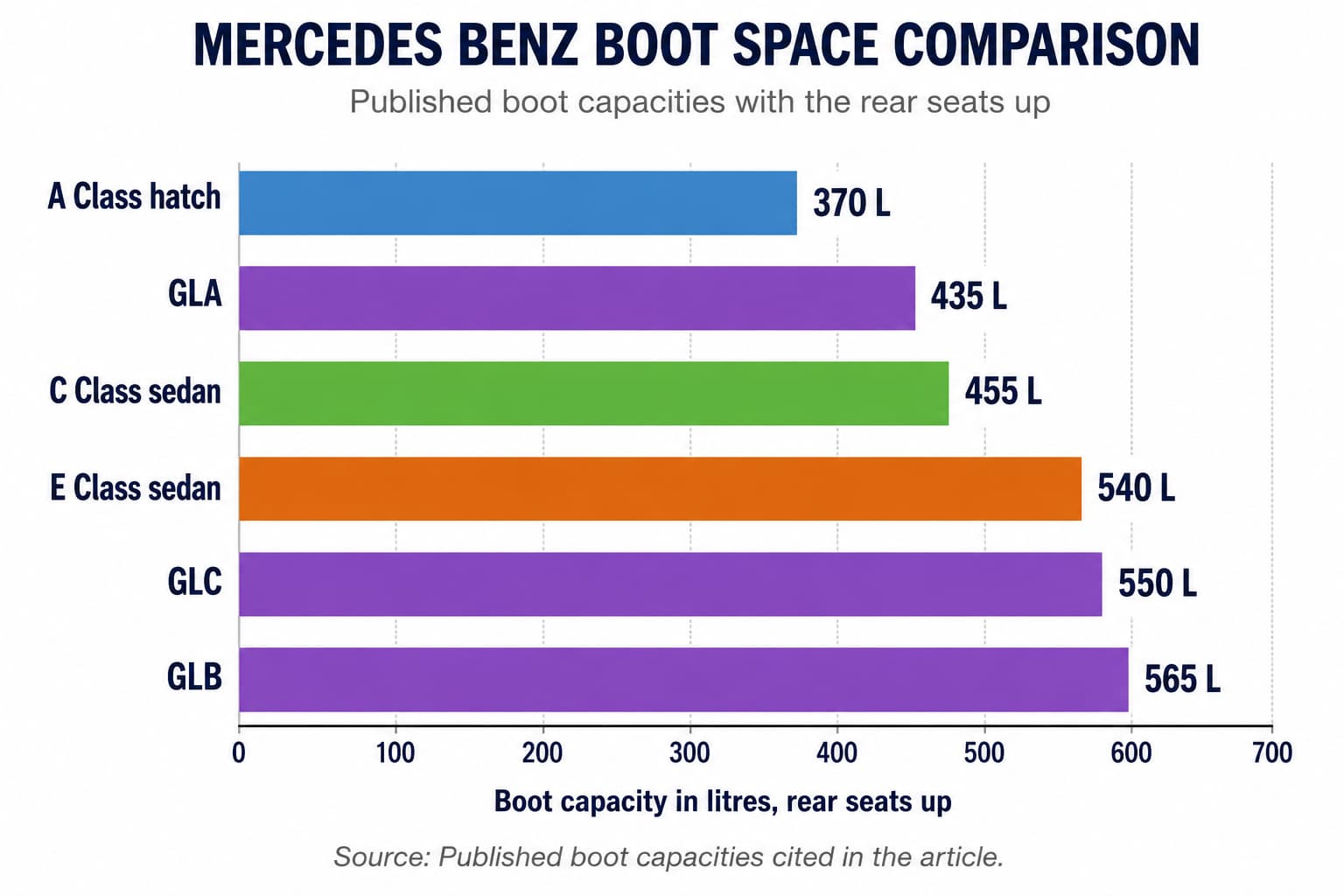
The GLB has the largest boot of the mainstream Mercedes-Benz range at 565 litres with the third row folded, followed by the GLC at 550 litres and the E-Class sedan at 540 litres. The A-Class hatch is the smallest at 370 litres.
Model | Boot capacity, rear seats up | Notes |
|---|---|---|
A-Class hatch | 370 litres | Expands to about 1,210 litres with the seats folded |
GLA | 435 litres | Expands to 1,430 litres with the seats folded |
C-Class sedan | 455 litres | Plug-in hybrid variants drop to 315 litres |
E-Class sedan | 540 litres | Plug-in hybrid variants drop to 370 litres |
GLC | 550 litres | Expands to 1,600 litres with the seats folded |
GLB | 565 litres | Quoted with the third row folded |
Plug-in hybrid variants carry noticeably smaller boots, because the battery sits under the boot floor. Check the specific variant rather than assuming the model figure applies.
Can a GLC tow a caravan?
The GLC is rated to tow up to 2,500kg braked, which covers many mid-size caravans. Confirm the figure on the individual vehicle, because ratings vary by variant and model year, and the unbraked limit is 750kg.
Towing capacity is only half the calculation. The towball download limit and the gross combination mass also apply, so a vehicle rated at 2,500kg cannot always tow a 2,500kg van legally once loaded. Check the compliance plate and the owner’s handbook for the specific car before committing to a caravan.
Which used Mercedes-Benz models need extra caution?
The S-Class, Mercedes-AMG models, the GLE and ML, and any car fitted with air suspension are the cheapest to buy relative to their original price and the most expensive to keep. They are not bad cars. They are cars where a single repair can exceed what a buyer paid for the vehicle.
S-Class. The heaviest depreciation in the range puts advanced technology within reach at low used prices, with high repair exposure on air suspension and electronics. An affordable purchase, but not an affordable car to own.
Mercedes-AMG. Higher servicing, tyre, brake and fuel costs, plus greater modification and track use risk on used examples. Insurance can be significantly higher for younger drivers.
GLE and ML. Large SUVs with higher running costs, diesel and petrol V6 options and air suspension on some variants.
Any car with AIRMATIC. Confirm it sits level and does not sag overnight.
Buyers whose budget is tight after the purchase should stay with the A-Class, C-Class, GLA or GLC.
The Takata airbag recall on used Mercedes-Benz models
Check the Takata airbag recall status on any used Mercedes-Benz before buying. The recall was compulsory; it named models that are common on the used market, and the check is free.
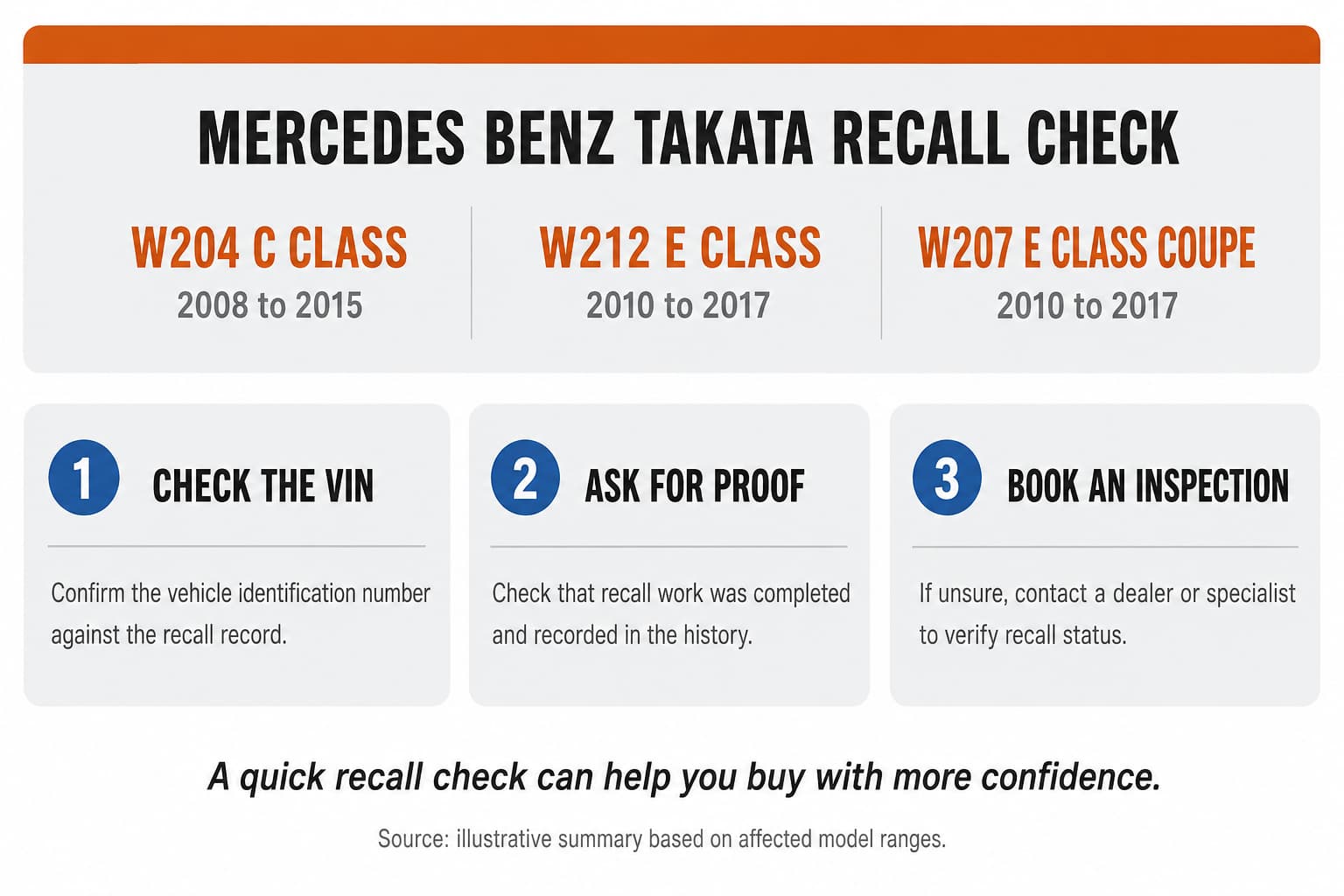
Mercedes-Benz Australia entered a court-enforceable undertaking with the ACCC after failing to initiate some compulsory Takata recalls on time, covering certain W204 C-Class cars built between 2008 and 2015 and particular W212 E-Class and W207 E-Class coupe models built from 2010 to 2017. Mercedes-Benz Australia was later fined $12.5 million over its handling of the recall, the first time a company had been penalised for failing to comply with a mandatory recall notice.
Two points keep this in proportion. Mercedes-Benz vehicles did not contain the higher-risk Takata Alpha airbags identified in the recall notice. Manufacturers successfully recalled 99.9 per cent of affected vehicles in what was Australia’s first compulsory motor vehicle recall and the largest in its history, affecting over 4 million airbags in about 3 million vehicles.
Almost every affected car has been rectified. Confirming it on the specific vehicle takes minutes.
Should you buy a petrol or diesel Mercedes-Benz?
Choose petrol for mostly short suburban trips and diesel for regular highway driving. Diesel models are badged with a d, such as the C 220 d or E 220 d, and use a diesel particulate filter that needs longer runs at higher speed to clean itself.
Petrol (M270, M274, M276) suits city commuting, school runs and stop-start traffic. Many variants require premium unleaded.
Diesel (OM651, OM654) suits long-distance driving and offers stronger low-speed pulling power and better highway economy.
Direct injection petrol engines can accumulate carbon deposits over time, and thermostat and water pump wear has been reported on some four-cylinder units. On diesels, ask about warning lights and whether the car does regular longer trips.
What does a used Mercedes-Benz cost to run?
A used Mercedes-Benz costs more to service than a mainstream car of the same size, and the gap widens once the vehicle is out of warranty. Budget for it before buying rather than after.
Mercedes-Benz matches its five-year, unlimited-kilometre warranty with five years of capped price servicing, and every model needs servicing every 12 months regardless of kilometres, though maintenance costs are higher than most competitors right across the board. Older used cars generally sit outside that capped price programme, so ask what the next service will cost before committing.
Two things reduce ownership cost significantly. The first is buying a car with complete records rather than a cheaper car without them. The second is using a reputable independent European specialist for out-of-warranty work, which lowers labour cost while keeping the service record intact.
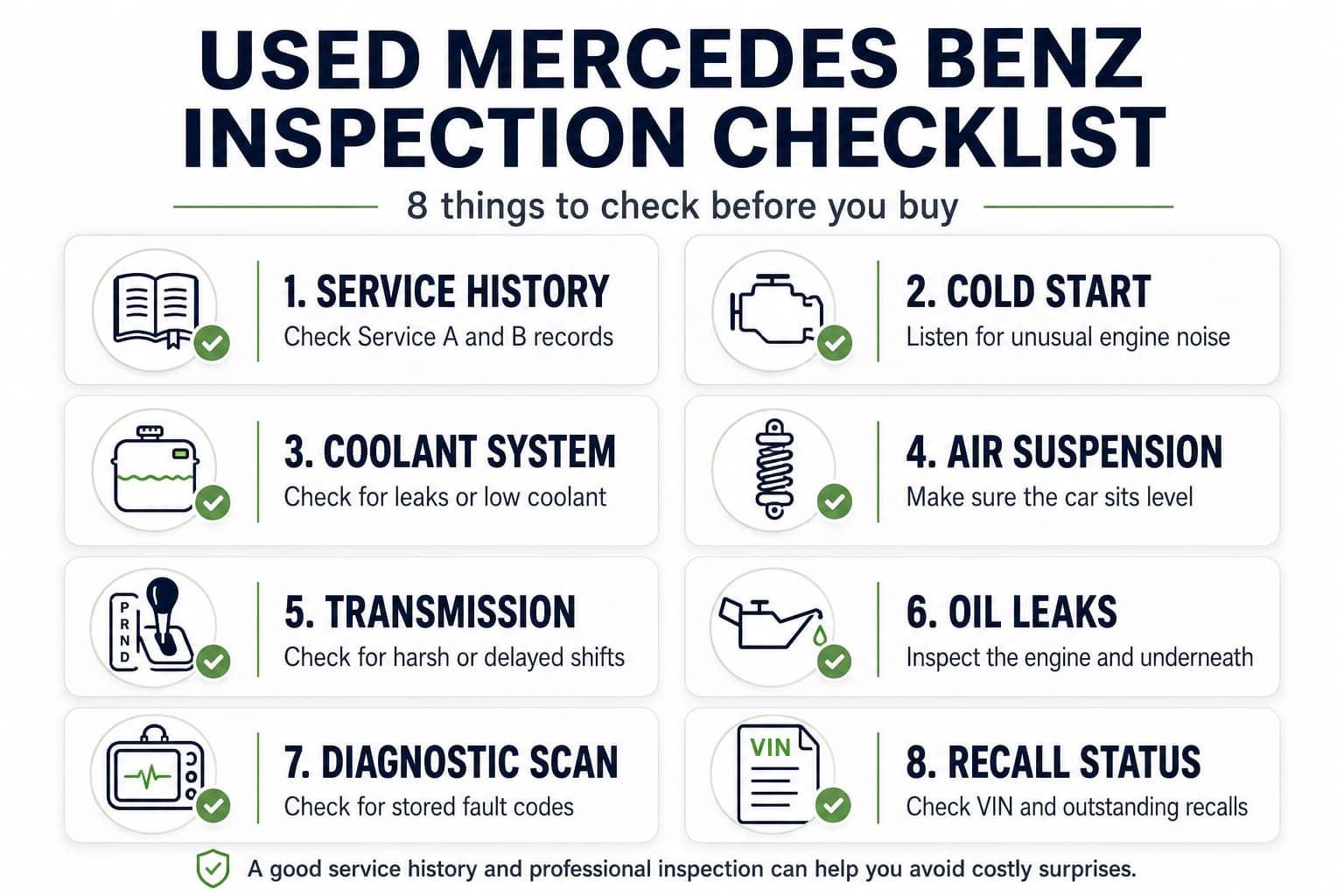
Common things to check on a used Mercedes-Benz
Inspect the areas below on the individual car. None of these is a fault present on every vehicle, and a well-maintained example may show none of them.
Service history. Confirm the logbook is complete and that Service A and Service B were done on schedule.
Cold start. Listen for timing chain rattle in the first seconds, particularly on earlier diesel engines.
Coolant. Look for thermostat or water pump residue and a dropping coolant level.
Air suspension. On cars with AIRMATIC, check that the car sits level and has not sagged overnight.
Transmission behaviour. Feel for harsh or delayed shifts, which can indicate a conductor plate fault.
Oil leaks. Check around the valve cover and the underside of the engine.
Warning lights and a diagnostic scan. A scan reveals stored fault codes that a dashboard check will not.
Recall status. Check the vehicle identification number, including the Takata airbag recall.
The order to work through it in
Follow these steps in sequence. Each one is cheap or free, and each can stop you spending money on the next.
Read the listing and note the build date, generation code, variant, transmission and kilometres.
Ask for the full service history and confirm Service A and Service B intervals were met.
Check the vehicle identification number for outstanding recalls, including Takata.
Run a PPSR check for money owing, written-off status and stolen records.
Inspect the car from cold, before it has been warmed up for you.
Test drive at low speed and highway speed, feeling for transmission and suspension faults.
Book a pre-purchase inspection with a European specialist, including a diagnostic scan.
Confirm the roadworthy certificate and what warranty applies to that specific vehicle.
What determines the price of a used Mercedes-Benz?
The price of a used Mercedes-Benz is set by generation, variant, age, kilometres, condition, service history and demand rather than by the badge alone. Two cars of the same year can sit far apart for good reasons.
The main factors are:
Generation and variant. A W205 C 300 sits well above a W204 C 200 of similar kilometres.
Engine and drivetrain. V6 and 4MATIC variants generally sit above four-cylinder, rear-wheel-drive cars.
Service history. Complete records with the correct oil specification support a higher price and a faster sale.
Options fitted. Sunroof, AIRMATIC, upgraded infotainment and AMG Line packages all affect value.
Condition of consumables, including tyres, brakes and wheel kerb damage.
Roadworthy and registration status, and how much registration remains.
Demand. Family SUV demand keeps GLC values firmer than equivalent sedans.
Compare like with like before judging whether a price is fair.
How the C-Class, E-Class and GLC compare with rivals
Each Mercedes-Benz competes against strong German, Japanese and Korean alternatives, and J & V Elite Motors stocks a range of brands. The table below sets out what you gain and give up.
Mercedes-Benz | Common alternatives | What the Mercedes-Benz offers | What the alternative often offers |
|---|---|---|---|
C-Class | BMW 3 Series, Audi A4, Lexus IS | Ride comfort and cabin presentation | Sharper handling from the BMW, lower running costs from the Lexus |
E-Class | BMW 5 Series, Lexus ES, Genesis G80 | Space and long-distance comfort per dollar | Simpler ownership and stronger warranty history |
GLC | BMW X3, Audi Q5, Volvo XC60 | C-Class engineering in an SUV body | Broader availability and, on the Volvo, strong safety credentials |
Test drive more than one. The right answer depends on how the car feels and what condition the individual vehicle is in.
Registration, roadworthy and warranty in Victoria
Buying from a licensed motor car trader in Victoria gives you protections a private sale does not.
A statutory warranty may apply. Consumer Affairs Victoria states that a licensed motor car trader must provide a statutory warranty if the car is less than 10 years old and has travelled less than 160,000 kilometres. The warranty lasts for three months or 5,000 kilometres after purchase, whichever occurs first. It does not cover items such as tyres, batteries, audio equipment or navigation systems, and it does not cover faults already listed on a defect notice.
Older prestige cars frequently fall outside those limits. A W204 C-Class or W212 E-Class may be past the age threshold, so check the position on the specific vehicle rather than assuming cover applies.
A current roadworthy certificate is required to transfer registration in Victoria. Confirm the roadworthy and registration status for the individual vehicle rather than assuming it is included.
How J & V Elite Motors can help
J & V Elite Motors is a family-operated used car dealership in Dandenong, Victoria, holding motor car trader licence LMCT 9914. The business was established by Zia Agahi in 2003. Zia worked as a mechanic before starting the dealership, which shaped how the business approaches vehicle selection and customer questions.
Practical support available at the Dandenong dealership includes:
Browsing used Mercedes-Benz cars and all current listings online before visiting
Inspections and test drives at 21 to 23 Hammond Road, Dandenong
Vehicle finance enquiries, subject to application, eligibility, lender criteria and approval
Trade-in enquiries on your existing vehicle
Warranty options, which vary by vehicle
Servicing through the dealership’s own service centre after purchase
The website states that stock is pre-inspected through a licensed VicRoads auto repair shop, and the business identifies itself as an approved Australian Warranty Network dealer. Stock changes regularly, so check current listings for what is available today.
Buyers in Noble Park, Springvale, Keysborough and Mulgrave are all a short drive from the dealership. You can read more about the dealership, or compare the range against used Volkswagen cars if a mainstream European alternative would suit better.
Choosing your next used Mercedes-Benz
Decide what you can afford to run before deciding which badge to buy. The A-Class and CLA suit a first luxury car, the C-Class suits the widest range of buyers, the E-Class suits long-distance driving, and the GLA, GLB and GLC suit families wanting an SUV. Once the model is settled, judge each car on its service history, recall status and inspection results rather than kilometres or price alone.
Browse the current used Mercedes-Benz range at J & V Elite Motors, then contact the Dandenong team on (03) 9706 8999 to arrange an inspection and test drive.
Frequently Asked Questions
What is the cheapest Mercedes-Benz to own?
The A-Class is generally the cheapest Mercedes-Benz to buy and run, because it is the smallest, uses four-cylinder engines and wears smaller tyres. The C-Class is close behind and offers considerably more space. Avoid assuming a cheaper purchase price means cheaper ownership, because larger and older models often cost more to keep.
Is a used Mercedes-Benz worth buying?
A used Mercedes-Benz is worth buying when the car has complete service records, and the budget covers ongoing maintenance. Depreciation makes the purchase affordable, but servicing, parts and repairs stay at a prestige level. Buyers who cannot cover a major service plus one unplanned repair in the same year should consider a mainstream alternative.
What is the difference between Service A and Service B?
Service A is the minor service and Service B is the major one, and Mercedes-Benz alternates between them. Both fall due every 12 months regardless of kilometres travelled. A complete used car history shows the two alternating in sequence with no gaps.
How many kilometres is too many for a used Mercedes-Benz?
There is no single figure. A car with complete records and mostly highway use can be in better condition at 150,000km than a neglected car at 80,000km. Focus on service history, condition and whether interval-based work has been done rather than the odometer alone.
Are Mercedes-Benz cars expensive to repair?
Repairs generally cost more than on a mainstream car, because parts are European and some jobs take longer. Air suspension, transmission and electronic repairs carry the highest exposure. An independent European specialist usually charges less than a franchised dealer for out-of-warranty work.
What is a PPSR check and do I need one?
A PPSR check searches the Personal Property Securities Register and shows whether a vehicle has money owing on it, has been written off, or has been reported stolen. Buying a car with finance owing risks the financier repossessing it. Licensed dealers clear this before sale, and a private buyer should always run the check.
Can I trade in my current car and arrange finance?
Yes, both are handled as enquiries at the dealership. Trade-in offers depend on the vehicle’s age, condition, kilometres and market demand. Finance is subject to application, eligibility, lender criteria and approval.