
Best Used Cars for Students and P-Platers
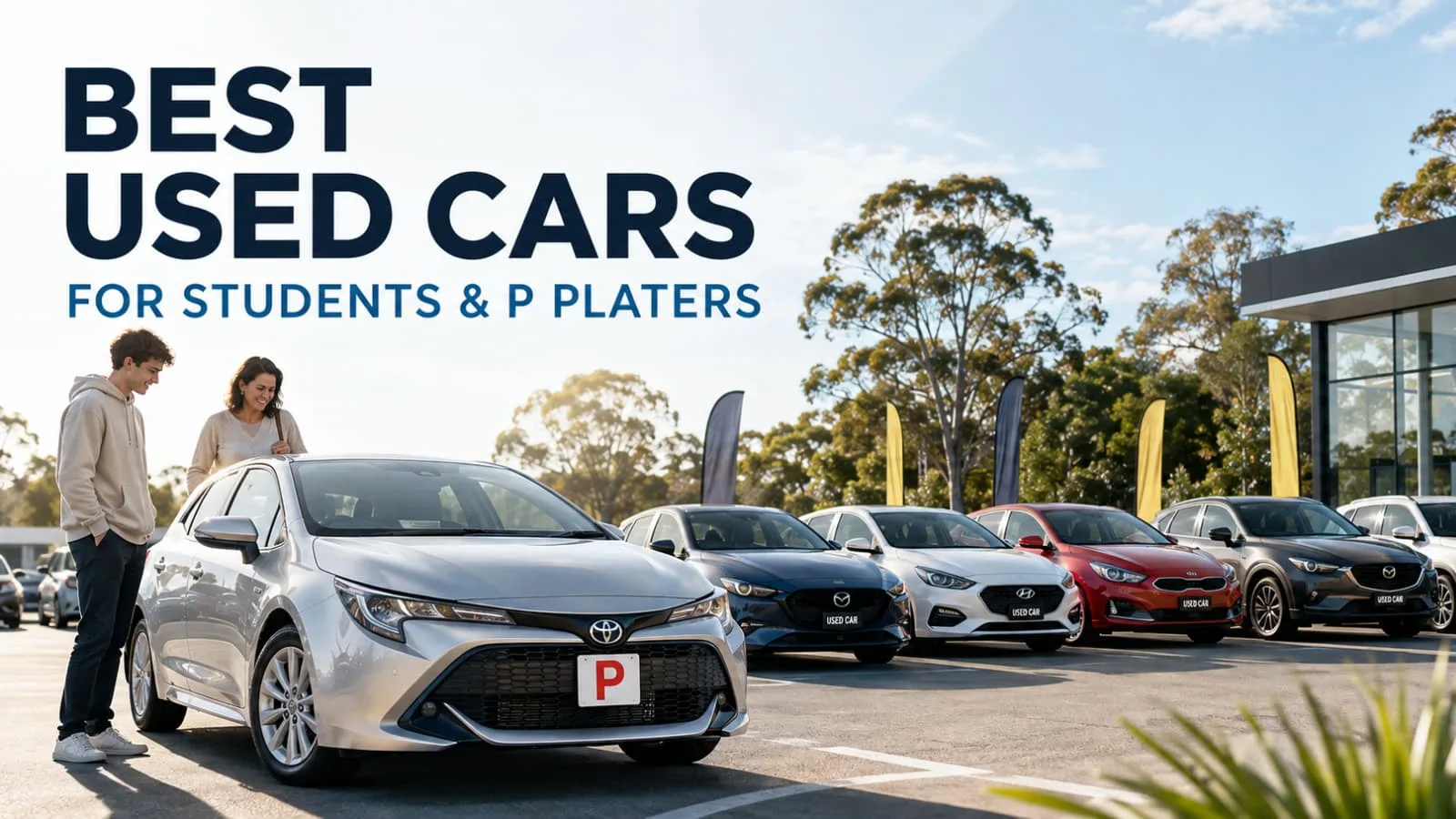
The best used cars for students and P-platers in Victoria are small cars and small SUVs that pass three tests: the car must be legal for probationary drivers, it must hold a strong Used Car Safety Rating, and the insurance quote must be affordable. Named Safer Pick models that meet the safety test include the Toyota Corolla, Mazda3, Hyundai i30, Kia Cerato, Mazda CX-3 and Suzuki Vitara. |
Key takeaways
|
What cars can P-platers drive in Victoria?
Victorian probationary drivers are banned from driving a vehicle that has a power-to-mass ratio above 130 kilowatts per tonne, carries a banned rating in the probationary vehicle database, or has an engine modified to increase performance by anyone other than the manufacturer. Breaking these rules can result in a fine.
Learner permit holders are not subject to the banned vehicle rule. It applies to P1 and P2 probationary licence holders.
How do I calculate the power-to-mass ratio?
Divide the engine power in kilowatts by the tare mass in kilograms, then multiply by 1,000. A car producing 110kW with a tare mass of 1,320kg returns 83 kilowatts per tonne, comfortably inside the limit. A car producing 200kW with a tare mass of 1,450kg returns 138 kilowatts per tonne and is banned.
Both figures appear in the vehicle specifications. Use the tare mass rather than the gross vehicle mass, and check the exact variant, because power outputs differ between engines in the same model range.
How do I check if a car is P-plate legal?
Search the vehicle in the VicRoads probationary vehicle database. The database returns one of three statuses: approved, banned, or under review. A probationary driver cannot drive a vehicle listed as under review until it has been assessed. If you are not sure whether a vehicle is banned, do not drive it.
The database is the only authoritative check. Calculate the ratio yourself as a first filter, then confirm the exact variant and build year in the database before paying a deposit.
H3: When can a P-plater drive a banned vehicle?
Three exemptions exist. A probationary driver may drive a banned vehicle with a supervising driver who holds a full licence and sits beside them. A work-related exemption applies automatically where an employer requires it, or where the driver is self-employed with an ABN. An undue hardship exemption can be applied for on education, employment or family grounds, with supporting documents.
Can P-platers drive turbo cars in Victoria?
Yes. A turbocharged car is not automatically banned in Victoria. Older guidance said probationary drivers could not drive turbocharged, supercharged or eight-cylinder vehicles, and many articles still repeat it.
The current rule is based on the power-to-mass ratio, the database rating and engine modification. Many modern small turbocharged cars sit well under 130 kilowatts per tonne and are approved. A naturally aspirated car is not automatically approved either, because a large engine in a light body can exceed the limit.
Confirm the specific vehicle against the database rather than relying on an article, including this one.
Does an automatic licence restrict which car you can buy?
Yes. In Victoria, passing the probationary drive test in an automatic vehicle places an ‘A’ condition on the licence, restricting the holder to automatic vehicles. Transport Victoria lists ‘A - automatic transmission’ among the conditions that may be imposed on a driver licence.
The condition applies for the whole probationary period unless removed by passing a practical driving test in a manual car. It lifts automatically at the end of the probationary period.
The buying consequence is simple. A driver with an ‘A’ condition should not buy a manual car, however cheap it looks, until the condition is removed or the full licence is granted.
Which used cars are safest for students and P-platers?
The safest realistic first cars are small cars and small SUVs that hold a Safer Pick rating in the Used Car Safety Ratings. A Safer Pick must score five stars for both overall safety and driver protection, and at least four stars for crash avoidance and protection of other road users.
Safer Pick small cars
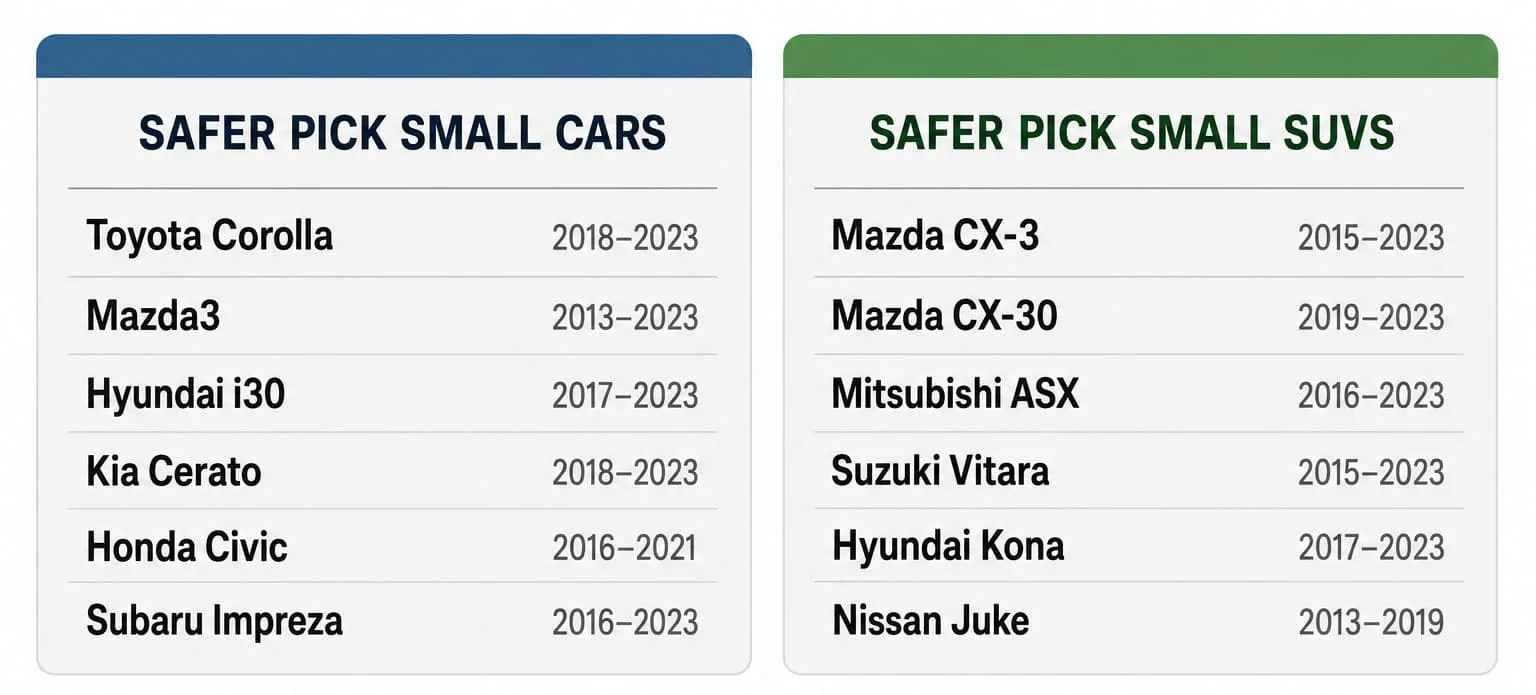
Small cars are the strongest category for a first car. The Toyota Corolla (2018-2023), Mazda3 (2013-2023), Hyundai i30 (2017-2023), Kia Cerato (2018-2023), Honda Civic (2016-2021) and Subaru Impreza (2016-2023) all earned five-star Safer Pick status in the 2025 ratings.
The year range is not a detail to skip. A Honda Civic built between 2016 and 2021 is a Safer Pick, while an early-2000s Civic rates two stars. Same badge, very different protection.
Safer Pick small SUVs
Small SUVs suit buyers wanting a higher seating position. The Mazda CX-3 (2015-2023), Mazda CX-30 (2019-2023), Mitsubishi ASX (2016-2023), Suzuki Vitara (2015-2023), Hyundai Kona (2017-2023) and Nissan Juke (2013-2019) all achieved five stars and Safer Pick status.
Expect to pay more than an equivalent small car, and expect slightly higher fuel and insurance costs.
Why light cars deserve caution
Light cars are the cheapest category and the least protective. Of 49 light car models rated, none reached Safer Pick standard. Some light cars still earn five stars overall, but each has something holding it back across the four measures.
A light car can still be a sensible first car on a tight budget. Check its individual rating rather than assuming the category is safe, and prioritise electronic stability control.
Which used cars should a P-plater avoid?
Avoid older versions of otherwise sound models. The Toyota Corolla (2007-2013), Hyundai Elantra (2011-2015), Nissan Tiida (2006-2013), Kia Cerato (2004-2008) and Hyundai Accent (2000-2006) all rate poorly for safety despite carrying familiar badges.
Utes are also a poor first-car choice on safety grounds. Seventy per cent of utes assessed rated only one or two stars, and no used ute was named a Safer Pick. Modern small cars now offer better driver protection than modern utes.
Which body type suits a student or P-plater best?
Small hatchbacks suit most first-car buyers, because they balance safety, space and running costs. Light hatchbacks cost the least to buy and run. Small sedans add boot space. Small SUVs add seating height and cost.
Body type | Best for | Key strength | Main trade-off |
|---|---|---|---|
Light hatchback | The tightest budgets and city parking | Lowest purchase price, fuel use and insurance | No model reached Safer Pick standard |
Small hatchback | Most first-car buyers | Best balance of safety, space and running costs | Costs more than a light car |
Small sedan | Buyers wanting a bigger boot | More luggage room for similar running costs | Harder to park than a hatch |
Small SUV | Buyers wanting higher seating | Easier entry and better forward vision | Higher purchase price, fuel use and insurance |
Terms every first-car buyer should know
First-car buying uses licensing, safety and legal terms that appear throughout listings and government websites. The table below defines each term used in this guide.
Term | What it means |
|---|---|
P1 licence | The first probationary stage in Victoria, displaying red P plates. |
P2 licence | The second probationary stage, displaying green P plates. |
Probationary prohibited vehicle | A vehicle a probationary driver is banned from driving without an exemption. |
Power-to-mass ratio | Engine power divided by unladen weight, expressed in kilowatts per tonne. |
Tare mass | The unladen weight of the vehicle, used in the power-to-mass calculation. |
‘A’ condition | An automatic transmission condition on a Victorian licence, restricting the holder to automatic vehicles. |
ANCAP rating | A laboratory crash-test star rating published when a vehicle is new. |
Used Car Safety Rating | A star rating based on real-world police-reported crash outcomes, published by Monash University Accident Research Centre. |
Safer Pick | A designation for vehicles scoring five stars for overall safety and driver protection, and at least four for crash avoidance and other road users. |
Electronic stability control | A system that helps prevent skids and loss of control. |
Autonomous emergency braking | A system that brakes automatically when a collision is likely. |
Roadworthy certificate | The Victorian inspection certificate required to transfer registration. |
PPSR | The Personal Property Securities Register, showing money owing, written-off status and stolen records. |
Statutory warranty | The warranty a licensed Victorian motor car trader must provide on an eligible used car. |
How do Used Car Safety Ratings work?
The Used Car Safety Ratings rate used vehicles on real-world crash outcomes rather than laboratory tests, which makes them the most useful safety measure for a first car. They are produced by the Monash University Accident Research Centre and published through the Transport Accident Commission’s How Safe Is Your Car website.
The 2025 ratings analysed 9.5 million vehicles and 2.6 million injured road users from police-reported crashes across Australia and New Zealand between 1987 and 2023, covering 561 models built from 1982 to 2023. Of those, 72 were named Safer Picks.
Two findings matter most to a first-car buyer.
Safety is affordable. Every Safer Pick but one is available second-hand for under $25,000, and more than half are priced at $10,000 or less.
Age matters. The average risk of death or serious injury for drivers in 2023-built vehicles is 43 per cent lower than in 2001 models, and choosing a higher-rated vehicle can reduce the risk of death or serious injury by up to fifteen times compared with the worst performers.
Used Car Safety Ratings compared with ANCAP
ANCAP publishes laboratory crash-test ratings when a vehicle is new. The Used Car Safety Ratings measure what actually happened to people in real crashes, which takes years of data to build. For an older used car with no current ANCAP rating, the Used Car Safety Rating is the more relevant figure.
Check both where available. An ANCAP five-star rating from 2010 is not equivalent to one from 2023, because the testing standard has tightened.
Which safety features should a first car have?
Electronic stability control is the single most important feature on a first car. Professor Stuart Newstead, who leads the ratings research, has said stability control should be a must for every novice driver.
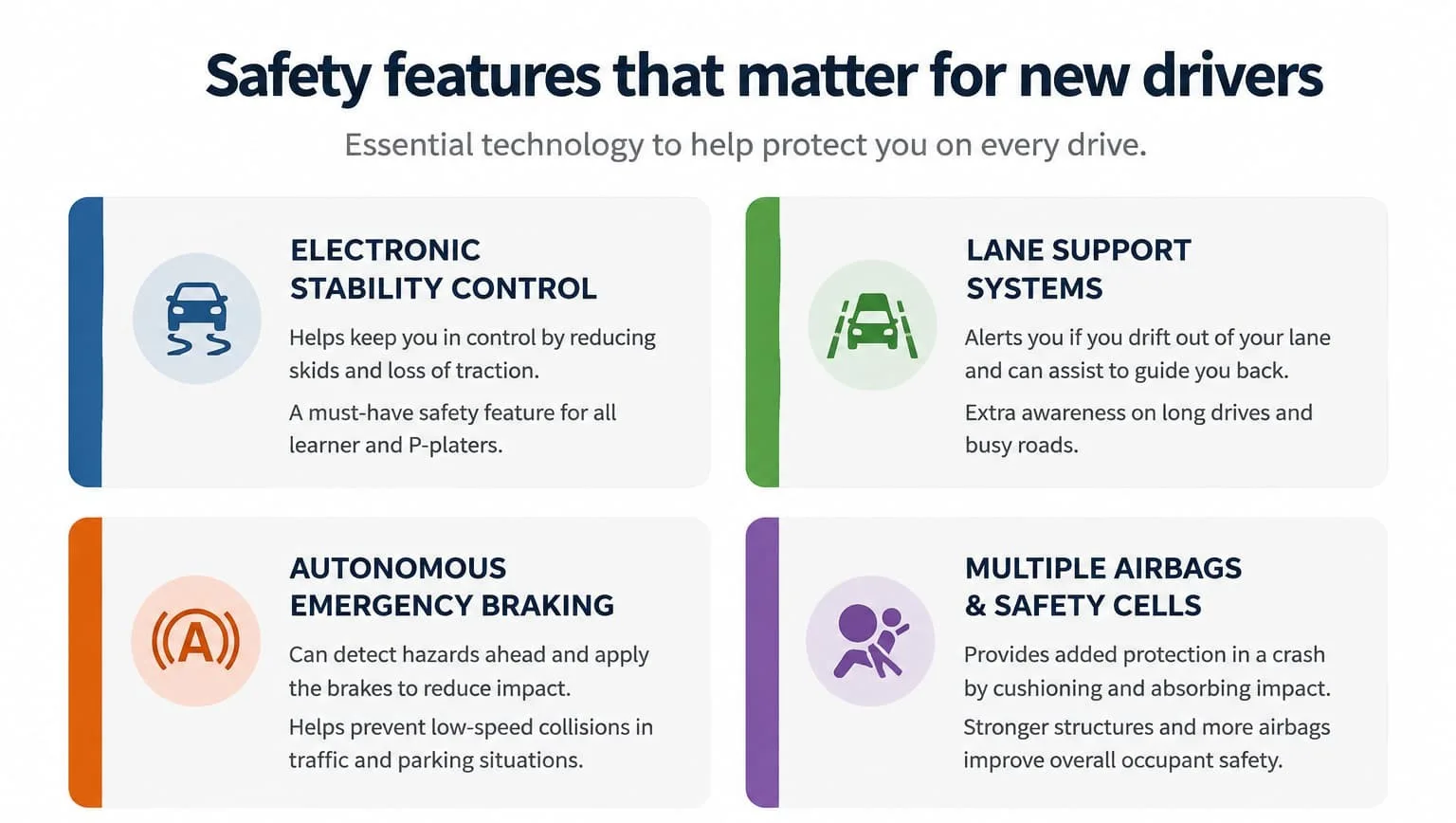
Anti-lock brakes became mandatory on new cars in Australia from 2003, so a used car built after that year should have them. Curtain and side airbags protect the head and chest in side impacts. Autonomous emergency braking appears on many later used cars and helps avoid the low-speed crashes new drivers have most often.
What does a first car cost to run?
The purchase price is usually the smaller part of the first year. Insurance, registration, fuel, servicing and tyres together often cost more annually than the car loses in value.
How much is insurance for a young driver?
Insurance is usually the highest yearly cost for a driver under 25, and premiums vary widely between models. Get a quote on the exact car, with the exact driver listed, before committing to a purchase. A car that looks affordable can become unaffordable once the premium arrives.
Several factors push a young driver’s premium up: engine size and power, the car’s repair cost, where it is garaged overnight, and whether any driver under 25 is listed. Comprehensive cover costs more than third party property cover but protects the vehicle itself, which matters when the car represents most of a student’s savings.
This is general information rather than financial advice. Compare policies and read the product disclosure statement.
What should you check before buying a first car?
Work through the following on the individual car. A licensed dealer will have cleared several of these already, while a private seller may not have.
The order to work through it in
Follow these steps in sequence. Each is cheap or free, and each can stop you spending money on the next.
Confirm the exact variant is approved in the VicRoads probationary vehicle database.
Check the licence for an ‘A’ condition before considering any manual car.
Look up the Used Car Safety Rating and the ANCAP rating for that exact build year.
Get an insurance quote on the specific car with the young driver listed.
Ask for the service history and check for a stamped logbook without long gaps.
Run a PPSR check for money owing, written-off status and stolen records.
Inspect the car from cold, then test drive it, including at higher speed.
Book a pre-purchase inspection, then confirm the roadworthy certificate.
What determines the price of a first car?
The price of a small used car is set by age, kilometres, condition, service history, transmission and demand rather than the badge alone. Two cars of the same model and year can sit far apart for good reasons.
The main factors are:
Age and build year. Newer cars carry more safety equipment and generally command more.
Kilometres and condition, including tyres, brakes and panel condition.
Service history. A complete logbook supports a higher price and a faster sale.
Transmission. Automatic models are in higher demand than manuals among first-car buyers.
Safety rating. Five-star and Safer Pick models hold value better.
Roadworthy and registration status, and how much registration remains.
Demand. Small, cheap, P-plate legal cars are the most contested part of the used market.
A slightly dearer car with full records is often cheaper across three years of ownership.
Registration, roadworthy and warranty in Victoria
Buying from a licensed motor car trader in Victoria gives protections a private sale does not.
A statutory warranty may apply. Consumer Affairs Victoria states that a licensed motor car trader must provide a statutory warranty if the car is less than 10 years old and has travelled less than 160,000 kilometres. The warranty lasts for three months or 5,000 kilometres after purchase, whichever occurs first. It does not cover items such as tyres, batteries, audio equipment or navigation systems, and it does not cover faults already listed on a defect notice.
Cheap first cars frequently sit outside those limits, so check the position on the specific vehicle rather than assuming cover applies.
A current roadworthy certificate is required to transfer registration in Victoria. Registration transfer and duty are handled through the Victorian Government. Confirm the roadworthy and registration position for the individual vehicle rather than assuming it is included.
How J & V Elite Motors can help
J & V Elite Motors is a family-operated used car dealership in Dandenong, Victoria, holding motor car trader licence LMCT 9914. The business was established by Zia Agahi in 2003. Zia worked as a mechanic before starting the dealership, which shaped how the business approaches vehicle selection and customer questions.
Practical support available at the Dandenong dealership includes:
Browsing all current listings and used car brands online before visiting
Inspections and test drives at 21 to 23 Hammond Road, Dandenong
Vehicle finance enquiries, subject to application, eligibility, lender criteria and approval
Trade-in enquiries on an existing family vehicle
Warranty options, which vary by vehicle
Servicing through the dealership’s own service centre after purchase
The website states that stock is pre-inspected through a licensed VicRoads auto repair shop, and the business identifies itself as an approved Australian Warranty Network dealer. Stock changes regularly, so check current listings for what is available today, and confirm the P-plate status of any specific vehicle before buying.
Families in Noble Park, Springvale, Keysborough and Mulgrave are all a short drive from the dealership. You can read more about the dealership, or browse used Toyota cars, used Hyundai cars and used Mazda cars, which include many models commonly chosen as first cars.
Choosing your first car
Work through the three gates in order. Confirm the car is legal for a probationary driver, confirm it holds a strong Used Car Safety Rating for its exact build year, then confirm the insurance and running costs fit the budget. Only after those three should the shortlist come down to colour, kilometres and price.
Browse the current used car listings at J & V Elite Motors, then contact the Dandenong team on (03) 9706 8999 to arrange an inspection and test drive.
Frequently Asked Questions
What is the best first car for a P-plater in Victoria?
The best first car for a Victorian P-plater is a small car or small SUV holding a Safer Pick rating that sits under 130 kilowatts per tonne and returns an affordable insurance quote. The Toyota Corolla, Mazda3, Hyundai i30, Kia Cerato, Mazda CX-3 and Suzuki Vitara all hold Safer Pick status in recent years. Confirm the exact variant in the VicRoads database before buying.
Can P-platers drive turbo cars in Victoria?
Yes, provided the vehicle is not banned in the probationary vehicle database and its power-to-mass ratio does not exceed 130 kilowatts per tonne. The former blanket ban on turbocharged and supercharged vehicles no longer describes the Victorian rule. Many small turbocharged cars are approved.
Are light cars a safe choice for a first car?
Light cars are the least protective category in the Used Car Safety Ratings. Of 49 light models rated, none reached Safer Pick standard. A light car can still be sensible on a tight budget, but check the individual model’s rating rather than assuming the category is safe, and insist on electronic stability control.
Can I buy a manual car on an automatic licence?
No, not while the ‘A’ condition applies. Passing the Victorian drive test in an automatic places an automatic transmission condition on the licence for the probationary period. It can be removed by passing a practical test in a manual car, and it lifts automatically when the full licence is granted.
Is it cheaper to buy a first car privately or from a dealer?
A private sale can have a lower asking price, but it comes without a statutory warranty, without a cleared PPSR check, and often without a roadworthy certificate. A licensed dealer handles those. Factor in the cost and risk of arranging them yourself before comparing the two prices.
How many kilometres is too many for a first car?
There is no single figure. A car with complete service records at 150,000km can be a better buy than a neglected car at 80,000km. Focus on service history, condition and safety rating rather than the odometer alone.