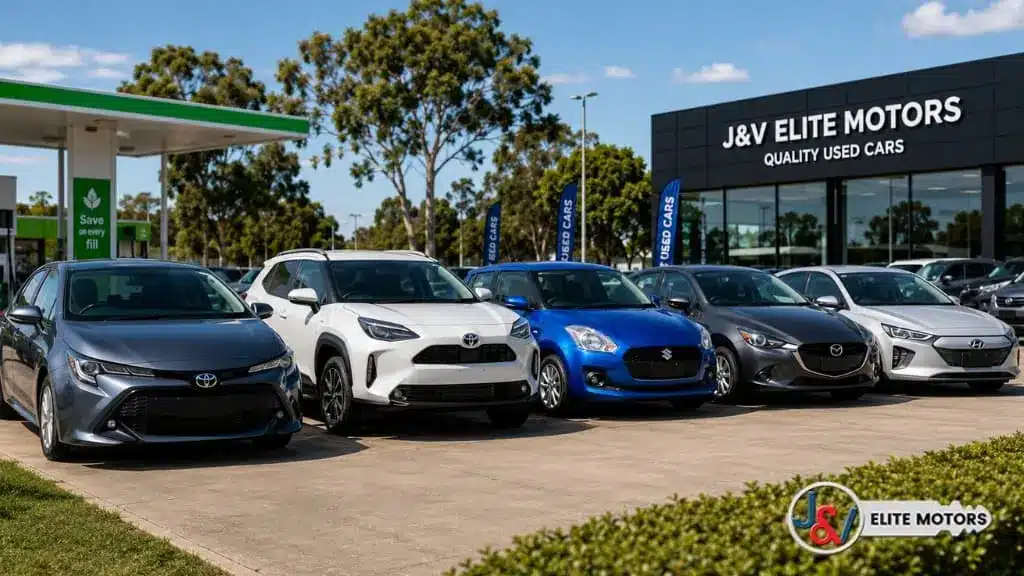
- Most efficient overall: used hybrids Toyota Yaris Hybrid (~3.3 L/100km), Corolla Hybrid (~3.9), Yaris Cross Hybrid (~3.8).
- Best cheap petrol option: Suzuki Swift and Mazda2 at roughly 4.6–5.4 L/100km, from around $12,000.
- Best for high highway kilometres: an efficient turbo-diesel but only if you can keep the DPF healthy.
- Under $10,000: older Swift, Yaris, Mazda2 or Honda Jazz; an early Prius for hybrid economy.
- A hybrid can save $1,000+ a year in fuel versus an average mid-size car, and holds its value well.
- Before you buy: check the service history, run a PPSR check, confirm the ANCAP rating and (for hybrids) the battery health and warranty.
What counts as a fuel-efficient car in Australia?
A car is considered fuel-efficient in Australia when its combined fuel consumption sits below about 6.0 L/100km, and very efficient once it dips under 5.0 L/100km. The best hybrids now achieve under 4.0 L/100km.
Fuel use here is measured in litres per 100 kilometres (L/100km); the lower the number, the less fuel you burn. Every new car sold in Australia carries a fuel-consumption label showing three figures: urban (city), extra-urban (highway) and combined. The combined figure is the one to compare cars on, and it comes from a standardised lab test under the Australian Design Rules (ADR).
- Under 4.0 L/100km — exceptional, hybrid territory
- 4.0–5.5 L/100km — excellent, efficient hybrids and light petrol cars
- 5.5–6.5 L/100km — good, most small cars and small SUVs
- 6.5–8.0 L/100km — average for mid-size cars
- Over 8.0 L/100km — thirsty by today’s standards
ADR figures vs real-world economy
The official ADR number is a laboratory result, so treat it as a best case. In real Australian driving hills, air-conditioning, traffic and highway speeds, expect to use roughly 10–25% more fuel than the label claims. A Corolla Hybrid rated at 3.9 L/100km, for example, realistically returns about 4.2–4.8 L/100km around town. To check any model’s official figures yourself, search the federal Green Vehicle Guide, which lists ADR fuel consumption and CO2 emissions for vehicles sold in Australia.

Best fuel-efficient used cars in Australia (top picks)
Here are the standout used models for fuel economy, value and reliability, spanning hybrids, petrol light cars and efficient small SUVs. All figures are official ADR combined unless noted. You can browse our current used car listings to see which of these are in stock right now.
Model | Powertrain | L/100km | Used price (AU) | Best for |
|---|---|---|---|---|
Hybrid | ~3.9 | $19,000–$32,000 | All-round city economy | |
Hybrid (small SUV) | ~3.8 | $24,000–$34,000 | Efficient small SUV | |
Hybrid (light) | ~3.3 | $20,000–$28,000 | Lowest consumption | |
Hybrid | ~3.4–4.0 | $12,000–$30,000 | Proven hybrid value | |
Hybrid | ~4.0 | $25,000–$36,000 | Roomy hybrid SUV | |
Hybrid | ~3.4–4.0 | $20,000–$30,000 | Hatch comfort + economy | |
Petrol / mild-hybrid | ~4.6–5.0 | $12,000–$22,000 | Cheap, fun, frugal | |
Petrol | ~5.0–5.4 | $12,000–$22,000 | Reliable light car | |
Petrol | ~6.0 | $15,000–$26,000 | Bulletproof small car | |
Petrol | ~6.0–6.5 | $16,000–$30,000 | Practical and refined | |
Petrol (turbo) | ~5.0–5.8 | $14,000–$24,000 | European feel | |
Petrol/hybridd | ~5.5–6.5 / ~4.3 | $10,000–$20,000 | Budget buy-in |

Most fuel-efficient used hybrids
Used hybrids deliver the lowest fuel consumption you can get without plugging in, because their petrol engine and electric motor work together and recover energy under braking, ideal for stop-start city driving.
Toyota Corolla Hybrid is the benchmark. The current-generation hatch and sedan (2018 onward) claim around 3.9 L/100km combined, with real-world figures commonly in the low-to-mid 4s. It pairs that economy with Toyota’s reputation for reliability and capped-price servicing, which is why it holds its value strongly on the used market.
Toyota Yaris Cross Hybrid (2020 onward) is the pick if you want a small SUV. The 2WD version is rated at about 3.8 L/100k,m remarkable for a high-riding body, while the AWD version claims around 4.0 L/100km.
Toyota Yaris Hybrid is the outright economy champion at roughly 3.3 L/100km, though its light-car size suits singles and city commuters more than families.
Toyota Prius remains a smart used buy. Earlier generations can be found from around $12,000 and still return 3.5–4.5 L/100km in practice. Kia Niro Hybrid (4.0 L/100km) and Hyundai Ioniq Hybrid offer hybrid economy with longer warranties from new, which can transfer to you as the second owner.
How long do hybrid batteries last in used cars?
Most fuel-efficient used petrol cars
If you’d rather avoid hybrid complexity or want a lower purchase price, several used petrol cars are genuinely frugal. Light cars with small, efficient engines are the sweet spot.
The Suzuki Swift is a long-time favourite: light, fun to drive and economical at roughly 4.6–5.0 L/100km depending on the year and transmission. The Mazda2 is similarly thrifty (around 5.0 L/100km for the auto) and well built, with low servicing costs. The Volkswagen Polo uses a small turbocharged engine to combine economy (around 5.0–5.8 L/100km) with a more European drive, though it asks for 95 RON premium fuel on some variants.
Step up a size, and the Toyota Corolla petrol (around 6.0 L/100km) and Honda Civic (around 6.0–6.5 L/100km) deliver more space while staying economical, and both are renowned for reliability. The MG3 is the budget entry point, with cheap buy-in prices and an available hybrid version that drops consumption to about 4.3 L/100km. Prefer to shop by manufacturer? You can browse used cars by brand to go straight to Toyota, Mazda, Honda or Volkswagen stock.
Most fuel-efficient used diesel cars
Diesel used cars suit high-kilometre highway drivers more than city commuters. A modern turbo-diesel can return excellent economy on the open road,d often 4.5–6.0 L/100km in a small car or SU, and diesels produce strong low-rev torque, which helps with towing and country driving.
The catch for fuel-economy buyers is the diesel particulate filter (DPF). DPFs need regular highway running to regenerate and clear soot; on short city trips they can clog, leading to expensive repairs. So a used diesel only makes financial sense if you regularly drive longer distances. For most metro buyers chasing the lowest fuel bills, a hybrid will be cheaper and simpler to live with.
If you do cover serious kilometres, look at efficient small diesels and diesel small SUVs with a full service history and evidence the DPF is healthy.
Cheap fuel-efficient used cars (under $10,000 and under $15,000)
You don’t need a big budget to run a cheap, economical car. The trick is to target proven light cars with simple, efficient petrol engines.
Under $10,000, look at older Suzuki Swift, Mazda2, Toyota Yaris, Honda Jazz, Kia Rio and Hyundai i20/i30 examples from roughly 2012–2016. Most return 5–6.5 L/100km and cost little to service. An early Toyota Prius can also sneak into this bracket and delivers hybrid economy, though factor in eventual battery servicing.
Under $15,000, you can move to newer, lower-kilometre versions of those same models, or a tidy Toyota Corolla or Volkswagen Polo. This budget also opens up early MG3 hybrid stock for buyers who want hybrid economy at a light-car price.
Whatever you spend, prioritise a complete service history and a clean ownership check over chasing the absolute lowest fuel figure; a neglected efficient car costs more in the long run than a well-kept thirsty one.
Hybrid vs petrol vs diesel: which is cheapest to run?
Hybrid | Petrol (light) | Diesel | |
|---|---|---|---|
Best driving type | City / mixed | City / suburban | Highway/country |
Typical economy | 3.8–4.5 L/100km | 4.5–6.0 L/100km | 4.5–6.0 L/100km |
Buy-in price | Higher | Lowest | Higher |
Servicing | Capped-price; battery checks | Cheapest, simplest | Pricier; DPF risk |
Watch-outs | Battery health | Few | DPF, injectors, turbo |
How much could you save on fuel?
- Hybrid at 4.0 L/100km: ~600 L/year → ~$1,140/year
- Light petrol at 5.5 L/100km: ~825 L/year → ~$1,570/year
- Mid-size petrol at 8.0 L/100km: ~1,200 L/year → ~$2,280/year
Switching from a thirsty mid-sizer to a used hybrid can save well over $1,000 a year in fuel alone, and that’s before lower servicing and stronger resale are factored in. To estimate your own numbers, multiply your yearly kilometres by the car’s combined L/100km, divide by 100, then multiply by the fuel price. If the upfront price is the hurdle, you can arrange car finance to spread the cost while you start saving at the bowser.

Do fuel-efficient used cars hold their value?
Yes,s fuel-efficient cars, and hybrids in particular, tend to hold their value well in Australia because demand is strong and supply of used examples is tight. The Toyota Corolla and Corolla Hybrid are consistently among the best at resisting depreciation, helped by Toyota’s reliability reputation and capped-price servicing.
That strong resale is good news long-term but means you’ll pay a premium to buy in, so shop patiently and compare several listings on RedBook or carsales to gauge fair value. The upcoming tightening of the New Vehicle Efficiency Standard (NVES), which began applying CO2 targets to new vehicles from mid-2025, is also expected to keep demand high for efficient used cars as buyers seek lower running costs.
Are fuel-efficient used cars safe?
Yes, most fuel-efficient small cars from the past decade carry a 5-star ANCAP safety rating, so you don’t have to trade safety for economy. The Toyota Corolla, Yaris Cross, Mazda2, Mazda3, Volkswagen Polo and Hyundai i30 all earned 5 stars in their mainstream model years.
One thing to watch: ANCAP ratings are tied to a specific model and date stamp, and older examples of the same nameplate may carry a lower (or expired) rating. Check the exact build year against the rating on the ANCAP website before you buy, and prioritise cars with autonomous emergency braking (AEB), which became common from around 2018.
What to check when buying a fuel-efficient used car
- Confirm the real fuel figure. Look up the model’s official combined L/100km on the Green Vehicle Guide, and remember real-world use runs higher.
- Get the full service history. A complete logbook is the single best sign of a well-cared-for car,r and it’s essential for keeping a hybrid battery warranty valid.
- Run a PPSR check. The Personal Property Securities Register reveals any money owing, write-off or stolen status. It costs only a few dollars and protects you from buying someone else’s debt.
- Confirm the safety rating. Check the model and build year against its ANCAP rating and look for autonomous emergency braking (AEB).
- Check the hybrid battery (if applicable). Ask for a recent hybrid health check and confirm whether the battery is still under warranty.
- Check the roadworthy certificate (RWC). Most states require a current roadworthy (or safety) certificate before a used car is sold or re-registered; confirm it’s valid or factor any work into your offer.
- Book a pre-purchase inspection. An independent mechanic or a service such as RACV/NRMA can spot hidden faults, worn brakes, DPF issues, and oil consumption that a quick test drive won’t. Buying from a dealer with an on-site service centre makes this easier; get in touch to arrange a closer look or a test drive.
- Test drive properly. Listen for unusual noises, test the brakes and transmission, and check the air-conditioning and all electronics.
- Compare the price. Use RedBook valuations and current carsales listings so you negotiate from a position of knowledge.

Find your fuel-efficient used car at J&V Elite Motors
Ready to cut your running costs? Browse our latest used cars or explore stock by brand. With 20+ years of selling quality used cars in Dandenong, an on-site service centre, and Australia-wide warranties, we can help you buy with confidence and even sort your finance. Contact us to book a test drive.