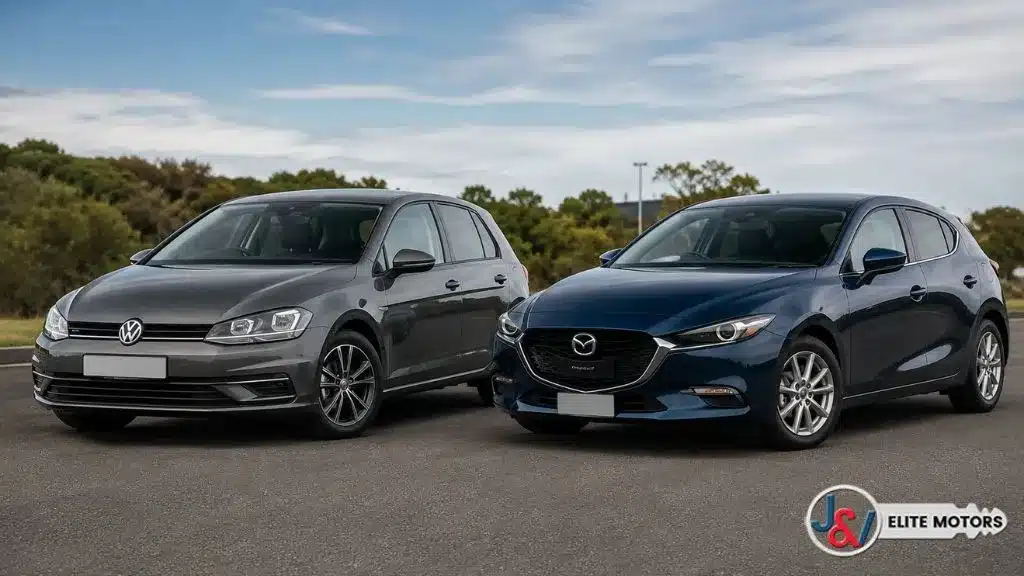
For most Australian used buyers, the Mazda3 is the safer, cheaper car to own; it’s famously reliable, holds its value well, and is cheap to service. The Volkswagen Golf is the better car to drive and feels more premium inside, but its DSG dual-clutch gearbox and higher European servicing costs add risk and expense. Buy the Mazda3 if you want dependability and low running costs; buy the Golf if you want a turbocharged, refined drive and you’re prepared to budget for upkeep.
This showdown compares them across the things that actually matter when you’re spending your own money: reliability, running costs, resale, the driving experience, practicality, safety and which years are worth buying.
Volkswagen Golf vs Mazda3 at a glance
Volkswagen Golf | Mazda3 | |
|---|---|---|
Body type | 5-door small hatch (also wagon) | 5-door hatch (and sedan) |
Common used generations | Mk6 (2009–13), Mk7 (2013–17), Mk7.5 (2017–20) | BL (2009–13), BM/BN (2013–19), BP (2019–) |
Typical engine | 1.4 TSI turbo-petrol (also 1.2/1.8/2.0) | 2.0L & 2.5L Skyactiv naturally aspirated petrol |
Transmission | DSG dual-clutch auto (some manual) | 6-speed conventional auto or 6-speed manual |
Boot space (hatch) | ~380 L | ~295 L (BP) |
Reliability reputation | Good, but DSG and electrical risks | Very strong |
Servicing cost | Higher (European) | Lower (capped-price) |
Resale/depreciation | Depreciates faster | Holds value well |
Safety | 5-star ANCAP (mainstream years) | 5-star ANCAP (mainstream years) |
Used price range (AU) | ~$8,000–$30,000+ | ~$8,000–$30,000+ |
Best for | Driving feel, premium cabin, torque | Dependability, low running costs, value |
Is the Mazda3 more reliable than the VW Golf?
Yes, on balance the Mazda3 is the more reliable used buy. Mazda’s small hatch uses simpler, naturally aspirated engines and a conventional automatic, so there are fewer expensive parts to go wrong.
The Golf can be just as dependable when it’s been serviced properly, but it carries two extra risks: its DSG dual-clutch gearbox and a handful of known mechanical and electrical faults on earlier cars. Neither car is fragile, but the Mazda3 is the lower-stress ownership proposition.
Common problems with a used VW Golf
- DSG dual-clutch faults — the most important one (covered below).
- Water pump and thermostat — failures aren’t unusual and can cause overheating if ignored.
- Timing chain (early TSI engines) — some early turbo engines suffered timing-chain tensioner wear; listen for a rattle on cold start.
Electrical niggles — infotainment glitches, sensors and electric window faults appear more often than on the Mazda. - Carbon build-up — direct-injection turbo engines can build up intake carbon over high kilometres.
Is the VW Golf DSG gearbox reliable?
It can be, but it’s the single biggest risk on a used Golf and the year matters. The 7-speed dry-clutch DSG (the DQ200) fitted to lower-powered Golfs from roughly 2008 to 2014 has the worst record. Tell-tale symptoms are shuddering or jerking when pulling away from a stop, hesitation between gears, or a flashing gear indicator on the dash. Most faults trace back to either the clutch pack or the mechatronic unit (the gearbox’s electro-hydraulic brain). A specialist mechatronic repair typically runs $1,800–$4,500 depending on whether it can be rebuilt or needs replacing.
Two things reduce the risk a lot. First, Volkswagen introduced a revised clutch pack from around 2015, so later Mk7 and Mk7.5 cars are generally a safer bet than pre-2015 examples. Second, regular DSG fluid services are the best prevention and cost a fraction of a major repair, so a Golf with documented DSG services is far more reassuring than one without. On the test drive, a healthy DSG should pull away smoothly with no shudder and shift cleanly and quickly. If it shunts, hesitates or shudders, walk away.
If a dual-clutch gearbox makes you nervous, it’s worth reading our manual vs automatic used car guide before you decide a manual Golf or a conventional-auto Mazda3 sidesteps the DSG question entirely. You can also browse our current used Volkswagen range to see which gearboxes are in stock.
Mazda3 reliability and known niggles

Are Volkswagen Golfs expensive to maintain in Australia?
Yes, expect to pay more to service and maintain a Golf than a Mazda3. As a European car, the Golf uses pricier parts and specialist labour, and its DSG gearbox needs periodic fluid services that a conventional auto doesn’t. Mazda, by contrast, offers capped-price servicing and has a denser dealer and independent network, so routine maintenance is cheaper and more predictable.
For the Golf, budget for higher consumable costs (brakes, filters, DSG fluid) and factor in that turbocharged engines are less forgiving of skipped oil changes. For the Mazda3, running costs are closer to a Toyota Corolla low, predictable and easy to source parts for. Over a five-year ownership window, the Mazda3 almost always has the lower total cost of ownership, even before you account for the Golf’s repair risk.
Does the Mazda3 hold its value better than the Golf?
Yes. The Mazda3 holds its value noticeably better than the Volkswagen Golf in the Australian used market. Strong demand, a bulletproof reliability reputation and cheap running costs keep Mazda3 resale prices firm. The Golf depreciates faster partly because buyers price in the higher servicing and DSG risk, and partly because European cars generally shed value quicker here.
What this means in practice: if you buy a Mazda3, you’ll likely get more of your money back when you sell. If you buy a Golf, the faster depreciation can actually work in your favour as a buyer; you can pick up a near-premium European hatch for less than its original price. Just remember the equation reverses when it’s your turn to sell.
Is the Golf or Mazda3 better to drive?
The Golf is the more polished, effortless car; the Mazda3 is the sharper, more engaging one. This is the area where the Golf earns back some ground.
The Golf’s turbocharged TSI engine delivers strong low-down torque, so it feels punchy and relaxed around town and on the highway without needing to rev hard. The ride is composed and grown-up, the cabin is quiet, and the whole car has a premium European feel that belies its price. It’s the better long-distance cruiser.
The Mazda3 takes a different approach. Its naturally aspirated Skyactiv engine needs a few more revs to give its best, but the steering is sharper, and the chassis is genuinely fun on a back road; it’s the keener driver’s pick. The trade-off is a little more road noise and a less torquey feel in everyday driving, particularly on the smaller 2.0-litre engine.
If outright performance is the goal, both have hot versions: the Golf GTI is the celebrated hot-hatch benchmark, while the Mazda3 SP25 steps up to a larger 2.5-litre engine for more everyday grunt (without GTI-level pace).
Practicality: boot space and interior
Which has more boot space, the Golf or the Mazda3?
Interior and tech

Are the Golf and Mazda3 safe cars?
Yes, both earned the maximum 5-star ANCAP safety rating in their mainstream model years. Each comes with a comprehensive airbag set and electronic stability control, and later examples of both add active-safety features such as autonomous emergency braking (AEB), blind-spot monitoring and lane-keep assist on higher grades. If safety tech matters to you, focus on post-2017 cars, where these features became far more common across the range. Always confirm exactly which features a specific car has, as it varies by grade and year.
What year used Golf or Mazda3 should you buy?
Volkswagen Golf generations
- Mk6 (2009–2013): cheapest to buy, but the oldest and the highest-risk for DSG and ancillary faults. Only worth it with strong history and a clean inspection.
- Mk7 (2013–2017): the sweet spot for value. Aim for 2015 or later to get the revised DSG clutch pack and improved reliability.
- Mk7.5 (2017–2020): the pick if budget allows updated tech, more standard safety gear and the most refined of the commonly used Mazdas.
Mazda3 generations
- BL (2009–2013): older but dependable; good budget choice.
- BM/BN (2013–2019): the value sweet spot: Skyactiv efficiency, sharp looks and strong reliability.
- BP (2019–present): the newest, with the most premium interior and the most safety tech; commands the highest used prices.
For a deeper dive on choosing the right year and reading a service history, see our guide to choosing the right used car. You can also compare live stock on our used Mazda and used Volkswagen pages.
Grades and variants explained.
- Volkswagen Golf: Trendline (base), Comfortline (mid), Highline (top), plus the GTI and Golf R performance models. Higher grades add comfort, tech and safety kit.
- Mazda3: Neo (base), Maxx, Touring, SP25 (2.5-litre) and Astina (top). Astina and SP25 grades bring the larger engine and the most equipment.
What should you check when buying a used Golf or Mazda3?
- PPSR check — a quick online search of the Personal Property Securities Register tells you if the car has money owing on it or has been written off. Non-negotiable on any private sale.
- Pre-purchase inspection (PPI) — have a licensed mechanic (or an NRMA/RACV inspection) check the car over. On the Golf, ask them to focus on the DSG, water pump and oil condition; on the Mazda3, it’s a more routine check.
- Roadworthy Certificate (RWC) — make sure the car has a current roadworthy where your state requires one for transfer.
- Service history — full, stamped history is the strongest signal of a good car on either model, and especially important for documenting DSG fluid services on the Golf.
- Test drive — on the Golf, feel for DSG shudder or hesitation when pulling away. On both, listen for cold-start rattles, check all the electronics and infotainment, and watch for warning lights.
- Valuation — check a RedBook valuation so you know you’re paying a fair market price before you negotiate.

The verdict: should you buy a Golf or a Mazda3?
Choose the Mazda3 if you want the most dependable, lowest-stress ownership experience: it’s cheaper to service, holds its value better, and rarely springs an expensive surprise. It’s the smart head-over-heart pick and the safer choice for a first car or a no-fuss daily driver.
Choose the Volkswagen Golf if the driving experience and cabin quality matter most to you, you want turbocharged torque and European refinement for the money, and you’re comfortable buying a post-2015 car with full DSG service history and budgeting a little more for upkeep.
Put simply: the Mazda3 is the better buy, and the Golf is the better drive. Match the car to what you actually value, buy on history and inspection rather than looks, and either one can serve you well for years.
Ready to compare in person? Browse our used Volkswagen Golf and used Mazda3 stock, view all our used cars, or get in touch with our Dandenong team for a test drive.